
Which Function Represents Exponential Decay
Okay, picture this: You bought a bouncy ball for a dollar. A whole dollar! You bounce it. Each bounce gets lower and lower. Sad, right? That, my friend, is exponential decay in action. But how do we math that feeling?
Let's crack the code. We're looking for the function that screams, "I'm shrinking! I'm fading!" It's not a party; it's a slow, steady decline. Think of it as the opposite of your bank account growing after a winning lottery ticket. (Okay, maybe that's a party).
The Usual Suspects: Functions on Parade
First, a quick reminder of the function family. We've got linear functions (straight lines, predictable!). We've got quadratic functions (those U-shaped parabolas, all about curves). But we want something special. Something that embodies graceful (or not-so-graceful) decline.
Must Read
Think of these functions as party guests. The linear function is your responsible friend who always arrives on time and leaves at 10 PM sharp. The quadratic function is the drama queen who has a dramatic entrance and exit. We need the guest who slowly fades away, muttering about needing more snacks.
The key ingredient? An exponent! And a specific kind of exponent, at that.

Exponential Decay: The Formula's Secret Sauce
The general form for exponential functions looks like this: y = a * bx. Don't freak out! It's simpler than it looks. Let's break it down:
- y is the final amount (the height of the last tiny bounce).
- a is the initial amount (the height of your first enthusiastic bounce). This is also the y-intercept! Fancy that.
- b is the decay factor. This is the star of our show. Pay close attention.
- x is the time that passes (the number of bounces).
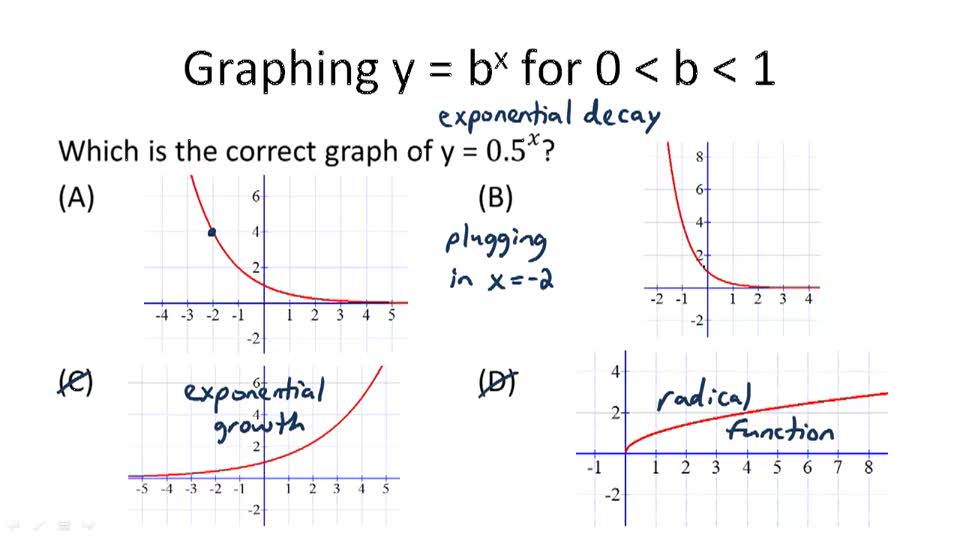
Here's the real kicker: For it to be decay, b must be between 0 and 1! I repeat: 0 < b < 1. Think of it as a percentage less than 100%. If 'b' is, let's say, 0.5, then after each step, the value gets halved. Cool, huh?
![[FREE] Which function represents exponential decay? o Of(x) = f(x) = px](https://media.brainly.com/image/rs:fill/w:750/q:75/plain/https://us-static.z-dn.net/files/dad/22ca437b08c2ddf76f7a16dabb0d985e.png)
Imagine 'a' is 100 (starting value). If 'b' is 0.8 (80%), you're only keeping 80% of what you had before. That's decay, baby!
Why the 0 to 1 Rule? (Or, Why Not Just Use a Negative Sign?)
Good question! Why can't we just use a negative sign in front of the 'b'? Well, then we'd have something like y = a * (-2)x. Plug in some numbers, and you'll see it bounces between positive and negative values. That's not decay; that's just… weird. It’s more of an oscillating situation, not a steady decline.
The decay factor being between 0 and 1 ensures a smooth, continuous decrease. It’s like watching the air slowly leak out of a balloon, not a yo-yo going up and down.

Examples in the Wild (Not Just Bouncy Balls)
Exponential decay is everywhere! Seriously. Think about:
- Radioactive decay: Those isotopes are slowly chilling out. The half-life is how long it takes for half of them to decay!
- Drug concentration in your body: Your body slowly eliminates medication. That's why you need to take pills regularly.
- The value of your car: Depressing but true. It's decaying exponentially (unless it's a classic DeLorean, then it might actually gain value!).
- The foam on your beer: Sad, but true. Each sip is exponential decay in action. (Okay, maybe that's just linear...but let’s stick with exponential for fun!).
So, How Do You Spot Exponential Decay in the Wild?
Look for that magic number between 0 and 1! If you see a function that looks like y = 5 * (0.7)x, BINGO! That's exponential decay. The 5 is your starting point, and the 0.7 (70%) is telling you that each step is only 70% of the previous value.

Conversely, y = 2 * (1.2)x is exponential growth. The 1.2 (120%) means you're getting more each step. Think of it as bacteria multiplying in a petri dish (or your credit card debt after a shopping spree). Not quite as fun, but still exponential!
In Conclusion: Decay is Okay (Sometimes)
Exponential decay might sound depressing (everything's dying!), but it's a fundamental concept. From bouncy balls to radioactive isotopes, it’s all around us. Now you know how to spot it, how to describe it, and why that magical number between 0 and 1 is so important.
So go forth and decay… mathematically speaking, of course!