
How Much W Does My Pc Need
Alright, settle in, grab your beverage of choice – virtual or otherwise – because we're about to demystify one of the great existential questions of the digital age: "How much W does my PC need?"
You know that moment. You're building a new rig, maybe just upgrading, and suddenly you're staring at the specs for a power supply unit (PSU). It's got numbers like 550W, 750W, 1000W, and your brain immediately goes, "W... is that for winning? Because I definitely want to win!"
Sadly, "W" stands for Watts. And no, it's not a secret code for how many hours you'll spend winning in your favorite game, though they are somewhat related. Watts, my friend, are the units of electrical power. Think of it like this: your PC components are a bunch of hungry, high-tech gourmands, and the PSU is the kitchen. The wattage number? That's the kitchen's maximum cooking capacity. It's not how much food it's currently making, but how much it can make at its absolute peak.
Must Read
So, why does this matter? Well, imagine trying to cook a five-course meal for twenty people in a kitchen designed for a microwave and a toaster. Things would get… stressed. Your guests (PC components) would be hangry, plates would be delayed, and eventually, the whole system might just shut down in a fit of rage. That, in a nutshell, is a PC running on an undersized PSU. It's the computer equivalent of a hangry toddler.
On the flip side, what if you bought a Michelin-star, industrial-grade kitchen capable of feeding a small army, just to heat up a frozen pizza? That’s an oversized PSU. It works, sure, but you've likely spent extra cash you didn't need to. It's like buying a monster truck just to pick up groceries. Slightly overkill, wouldn't you say?
![How Much Does A PC Weigh? [Gaming PC Weight] - Tech4Gamers](https://tech4gamers.com/wp-content/uploads/2023/03/How-Much-Does-A-PC-Weigh.jpg)
Too Little W: The Digital Drama
If your PC doesn't have enough "W" (wattage capacity, that is), your computer will start throwing a tantrum. You might experience random crashes, system instability, or worse, your computer might not even boot up. It's like trying to run a marathon on a single espresso shot – you'll conk out halfway, probably with a dramatic flourish. Your graphics card might suddenly decide it's had enough and refuse to render that crucial headshot in your game, or your CPU might throttle down, turning your blazing fast machine into a glorified spreadsheet calculator. Not ideal.
Too Much W: The Wallet Wince
Now, a bigger PSU than you strictly need won't harm your PC. It’s not like it’s going to overload anything; your components only draw the power they need, regardless of the PSU's maximum capacity. However, there are two downsides:

- Cost: Higher wattage PSUs are generally more expensive. Why pay for a 1200W behemoth if your system only ever pulls 400W? That's just throwing money at an imaginary problem.
- Efficiency (a tiny bit): PSUs are most efficient when they're running at about 50-60% of their maximum load. If you have a massively oversized PSU, it might be running at 20-30% load, which means it’s slightly less efficient at converting wall power to PC power. We're talking pennies on your electricity bill, but still, it's something!
So, How Do We Find That Sweet Spot?
This isn't rocket science, thankfully. We don't need to break out the multimeter and start doing complicated electrical equations (unless you're into that, in which case, bravo!). Here’s the layman's approach:
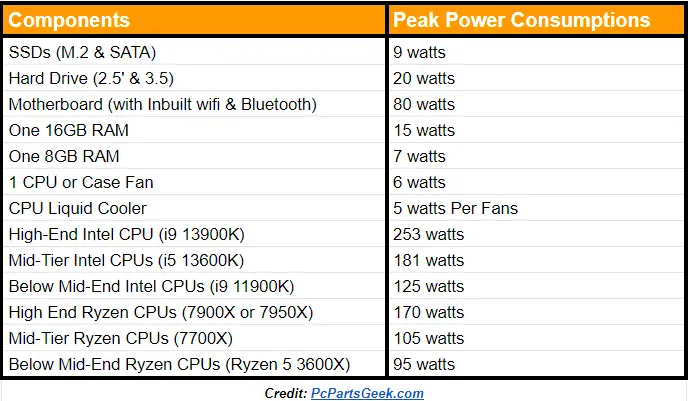
1. Identify the Hungry Hippos: The biggest power consumers in your PC are almost always your CPU (Central Processing Unit) and your GPU (Graphics Processing Unit). These are the workhorses that make everything run and look pretty. RAM, storage drives, and fans use comparatively little power.

2. Enter the Calculator: The easiest way to estimate your wattage needs is to use an online PSU calculator. Websites like PCPartPicker, OuterVision, or Cooler Master have fantastic tools. You just plug in your exact components – your CPU model, your GPU model, how many RAM sticks, storage drives, fans, RGB strips (because those also consume power, you dazzling peacock!), and boom! It gives you an estimated total wattage. It's like a digital fortune teller, but for your PC's power needs.
3. Add a Safety Buffer (The "Future-Proofing" Allowance): Once you have that estimated number, add 150-200W to it. Why? This is your wiggle room. It accounts for potential power spikes, component aging, and future upgrades. If your calculator says you need 450W, aim for a 650W PSU. It's like buying pants a size up – always comfortable, and leaves room for growth (or extra snacks). This headroom ensures your system runs stably, even under heavy load, and gives you space for that fancy new graphics card you've been eyeing next year.

A Surprising Fact to Impress Your Friends
Here’s a fun one: A 1000W power supply doesn't constantly pull 1000W from the wall. It only draws what your components demand. If your PC is just idling, browsing the web, it might only be pulling 80-150W, even with a massive PSU. The 1000W is its maximum capacity, not its constant hunger. So, no, your powerful gaming rig isn't turning into a secret space heater on your desk while you're just writing emails.
Also, look for PSUs with "80 Plus" ratings (Bronze, Gold, Platinum, Titanium). These indicate efficiency. An 80 Plus Gold PSU is at least 87% efficient at 100% load, meaning only 13% of the power it pulls from the wall is lost as heat. A higher rating means less wasted energy and potentially a cooler, quieter system. It’s like a fuel efficiency rating, but for electricity.
So, there you have it. The mystery of the "W" unravelled. It's not about winning, it's about power capacity. Calculate wisely, add some buffer, and your PC will run like a dream, without costing you an arm and a leg (or blowing up in a shower of sparks). Go forth and build, my friend, with newfound wattage wisdom!