
Creating A Series Of Lists In Ocaml
Ever felt that spark of inspiration, a fantastic idea bubbling up, only to watch it fizzle out because you couldn't quite capture it? Or perhaps you're staring at a mountain of data, desperately wishing there was a more elegant way to organize it all? Well, grab your favorite mug (mine's currently sporting a picture of a stoic corgi), because we're about to dive into the wonderful world of list creation in OCaml! It's like Marie Kondo-ing your thoughts, but with code.
Lists: The Building Blocks of OCaml
In OCaml, lists are fundamental. Think of them as ordered collections of items, all of the same type. You can have a list of numbers, a list of strings (like a playlist of your go-to road trip anthems), or even a list of lists! Think of it like those Russian nesting dolls, but instead of progressively smaller wooden figures, you have more lists within lists. The possibilities are delightfully endless.
So, how do we actually make these lists? It's simpler than you might think! Let's start with the basics:
Must Read
Creating a Simple List:
One way to create a list is to simply enumerate the elements between square brackets, separated by semicolons. For example:
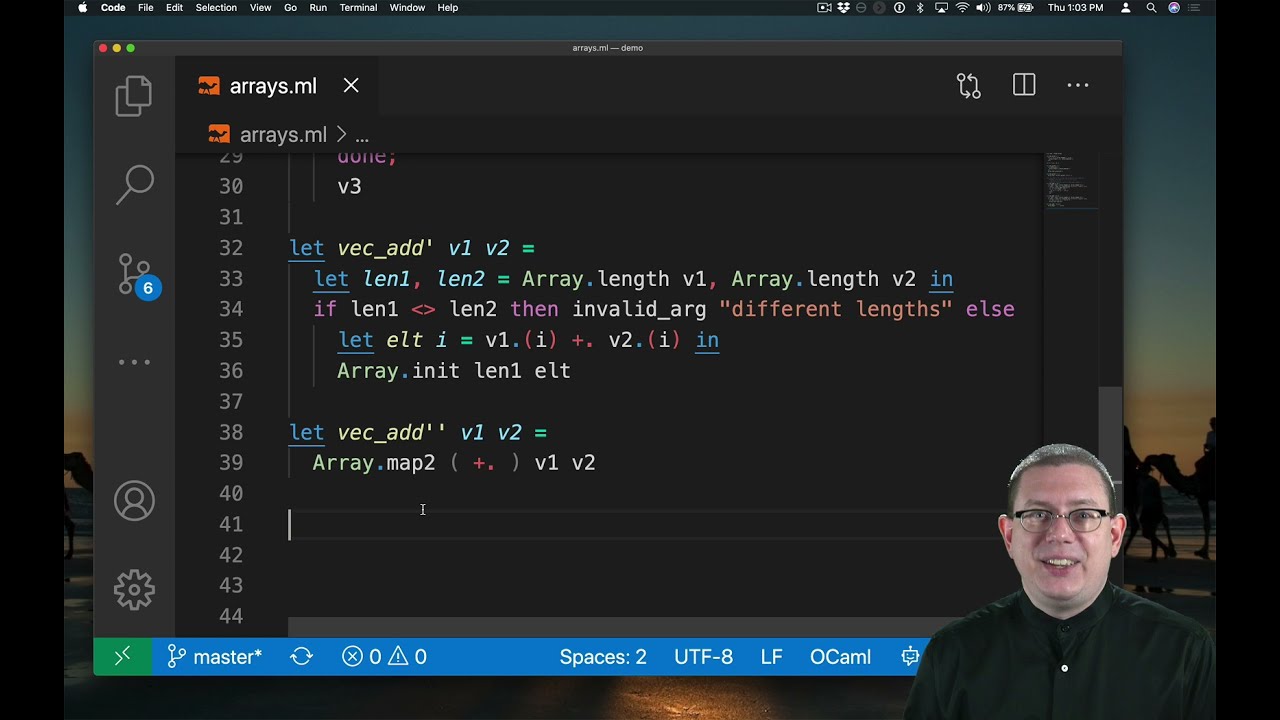
let my_numbers = [1; 2; 3; 4; 5];;
let my_colors = ["red"; "green"; "blue"];;
See? Painless! Notice the semicolons; they're crucial. They're like the commas in a grocery list, keeping everything neatly separated. And remember, every item in the list needs to be of the same type. You can't mix apples and oranges... or numbers and strings, in this case.
Adding Elements to Your List: Cons Operator
Now, let's say you've got a list, and you want to add something to the front. This is where the "cons" operator (::) comes in. It's like attaching a trailer to your car, adding something to the beginning of your list.
Example:

let original_list = [2; 3; 4];;
let new_list = 1 :: original_list;; (* new_list is now [1; 2; 3; 4] )
The "::" operator takes an element and an existing list, and returns a new list with the element added to the *front. It's like deciding to listen to your favorite song first on your road trip playlist.
Building Lists Incrementally: The Empty List
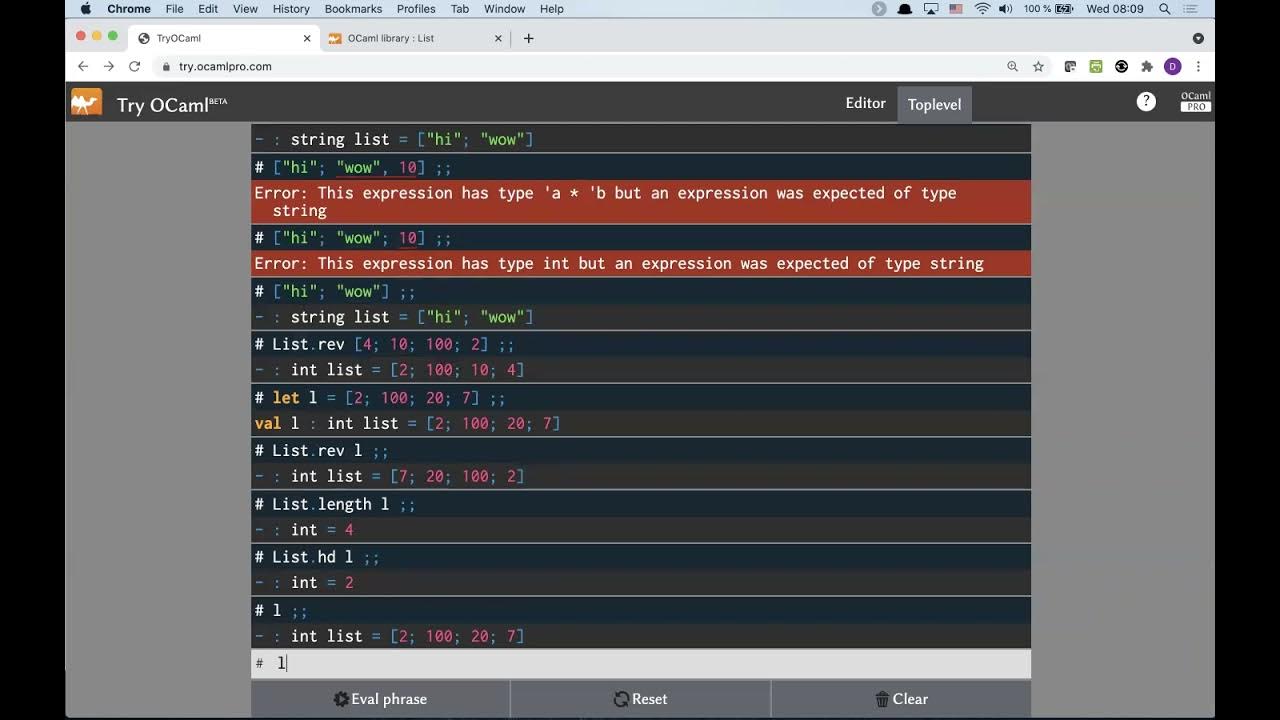
Every good list needs a starting point, right? In OCaml, that's the empty list, denoted by []. Think of it as a blank canvas, ready to be filled with your creative coding masterpieces. You can then build up a list using the cons operator.
Example:
let empty_list = [];;
let list1 = 3 :: empty_list;; (* list1 is now [3] )
let list2 = 2 :: list1;; ( list2 is now [2; 3] )
let list3 = 1 :: list2;; ( list3 is now [1; 2; 3] )
This is a great way to build lists piece by piece, making it perfect for dynamic situations where you don't know all the elements upfront. It's like adding ingredients to a soup one by one until you get the perfect flavor.
Beyond the Basics: List Comprehensions (Sort Of!)
While OCaml doesn't have the exact same "list comprehensions" you might find in Python, you can achieve similar results using functions like List.map and List.filter. These powerful tools allow you to transform and filter your lists with elegant ease.

List.map applies a function to each element of a list, creating a new list with the transformed elements. Imagine turning up the brightness on all the photos in your photo album.
List.filter, on the other hand, creates a new list containing only the elements that satisfy a certain condition. Think of it as deleting all the blurry or unflattering photos from that same album (we've all been there!).
Practical Tips and Cultural Musings
- Type Safety: OCaml is very strict about types. This is a good thing! It helps you catch errors early on, preventing your program from crashing in spectacular (and frustrating) ways.
- Immutability: Lists in OCaml are immutable. This means that once you create a list, you can't change it directly. Instead, you create a *new list based on the old one. Embrace immutability; it can lead to more predictable and easier-to-debug code.
- Real-World Applications: Lists are everywhere! From representing a queue of tasks to storing data from a database, lists are the unsung heroes of software development.
A Moment of Reflection
Learning about lists in OCaml isn't just about mastering a programming concept; it's about understanding how to organize and manipulate information. Just like a well-organized to-do list can help you conquer your day, understanding lists in programming can empower you to tackle complex problems with clarity and precision. So, the next time you're feeling overwhelmed, remember the power of lists. Break down the problem, create a list of steps, and conquer it, one element at a time.