Write The Electron Configuration For A Neutral Atom Of Cadmium.
Ever wonder what makes one element different from another? Or why some materials are shiny while others are dull? The secret lies within the tiny world of electrons and how they're arranged around an atom's nucleus! Figuring out the electron configuration of an atom is like understanding its personality profile – it tells us a lot about how it will behave and interact with other atoms. And trust me, it's more fun than it sounds! Today, we're diving into the electron configuration of cadmium, a silvery-blue metal with a surprising number of uses.
So, what's the point of knowing an electron configuration? Well, it's like having a cheat sheet for chemistry. Electron configuration explains an element's chemical properties. It helps us predict how it will bond with other elements to form compounds, its oxidation states, and even its color! Think of it as unlocking the secrets to understanding the building blocks of the universe.
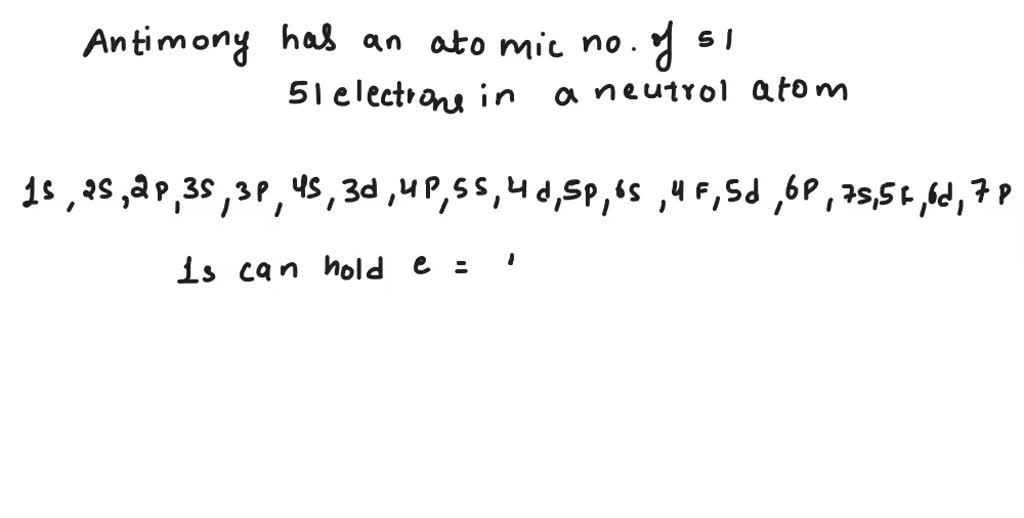
Let's get started with cadmium (Cd). Cadmium has an atomic number of 48, which means a neutral cadmium atom has 48 protons in its nucleus and, importantly, 48 electrons orbiting that nucleus. Our mission is to figure out how those 48 electrons are arranged around the cadmium nucleus. We’ll use the Aufbau principle (which basically means “building up”) and Hund's rule to guide us.
Must Read
We’ll fill the orbitals in order of increasing energy, remembering that:
- The first energy level (n=1) has one s orbital (1s), which can hold up to 2 electrons.
- The second energy level (n=2) has one s orbital (2s) and three p orbitals (2p), which can hold up to 8 electrons in total.
- The third energy level (n=3) has one s orbital (3s), three p orbitals (3p), and five d orbitals (3d), which can hold up to 18 electrons in total.
- The fourth energy level (n=4) has one s orbital (4s), three p orbitals (4p), five d orbitals (4d), and seven f orbitals (4f), which can hold up to 32 electrons in total.
- And so on…
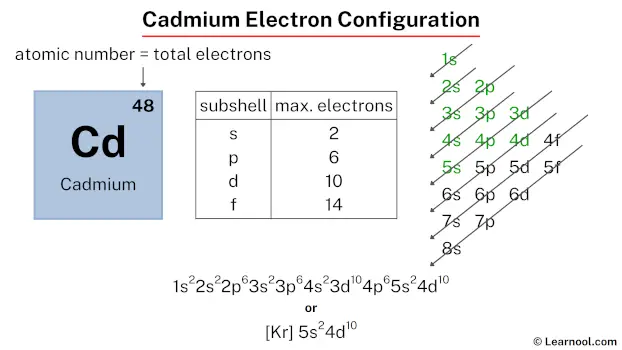
Following these rules, we start filling the orbitals: 1s2 2s2 2p6 3s2 3p6 4s2 3d10 4p6 5s2 4d10.
Let's break that down. We filled the 1s orbital with 2 electrons (1s2), the 2s orbital with 2 electrons (2s2), the 2p orbitals with 6 electrons (2p6), and so on, until we used all 48 electrons. The full electron configuration of cadmium is: 1s2 2s2 2p6 3s2 3p6 4s2 3d10 4p6 5s2 4d10.
But wait, there's a shortcut! We can use the noble gas notation. The noble gas that comes before cadmium in the periodic table is krypton (Kr), which has 36 electrons. Therefore, we can write the electron configuration of cadmium as: [Kr] 5s2 4d10. This notation tells us that cadmium has the same electron configuration as krypton, plus an additional 2 electrons in the 5s orbital and 10 electrons in the 4d orbital.
So there you have it! The electron configuration of cadmium. It might seem a little complex at first, but with a little practice, you'll be deciphering electron configurations like a pro. Remember, understanding electron configurations is like having a secret key to understanding the behavior of elements and the fascinating world of chemistry.