
Which Is Not True About Enzymes

Enzymes! They sound complicated, right? Like something stuck in a dusty textbook. But trust me, they're way cooler than you think. They're like tiny, super-efficient workers running around in your body (and everywhere else!).
Think of them as the ultimate catalysts. They speed things up. They're involved in almost every biological process imaginable, from digesting your lunch to helping you breathe. So, what isn't true about these amazing molecular machines?
Let's Play "Two Truths and a Lie" with Enzymes!
We're going to explore some common ideas about enzymes. But, one of them is a total fib! Can you spot the phony?
Must Read
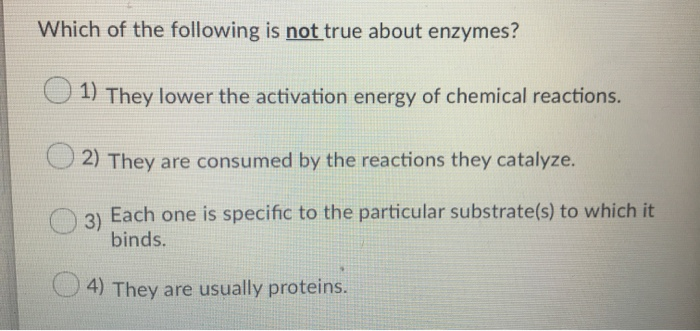
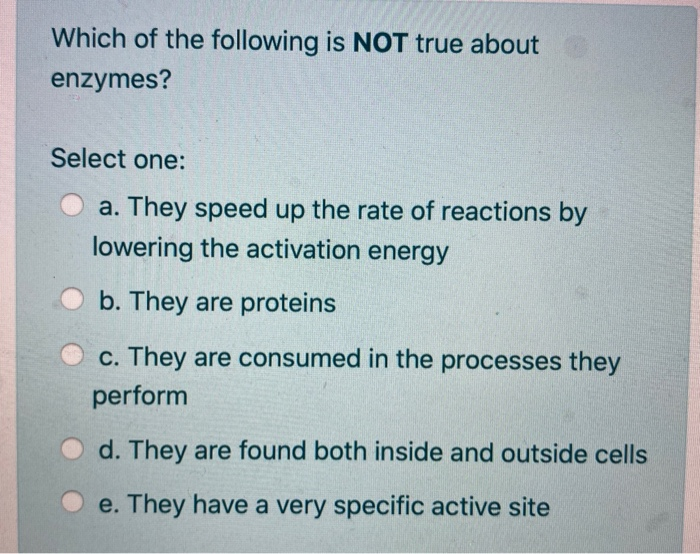
Enzyme Statement #1: Enzymes are Always Used Up in a Reaction.
This one seems like it could be true. After all, don't things usually get used up when they do work? But hold on!
Imagine a tireless baker. They churn out cake after cake. The baker doesn't become the cake, right? They just keep making more.
That's kind of how enzymes work. They help reactions happen, but they themselves remain unchanged. They're ready to catalyze another reaction as soon as they're done with the first. Efficient, right?

Enzyme Statement #2: Enzymes are Very Specific.
Imagine trying to use a key for your house to unlock your car. It wouldn't work, would it? Keys are designed for specific locks.
Enzymes are similar! Each enzyme has a specific shape. That shape matches a specific molecule, called a substrate. This is sometimes called the "lock and key" model. This ensures that the right reaction happens at the right time.
Think of it like this: A pizza cutter is perfect for pizza, but useless for soup! It's all about having the right tool for the job.
Enzyme Statement #3: Enzymes Work Best at Any Temperature.
This one sounds appealing. Imagine an enzyme that works perfectly no matter what! But, alas, it's not the case.
Think of cooking an egg. Too little heat, and it stays runny. Too much heat, and it becomes rubbery.
Enzymes are very sensitive to temperature. If it gets too hot, they can unfold and become inactive. This is called denaturation. Too cold and they slow down too much.
So, Which Statement is the Lie?
Drumroll please! The lie is Enzyme Statement #1: Enzymes are Always Used Up in a Reaction. Remember, enzymes are catalysts. They speed up reactions without being consumed themselves!
Pretty neat, huh? They're like the ultimate recyclers of the biological world.

Why Should You Care About Enzymes?
Besides being fascinating, enzymes are absolutely crucial for life as we know it. They're involved in everything from digesting your food to building your DNA.
Understanding how they work has huge implications. It can help us develop new medicines, create better biofuels, and even improve food production.
They're also involved in brewing beer! That's right, enzymes are responsible for breaking down starches into sugars that yeast can then ferment into alcohol. So, next time you enjoy a pint, thank the enzymes!
Think about cleaning products. Many detergents contain enzymes that break down stains. They're the reason that stubborn grass stain disappears from your jeans!
Learning about enzymes opens up a whole new world. You'll start seeing them everywhere!
Dive Deeper into the World of Enzymes
Hopefully, this little quiz has sparked your curiosity about enzymes. They're far from boring! In fact, they're one of the most interesting and important topics in biology.
So, go forth and explore! There's a whole universe of enzymatic wonders waiting to be discovered.
Whether you're a budding scientist or simply curious about the world around you, enzymes have something to offer. They're a testament to the elegance and complexity of life itself.