
What Purpose Do Fairness Measures Serve In A Product Development

Alright, gather ‘round, friends! Let’s talk about something that sounds drier than week-old toast: fairness measures in product development. I know, I know, it sounds like something you’d hear in a stuffy boardroom, but trust me, it’s actually way more interesting (and important!) than you think. Think of it as making sure your digital inventions don't accidentally become prejudiced jerks.
Imagine you're building a self-driving car. Awesome, right? But what if it's only trained on pictures of pedestrians with light skin? Suddenly, people with darker skin become… invisible obstacles? Yikes! That's a fairness fail of epic proportions. And that, my friends, is precisely why we need these "fairness measures." They're like ethical guardrails for our technological creations.
So, What ARE Fairness Measures, Exactly?
Okay, let's break it down. Fairness measures are basically a set of tools and techniques we use to quantify how fair (or unfair) a product is. Think of them like a report card for your algorithm. Are you acing it in inclusivity? Or are you failing miserably in representing diverse user groups?
Must Read
These measures look at things like:
- Equal opportunity: Does everyone have the same shot at a good outcome? No giving preference to robots over humans, okay?
- Statistical parity: Are the outcomes for different groups roughly the same? If your AI is deciding who gets a loan, you better not be disproportionately denying people based on their race or gender.
- Predictive accuracy: Is your product equally accurate for everyone? You wouldn't want facial recognition software that works perfectly on some people but completely bombs on others. Awkward!
And there are tons more! It’s like a whole fairness buffet. You pick the ones that are most relevant to your product and its potential impact.
Why Bother? (Besides Not Being a Jerk)
Great question! Besides the obvious moral imperative of not creating biased technology (which, let’s face it, should be reason enough), there are some pretty compelling practical reasons to care about fairness measures.
Firstly, reputation. Nobody wants to be the company that built the racist robot. The internet never forgets, and a PR disaster can sink your ship faster than you can say "algorithmic bias."
Secondly, compliance. Governments are starting to crack down on unfair AI. Regulations are coming, and you want to be ahead of the curve, not scrambling to fix your product at the last minute.
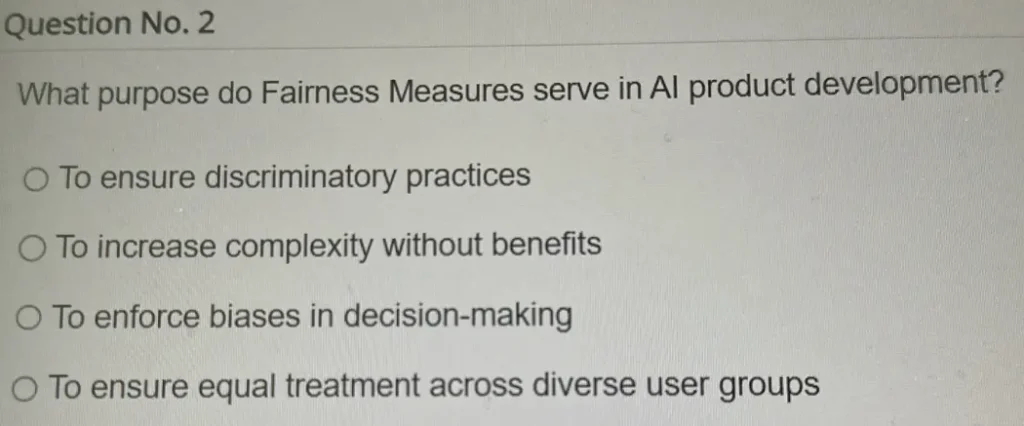
Thirdly, and perhaps surprisingly, better products. Addressing biases often leads to a deeper understanding of your users and their needs. This can result in a more robust, user-friendly, and ultimately better product for everyone. Think of it as unlocking hidden features you never knew existed!
The Fun Part: How to Actually Use Them
Okay, so you're convinced. Fairness measures are important. Now what? Here's the (slightly oversimplified) roadmap:

- Identify potential biases: Before you even start building, think about where biases might creep in. Who are your users? What data are you using? What assumptions are you making? Be honest with yourself.
- Choose your fairness metrics: Pick the measures that are most relevant to your product and the potential harms it could cause. Don't just pick the ones that make your product look good! (Yes, some people do that. Don't be that person.)
- Test, test, test! Regularly evaluate your product using your chosen fairness measures. Get feedback from diverse user groups. Be prepared to iterate and make changes.
- Document everything: Be transparent about your efforts to ensure fairness. Explain how you're measuring fairness, what steps you're taking to mitigate bias, and what the limitations of your approach are.
Remember: Fairness is not a destination, it's a journey. You'll never be 100% fair, but the goal is to keep improving and striving for a more equitable outcome.
The Takeaway (with a Sprinkling of Existential Dread)
In a world increasingly driven by algorithms, fairness measures are not just a nice-to-have, they're a necessity. They're our best shot at building technology that benefits everyone, not just a select few. And let's be honest, if we don't get this right, we're basically handing over the keys to the future to potentially biased robots. And that, my friends, is a truly terrifying thought.
So, go forth and build fairer products! The future of humanity might just depend on it (no pressure!). And if you ever feel overwhelmed, just remember this: even a small step in the right direction is better than none at all. Now, who wants more coffee?
