Okay, picture this: You're trying to make the world's most AMAZING peanut butter and jelly sandwich. You've got artisanal bread, organic peanut butter imported from a secret peanut farm in the Andes, and jelly made by actual singing fairies. This isn't just lunch; this is an experience.
Now, imagine you're following a recipe (because even sandwich artists need guidance, sometimes!). The recipe says, "Spread the 'Peanut Butter Bliss' evenly." Sounds straightforward, right? But then you try to access the peanut butter by saying something like, "Hey, 'Peanut Butter Bliss', give me your fifth ingredient!" (Even though peanut butter only has one ingredient: peanut butter! We're being dramatic here, people!).
That, my friends, is essentially what's happening when you get the dreaded TypeError: 'function' object is not subscriptable in Python. It's your code's way of saying, "Whoa there, partner! You're trying to treat me like something I'm not!"
Let's break down this theatrical error message. The important bit is the "not subscriptable" part. Think of "subscriptable" as meaning something you can access using square brackets, like a list or a dictionary. It's like saying, "Give me the third item from this shopping list!" or "What's the definition of 'onomatopoeia' in this dictionary?"
Functions, on the other hand, are like little recipe cards. They do things. They calculate things. They process things. They don't contain things in the same way a list or dictionary does. So, trying to access them with square brackets is like trying to get ingredient number five from the "Make a Sandwich" recipe card. It just doesn't compute!
Essentially, Python is shouting, "I'm a function! I do things, I don't hold things like that! Stop trying to put square pegs in round holes!" And honestly, it's a pretty valid complaint.
Python TypeError: ‘function’ object is not subscriptable Solution
Common Culprits and Hilarious Hijinks
So, how do you end up in this subscriptable snafu? Here are a few common scenarios, dressed up in slightly silly situations:
Scenario 1: Missing Parentheses (The "Oops, I Forgot My Glasses!" Moment)
Imagine you're trying to get the length of a string using the `len()` function. You intend to write `len("Hello")` which, correctly, gives you the number of characters. But if you accidentally write `len` (without the parentheses) and then try to do `len[0]`, BAM! You're trying to access the function itself like a list, and Python throws a fit! It's like trying to eat the recipe card instead of making the sandwich.
typeerror: function object is not subscriptable ( Easy ways to Fix )
Scenario 2: Function Call Confusion (The "Am I Calling You or Just Staring?" Fiasco)
Let's say you have a function called `get_user_name()` that retrieves a user's name from a database. You want to get the name and then access the first letter. But if you write `get_user_name[0]`, you're trying to access the function itself instead of the result of the function. You need to call the function first: `get_user_name()[0]` to get the user's name, then get the first letter. It's the difference between admiring a chef and actually tasting their delicious soup.
Scenario 3: Method Madness (The "Is This a Function or a Method?" Mystery)
TypeError: 'function' object is not subscriptable - YouTube
Methods are functions that belong to objects. For example, strings have methods like `.upper()` to convert them to uppercase. If you accidentally try to call a method directly on the class instead of on an instance of the class, you might end up in subscriptable territory. It’s like trying to use a specific car's GPS system without actually being in the car!
These are just a few examples, but the key takeaway is: make sure you're actually calling the function and that you're trying to access something that is subscriptable (like a list, string, or dictionary), not the function itself!
Don't Panic! You've Got This!
Encountering a TypeError: 'function' object is not subscriptable might feel like a sandwich-making catastrophe, but it's a perfectly normal part of the coding journey. It's a learning opportunity! It's a chance to flex your debugging muscles and show that error who's boss!
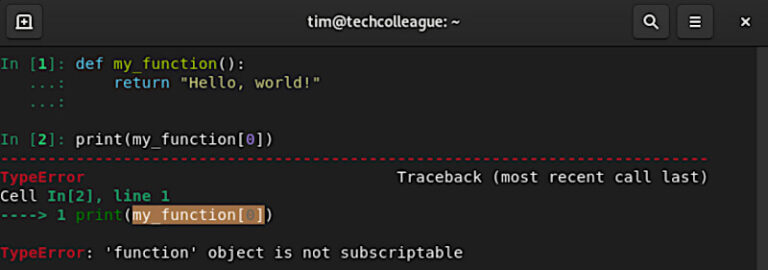
Python: How to Fix the "TypeError: 'function' object is not
So, the next time you see this error, take a deep breath, double-check your parentheses, make sure you're calling the function correctly, and remember the singing fairies and the artisanal peanut butter. You'll conquer this subscriptable situation in no time!
And hey, even if you accidentally eat the recipe card, at least you'll have a funny story to tell. Happy coding!