
Surface Area Of Volume Of Revolution

Ever spun around so fast you felt like you were seeing a whole new world? Well, math can do that too! Specifically, the math of surface area of volume of revolution. Sounds intimidating, right? Don't worry, it's actually a wildly creative concept. Think of it as math magic!
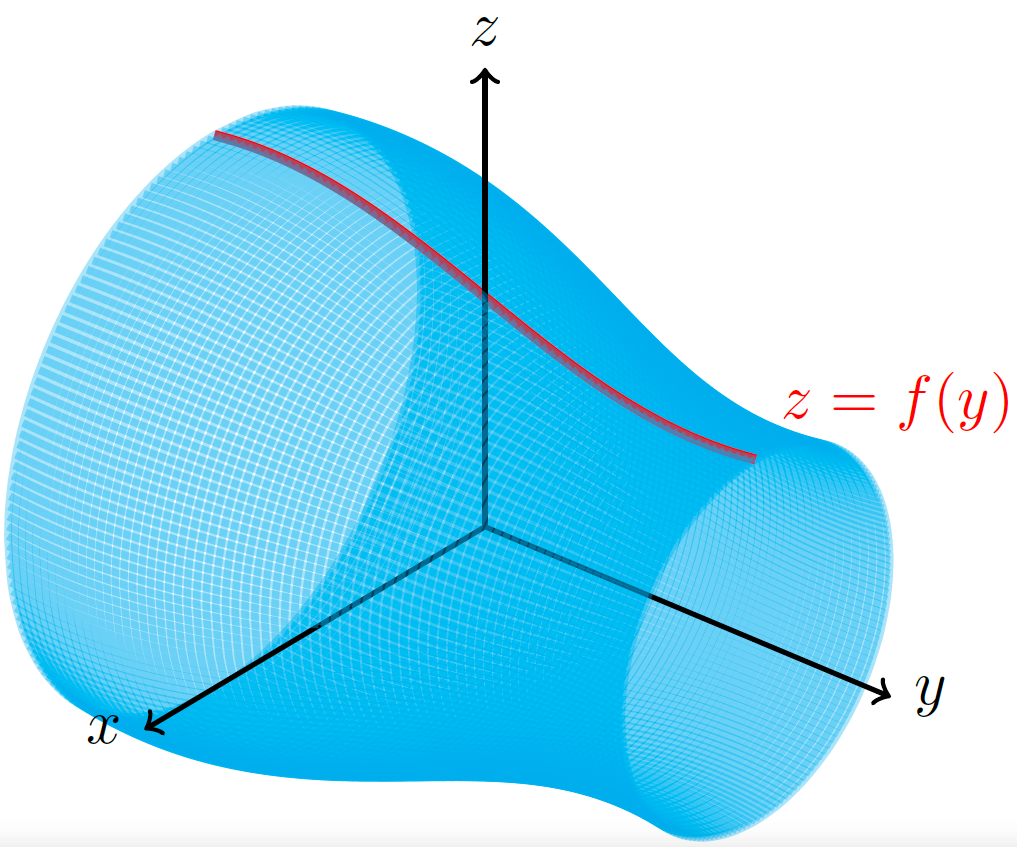
Imagine you've got a simple little curve. Maybe it looks like a smile, or perhaps a gentle hill. Now, picture grabbing that curve and spinning it around and around, like you're using a potter's wheel. What do you get? A 3D shape! A vase, a donut, maybe even a funky lampshade. That's a volume of revolution.
But what if you want to know how much paint you'd need to cover the outside of that vase? Or how much frosting to completely coat that donut? That's where the surface area part comes in. We're talking about the total area of the outside of our spinning shape.
Must Read
Okay, so why is this entertaining? Think about the possibilities! You can take almost any curve, spin it, and create a completely new and unique shape. A straight line spun around? A cylinder. A circle? A sphere! Suddenly, you're a mathematical sculptor, crafting objects with equations!
It's like a mathematical Etch-A-Sketch. Instead of shaking it to erase, you just change the curve and spin it again. New shape! New surface area! It's a constant source of creative output.
Why It's Special (and Secretly Useful!)
This isn't just some abstract math game. It’s used everywhere. Engineers use it to design tanks and containers. Architects use it to calculate the surface area of curved roofs. Even medical professionals use it to model the shapes of blood vessels!
See, understanding the surface area of volume of revolution allows you to calculate things efficiently. No more guessing how much material you'll need. No more over-estimating and wasting resources. It’s about precise calculations that save time, money, and materials.
It also links two major mathematical concepts: geometry and calculus. Geometry gives us the shapes, and calculus gives us the tools to analyze them. It's a beautiful marriage of ideas, working together to solve real-world problems.
And let's be honest, there's a certain satisfaction in watching a complex equation transform into a tangible, understandable value. It's like decoding a secret message and unlocking hidden knowledge.
Think of the humble circle. When spun, creates a perfect sphere! This concept truly highlights the magic of volume of revolution.
Getting Started: Don't Panic!
Okay, the formulas might look a bit intimidating at first. But don't let that scare you away! Start with simple curves and build your way up. There are tons of online resources and tutorials that can walk you through the process. And remember, the goal is to have fun exploring!

Experiment with different curves. Use graphing calculators to visualize the shapes. Play around with the formulas and see how changing the curve affects the surface area and volume. You might be surprised at how intuitive it becomes.
Think of it as learning a new language. At first, it seems foreign and confusing. But with practice and persistence, you'll start to understand the grammar and vocabulary. And soon, you'll be speaking fluently, crafting beautiful mathematical shapes with ease!
So, next time you're looking for a fun and challenging way to flex your math muscles, give surface area of volume of revolution a spin. You might just discover your inner mathematical artist!
And who knows? Maybe you'll even design the next great architectural marvel... all thanks to the magic of spinning curves!
Go ahead. Embrace the spin!