
Molecular Orbital Theory Of N2
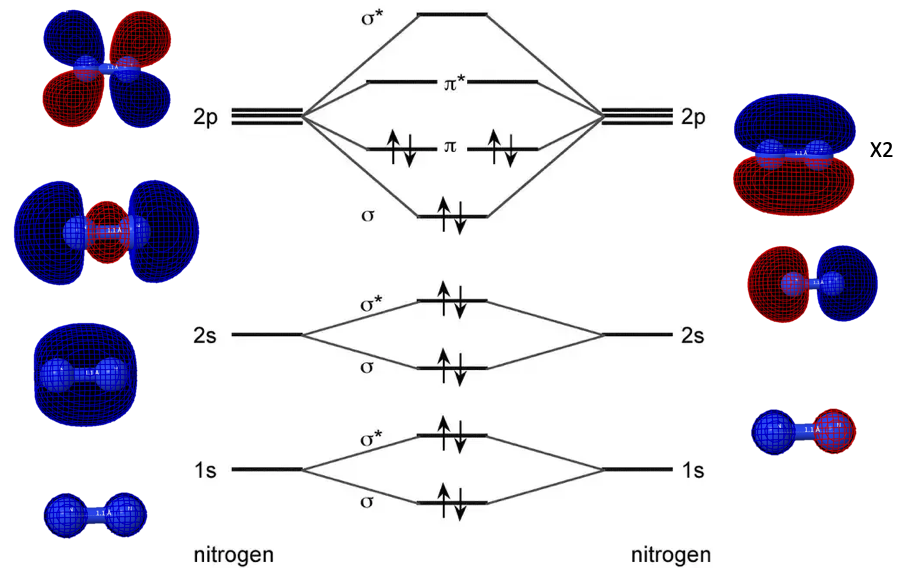
Alright, let's talk about Nitrogen, N2! Not the kind you pump into your car tires (though, similar principle!), but the kind that makes up most of the air we breathe. We're going to dive into something called Molecular Orbital (MO) Theory to understand how this stuff sticks together. Don't worry, it sounds intimidating, but trust me, it's kinda like Legos for electrons. We’re building something cool!
Think of atoms as individual players on a team. They each have their own talents (atomic orbitals), but to win the game (form a stable molecule), they need to combine those talents. MO theory is all about how these atomic orbitals combine to form molecular orbitals. These molecular orbitals are where the electrons actually hang out in the molecule. They’re like the different rooms in a clubhouse built specifically for our electrons.
Nitrogen (N) has the electron configuration 1s22s22p3. The 1s electrons are boring and tucked in close to the nucleus, not really participating in bonding. So we're mostly interested in the 2s and 2p orbitals. Each nitrogen atom has one 2s and three 2p orbitals. That's a total of four atomic orbitals each! When they combine, poof, we get eight molecular orbitals for N2. Magic!
Must Read
Building the Molecular Orbitals: Bonding vs. Antibonding
Now, here's the juicy bit. When atomic orbitals combine, they can do it in two ways: constructively (like two waves adding together to make a bigger wave) or destructively (like two waves canceling each other out).
Constructive combination creates bonding molecular orbitals. These are lower in energy than the original atomic orbitals, and they want electrons to be there. Filling these orbitals makes the molecule more stable – it's like giving the molecule a warm hug! We label them sigma (σ) and pi (π), depending on their shape. Imagine σ bonds like a head-on collision, and π bonds like a side-swipe. (Don’t try this at home... or with molecules!).

Destructive combination, on the other hand, creates antibonding molecular orbitals. These are higher in energy and are denoted with an asterisk (σ* and π). Electrons in these orbitals *weaken the bond. Think of them as bond-villains! The molecule doesn't want electrons here; it's like a tiny electric shock every time one enters. These antibonding orbitals are very important, if they get populated with electrons, the stability of the molecule will decrease.
For N2, we get one σ2s, one σ2s, one σ2p, two π2p, two π2p, and one σ2p. (Yeah, it’s a mouthful. Chemistry is sometimes like learning a whole new language!)

Filling the Orbitals: The Electron Configuration
Nitrogen has 7 electrons per atom, so N2 has a total of 14 electrons to place into our molecular orbitals. We fill them up according to increasing energy, following the Aufbau principle (fill the lowest energy levels first), Hund's rule (maximize unpaired electrons within a subshell), and the Pauli exclusion principle (only two electrons per orbital, and they have to have opposite spins).
The electron configuration of N2 then becomes: (σ2s)2(σ2s)2(σ2p)2(π2p)4. Notice anything missing? That’s right! All the antibonding orbitals (π2p and σ2p) are empty! This is fantastic news for the stability of N2.

Bond Order: How Many Bonds Are We Talking?
The bond order is a simple calculation that tells us how many bonds are holding the molecule together. It's calculated as: (number of electrons in bonding orbitals – number of electrons in antibonding orbitals) / 2.
For N2, that's (10 – 4) / 2 = 3. A bond order of 3 means that N2 has a triple bond! That's why it's so stable and unreactive. It takes a LOT of energy to break that triple bond.

Think of it this way: a single bond is like holding hands, a double bond is like linking arms, and a triple bond is like a full-on group hug! Trying to separate N2 is like trying to pry apart three people in a very enthusiastic embrace. Good luck with that!
So, there you have it. Molecular Orbital Theory helps us understand why N2 is such a stable molecule, thanks to its strong triple bond formed by the clever combination of atomic orbitals. It's a testament to how electrons can cooperate to create something incredibly stable and vital for life as we know it. And who knew that atoms could be such good team players?
Next time you breathe in, remember all those little nitrogen molecules, happily triple-bonded together, contributing to the air you need to survive. It's a truly remarkable thing, isn't it? Even if it took a little MO theory to truly see it. Now go forth and impress your friends with your newfound knowledge of molecular orbitals!