
Lewis Structure Of C2h2br2
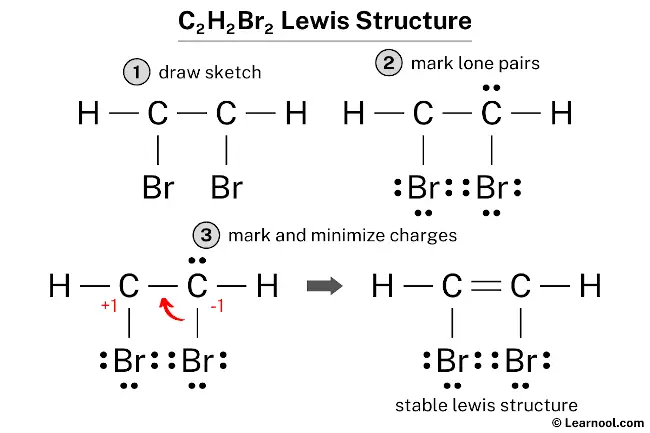
Alright, buckle up, chemistry adventurers! We're diving headfirst into the wild world of molecules to tackle a fun one: C2H2Br2. Think of it as a chemical puzzle, and we're about to become master puzzlers!
The Atomic Lineup
First, let's meet our players. We have two Carbon (C) atoms, two Hydrogen (H) atoms, and two Bromine (Br) atoms. It's like a tiny, slightly chaotic party!
Remember, Carbon is the life of the party, always wanting to make four bonds. Hydrogen is a simple guy, happy with just one bond. And Bromine? Well, it's the chill friend, content with one bond too.
Must Read
Building the Foundation
Now, let’s put those two Carbon atoms side-by-side. They're going to be the foundation of our molecule.
Since Carbon is always trying to form four bonds, let's start adding those other atoms. How about we attach a Hydrogen to each Carbon? Sounds like a good start!
But uh oh! Now each Carbon only has two bonds (one to the other Carbon and one to the Hydrogen). They're feeling a little incomplete. What's a molecule to do?
The Double (or Triple!) Bond Drama
This is where things get interesting. Those Carbon atoms are like, "Hey, I still need two more bonds!" So, they share another pair of electrons, forming a double bond. Even triple bond!
If they only make a double bond there is still place for other atoms, so let's put Bromine to the rescue! We can put them on the same side of carbon or on the opposite side!
Or, what about a triple bond! Each Carbon shares three pairs of electrons. That means there is only one bond to go!

If the bond is a triple bond, than there is no space for Bromine on each Carbon! It is so simple, only one Hydrogen and one Bromine can be attached in the structure!
Arrangement is Key
Okay, so we know what atoms are attached to what, but the arrangement matters! C2H2Br2 can exist in different forms, called isomers.
Think of it like arranging furniture in a room. You have the same furniture, but you can put it in different places to create different vibes. Same atoms, different arrangement, different molecule!
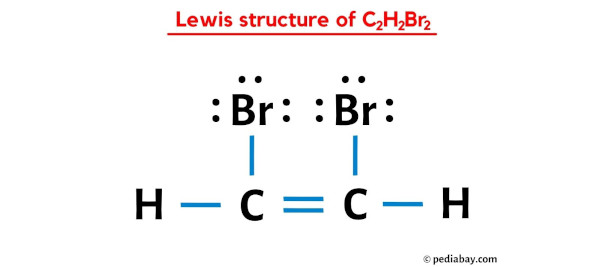
In the case of the double bond, we have 1,1-dibromoethene, where both Bromines are attached to the same Carbon. We have cis-1,2-dibromoethene, where the Bromines are on the same side. And we have trans-1,2-dibromoethene, where the Bromines are on opposite sides.
Drawing the Lewis Structure: A Simplified Guide
Now, let's get visual! Drawing a Lewis structure is like creating a map of our molecule, showing all the bonds and lone pairs of electrons.
Each line represents a shared pair of electrons (a bond). Remember, Carbon wants four lines coming off it, Hydrogen wants one, and Bromine wants one.
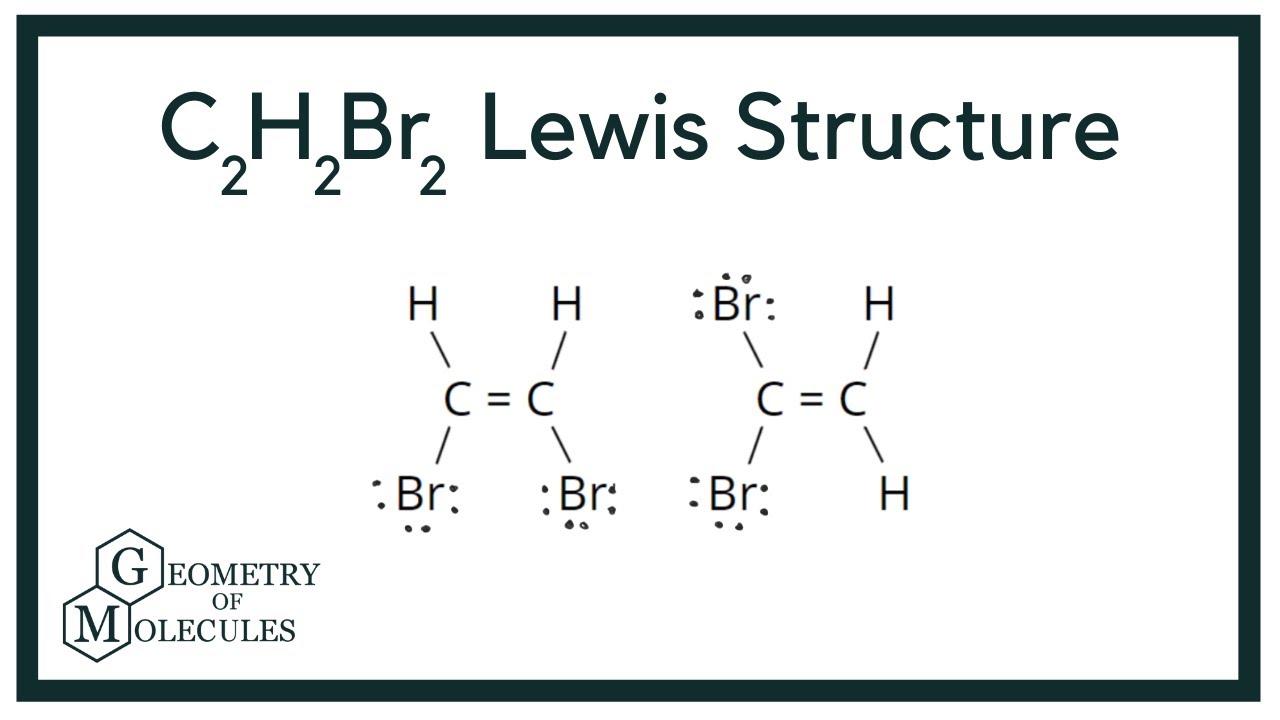
Let's consider cis-1,2-dibromoethene. We draw the two Carbon atoms connected by a double bond. Then, on each Carbon, we attach a Hydrogen and a Bromine, making sure the Bromines are on the same side of the double bond.
Now, for trans-1,2-dibromoethene, it's the same process, but we attach the Bromines on opposite sides of the double bond.
Finally, for 1,1-dibromoethene, we connect both Bromines in one Carbon and both Hydrogens for the other one.
Lone Pairs: The Shy Electrons
Don't forget about those lone pairs! Bromine has three lone pairs of electrons that aren't involved in bonding. We represent these as dots around the Bromine symbol. They are the shy friends who don't want to mingle!
Each Bromine will have six electrons around it in addition to the bond with Carbon, so you can draw three pairs of dots around each Bromine atom.
Putting It All Together: A Masterpiece!
Voila! You've created the Lewis structure for C2H2Br2! It's like a tiny work of art, showcasing the arrangement of atoms and electrons in this molecule.

Remember, practice makes perfect. The more you draw Lewis structures, the easier it will become. You'll be a molecular artist in no time!
Why This Matters (In a Fun Way!)
Okay, so why are we even doing this? Well, understanding the structure of molecules helps us understand their properties and behavior.
Imagine trying to build a house without knowing the blueprint! You'd end up with a wonky, unstable mess. Similarly, understanding the structure of molecules helps us predict how they'll react, what their properties are, and how we can use them.
For example, the different isomers of C2H2Br2 have different properties. Cis and trans isomers react in different way.
Also, imagine you are cooking. If you put too much salt it is going to be salty, you need to see what is the exact quantity of ingredients to have the best result! The same for chemistry.
Real-World Connections
These kinds of molecules are used in various applications, from pesticides to flame retardants. Understanding their structure allows scientists to design better and safer versions of these compounds.
Think of it like this: knowing how a car engine works allows mechanics to fix it and even improve its performance. Similarly, knowing the structure of molecules allows chemists to create new materials and technologies.
So, you see, even though drawing Lewis structures might seem like a purely academic exercise, it has real-world implications that impact our lives in many ways.
A Few Final Tips
Don't be afraid to make mistakes! Chemistry is all about experimentation and learning from your errors. Every mistake is a step closer to mastery.
Start with simple molecules and gradually work your way up to more complex ones. It's like learning to ride a bike – you wouldn't start on a unicycle, would you?
And most importantly, have fun! Chemistry is a fascinating and rewarding subject. Embrace the challenge and enjoy the journey!
Keep exploring, keep questioning, and keep drawing those Lewis structures! You're well on your way to becoming a chemistry superstar. Now go forth and conquer the molecular world!
So, next time someone mentions C2H2Br2, you can confidently say, "Oh, that's just dibromoethene! I know all about its Lewis structure and isomers!" And they'll be super impressed, I promise!