
How Many Gallons In A Barrel Of Crude Oil
The Great Oil Barrel Mystery: It's Not What You Think!
Picture a barrel. You know, the big, brown, sometimes rusty kind you see in old cartoons or on a construction site. Maybe it's rolling down a hill, chasing an unlucky hero. It's a classic image, right?
Now, picture a barrel of crude oil. The very substance that powers our cars and heats our homes. Naturally, you'd think an "oil barrel" would be, well, a barrel of oil. And you'd probably wonder: exactly how much oil does one of those hold?
A Number That Makes You Go "Hmmmm"
You might guess 50 gallons. Seems like a nice, round number, doesn't it? Easy to count, easy to remember. Or maybe 40 gallons? Also very sensible, a solid benchmark. Perhaps even a neat 100 gallons for impressive scale?
Must Read
But oh no, dear reader, the world of oil measurement isn't so simple. It rarely is, frankly. The answer, the official, globally accepted answer, is a number that seems to defy all logic and common sense. It's 42 gallons.
"Forty-two? What's so special about 42?" you might rightly exclaim.
And that, my friends, is where our playful journey into the slightly absurd begins. It's a number that feels picked out of a hat, a quirky little secret handshake for the oil industry. Almost like a cosmic joke whispered across the ages.
The Wild West of Oil and the Birth of 42
To understand this peculiar number, we have to take a whimsical trip back in time. Imagine the early days of American oil, back in the mid-19th century. Think rugged prospectors, muddy fields, and a whole lot of ambition. It was a glorious, chaotic free-for-all.

When oil was first discovered in Pennsylvania, there was no standard container. People used whatever they had lying around. Whiskey barrels, fish barrels, pickle barrels – you name it. These barrels came in all sorts of sizes, from a meager 30 gallons to a more generous 50.
This, as you can imagine, led to absolute mayhem. How do you trade something when nobody agrees on the size of the container? It was like trying to sell apples when some were in small baskets and others in giant sacks, all called "a barrel." Confusion reigned supreme, and cheating was probably rampant.
To bring some order to this delightful mess, the early oil producers needed a standard. They needed a measure everyone could agree on, a unit to make buying and selling fair. And in 1866, after much deliberation (or perhaps just picking one that seemed common), the Pennsylvania producers decided.
They settled on 42 gallons. Why 42? Well, here's where it gets a little hazy and a lot more charmingly random. One popular theory suggests it was based on the standard English wine barrel, which held 31.5 gallons, but with an extra 10.5 gallons added for "shrinkage" or leakage during transport.
Another thought is that it simply fit well on wagons and was a sturdy, manageable size for transport. It wasn't too big to lift, but big enough to hold a decent amount. So, it wasn't some grand, scientific calculation. It was pure, delightful pragmatism mixed with historical accident.
"It just kind of... happened," our oil ancestors might shrug, wiping their hands on a greasy rag.
And once it was set, it stuck. Like a catchy tune you can't get out of your head. The U.S. Congress officially recognized the 42-gallon barrel as the standard for crude oil in 1872. And that, folks, was that. The quirky standard was etched into history.
The Modern Myth of the Oil Barrel
Here's the kicker, though: when we talk about a barrel of crude oil today, we're almost never talking about an actual, physical wooden barrel. Seriously, when was the last time you saw a giant wooden barrel rolling off a supertanker? Spoiler alert: you probably haven't.
Modern oil is transported in massive pipelines, gigantic ships, and enormous tankers. It flows, it gushes, it moves in volumes far too vast for individual barrels. The "barrel" is now almost entirely a unit of measurement.
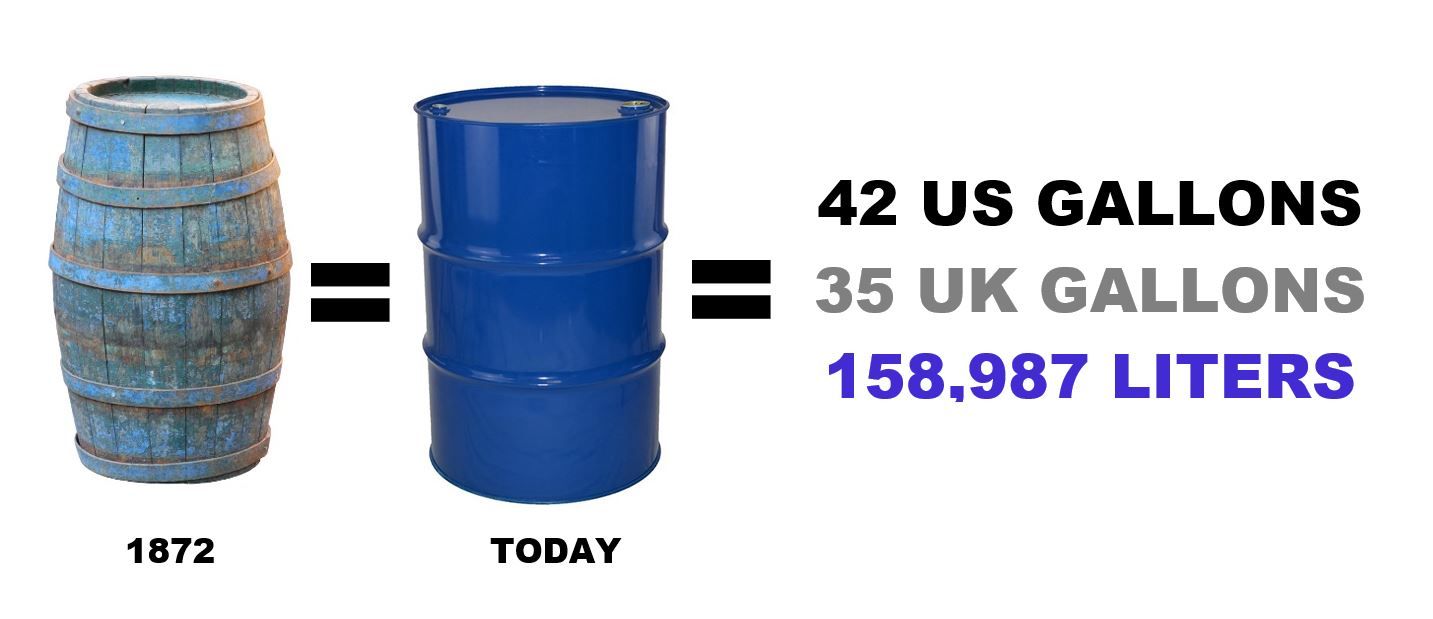
It's a bit like buying eggs by the "dozen." You don't usually see 12 chickens delivering exactly 12 eggs tied together. It's just a convenient way to quantify things. Similarly, a barrel of oil is a shorthand for 42 gallons, nothing more.
So, when you hear about oil prices per barrel, remember it's just a numerical placeholder. It's a ghost of a barrel, an echo from a bygone era of oil pioneers. A phantom measurement, if you will, but a very important one in the global economy.
My Unpopular Opinion: Let's Rebrand!
Now, for my slightly unpopular, but utterly logical, opinion. Why are we still clinging to 42 gallons? It’s confusing, it’s arbitrary, and it makes explaining things to curious folks like you unnecessarily complicated!
Wouldn't it be simpler to just say "42 gallons of oil"? Or perhaps even better, "50 gallons" and then we round it up for everyone's sanity? Imagine the ease! The clarity! The sheer joy of a nice, round number!
Think about it. We live in a world that mostly runs on metric, or at least uses nice base-10 numbers for most things. But nope, when it comes to crude oil, we're stuck in the charmingly illogical 19th century. It's like having a pocket calculator that only does multiplication by 42.
Perhaps the oil industry just likes to keep us on our toes. Maybe it's a secret initiation rite for economists and energy analysts. "Oh, you think you understand global markets? Tell us, young one, how many gallons are in a barrel?"
It’s a historical quirk, a vestige of a time when wine barrels and oil barrels briefly intertwined. But it’s also a gentle reminder of how sometimes, things just become standard because they do. Not because they make perfect sense, but because enough people agreed to it long ago.
"It's the answer to the ultimate question of oil measurement!" a playful voice might whisper, echoing The Hitchhiker's Guide to the Galaxy.
And much like the answer to the universe, 42 gallons in an oil barrel leaves you feeling a little amused, a little perplexed, and thoroughly entertained. It's just one of those wonderfully peculiar facts that make our world a little more interesting. So, next time you hear "a barrel of oil," you'll know it's not a barrel at all. It's an invisible, historical, utterly charming 42 gallons.