
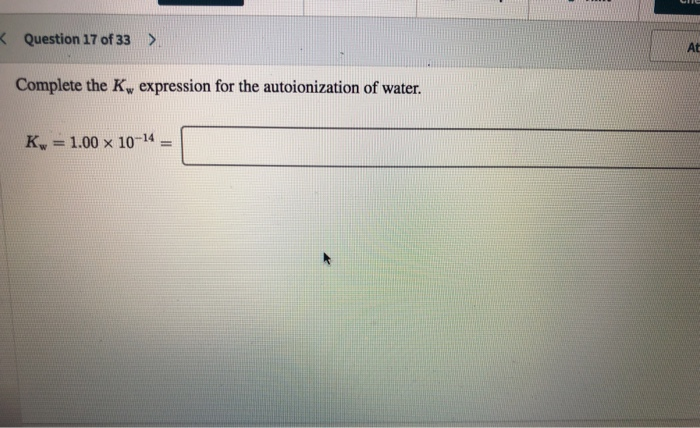
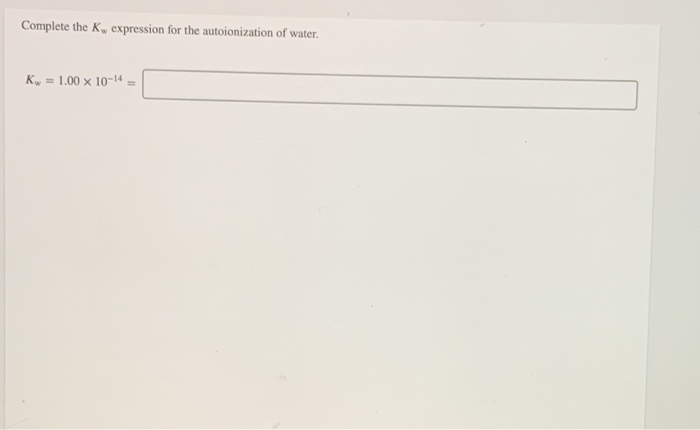
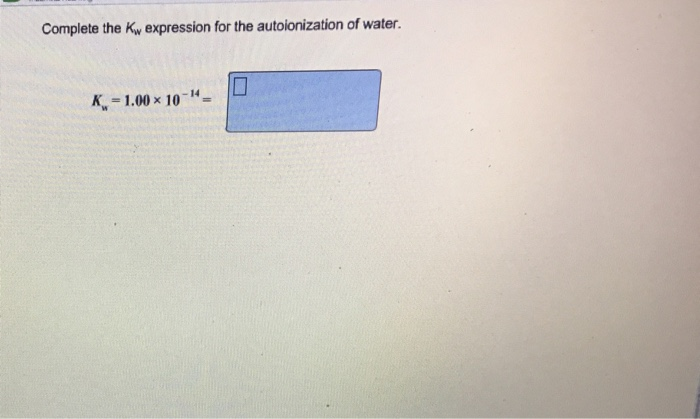
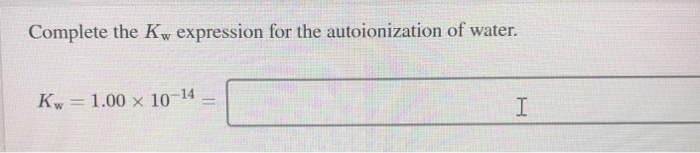
Complete The ð¾w Expression For The Autoionization Of Water.

Water, the elixir of life! It's in our oceans, our showers, and even our very own bodies. But did you know it's also secretly playing a chemistry game all the time?
That game is called autoionization, and it's like water molecules are having a tiny, never-ending dance-off. Think of it as water molecules passing around a tiny proton – a positively charged particle.
Ready to see the complete expression for this watery waltz?
Must Read
The Big Reveal: H2O + H2O ⇌ H3O+ + OH-
Okay, let's break this down. It looks like some alien equation, but I promise, it’s totally understandable. On the left side, we have two water molecules, represented by the good old H2O.
These two water molecules bump into each other, and one of them decides to be a little generous. It donates a proton (H+) to the other.
This is where the magic happens! On the right side of the equation, we have two new characters. The first is H3O+, also known as the hydronium ion. It’s basically a water molecule with an extra proton attached, feeling all charged up!
Then we have OH-, the hydroxide ion. This is what's left behind when a water molecule loses its proton. It's now negatively charged and ready to mingle!
The ⇌ symbol indicates that this reaction is reversible. It means the reaction goes both ways, forward and backward, simultaneously! It's like a continuous back-and-forth dance move.
Why Should You Care? (It's Cooler Than You Think!)
So, why is this little water dance so important? Well, it's fundamental to understanding acidity and basicity. Think of lemon juice (acidic) versus soap (basic).
The concentration of H3O+ and OH- in a solution determines whether it's acidic, basic, or neutral. More H3O+? You've got yourself an acid! More OH-? You're in base territory!
Pure water has equal concentrations of H3O+ and OH-, making it perfectly neutral. It's like the Switzerland of chemistry!
And get this: autoionization changes with temperature! Heat up the water, and you get more autoionization, meaning more H3O+ and OH-. It's like the water molecules are partying harder at higher temperatures!
Autoionization in Everyday Life (Yes, Really!)
You might be thinking, "Okay, that's cool for scientists in lab coats, but how does this affect me?". Well, you encounter autoionization every time you...drink water! (obviously).
It's also crucial in many industrial processes, from manufacturing pharmaceuticals to producing cleaning products. Autoionization is like the unsung hero working behind the scenes.
Even the pH of your swimming pool relies on this principle! Pool maintenance involves carefully balancing the concentrations of H3O+ and OH- to keep the water safe and comfortable. So, next time you're diving in, remember the autoionization of water!
Putting It All Together: A Visual Analogy
Imagine a crowded dance floor. Water molecules are like dancers, and the proton is like a shiny disco ball. Dancers occasionally pass the disco ball to each other.
The dancer holding the disco ball (H3O+) is feeling extra energized, while the dancer who just passed it (OH-) is a little more relaxed. The disco ball is constantly changing hands, creating a dynamic and balanced atmosphere.
If there are more dancers holding disco balls, the dance floor becomes more "acidic" (energetic). If there are more dancers who have just passed the disco ball, the dance floor becomes more "basic" (relaxed).
The key is that this is happening all the time, even when the dance floor seems calm on the surface. It’s a constant equilibrium!
The Kw: Water's Self-Ionization Constant
Now, for a little extra sprinkle of knowledge. Scientists have quantified this autoionization process using something called the ion product of water, also known as Kw.
Kw is simply the product of the concentrations of H3O+ and OH- at a given temperature. At 25°C, Kw is approximately 1.0 x 10⁻¹⁴. That's a tiny number, but it's incredibly significant!
This constant tells us that even in pure water, there are always some hydronium and hydroxide ions present. It's like a tiny whisper of acidity and basicity coexisting in perfect harmony.
Beyond Pure Water: Autoionization in Other Liquids?
Water isn’t the only liquid that can autoionize! Other substances, like ammonia (NH3) and sulfuric acid (H2SO4), can also undergo similar processes, although the details might differ.
In ammonia, for example, one ammonia molecule can donate a proton to another, forming NH4+ and NH2-. It’s the same principle, just with different players.
These autoionization processes are crucial in understanding the properties of these liquids and their behavior in chemical reactions. Chemistry is never ending, so that's why it is interesting!
Embrace Your Inner Water Molecule!
So, the next time you pour yourself a glass of water, remember the amazing chemistry happening at the molecular level. Water molecules are constantly autoionizing, playing a crucial role in the world around us.
Understanding the autoionization of water is not just for scientists. It's a window into the fascinating world of chemistry that affects our lives in countless ways.
Embrace your inner water molecule, and keep exploring the wonders of science! Because after all, knowledge is like water: essential for life, refreshing, and surprisingly full of surprises.
A Final, Hydrated Thought
Hopefully, this article has made the autoionization of water a little less intimidating and a lot more interesting. It’s a fundamental concept that unlocks a deeper understanding of chemistry.
Remember: H2O + H2O ⇌ H3O+ + OH-. The dance of water, the balance of acidity and basicity, the silent symphony of chemistry playing out in every drop!
Now go forth and spread the word! The world needs to know about the amazing autoionization of water! You're now part of an exclusive club. Welcome!