
What Is The Temperature Of Lightning
Picture this: you’re snuggled up inside, maybe with a mug of something warm, and outside, the heavens are putting on a light show. A flash! Then, a moment later, a rumble that rattles the windows. It’s glorious, a little bit terrifying, and utterly captivating. And if you’re anything like me, your brain probably zips to some pretty wild questions during these celestial theatrics. Like, for instance, “What in the actual heck is the temperature of that thing?”
Well, my friend, prepare to have your socks knocked off, your eyebrows slightly singed (metaphorically, of course), and your jaw dropped faster than a dropped ice cream cone on a hot summer day.
The Mind-Boggling Hot Truth!
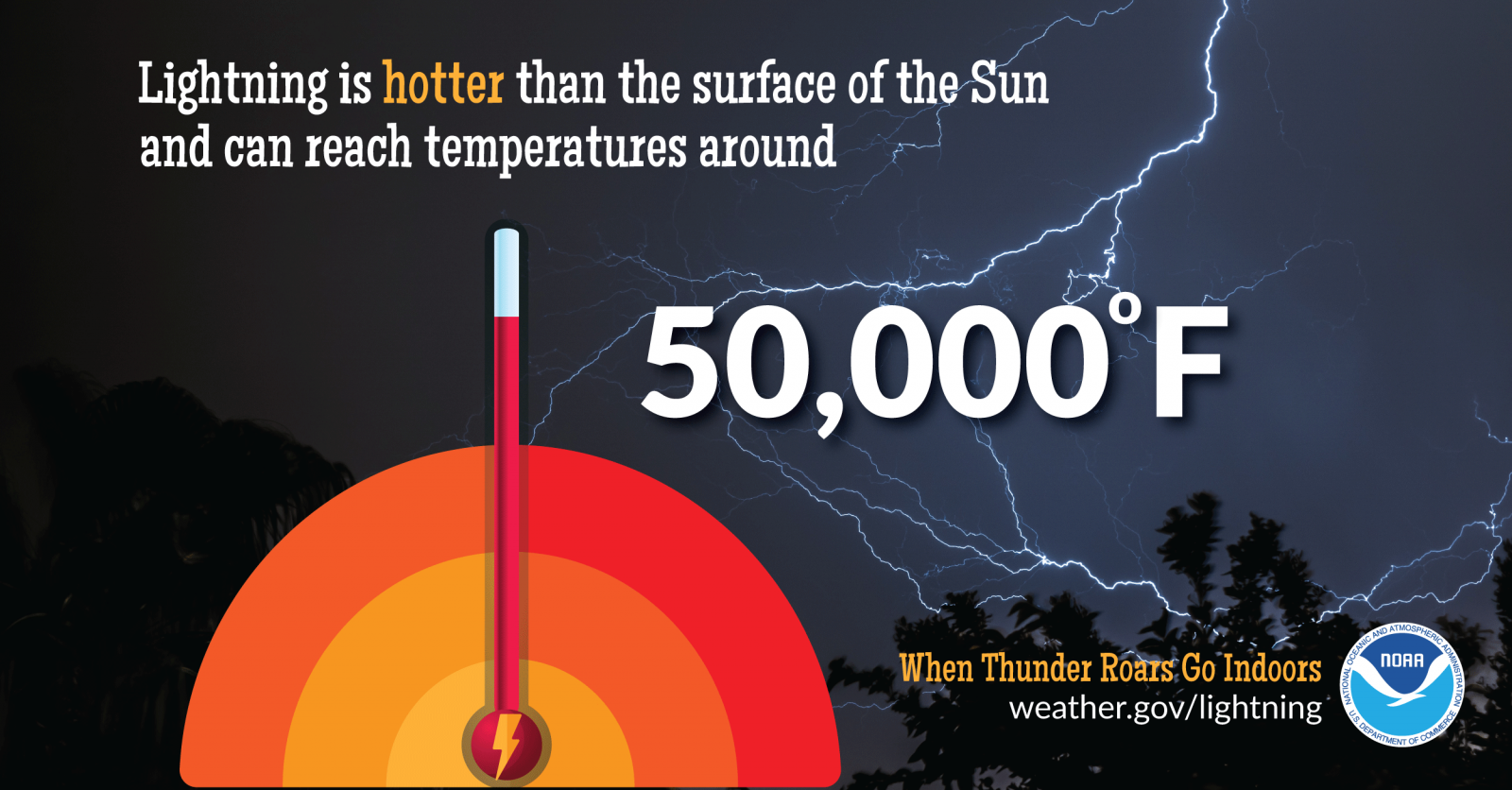
Are you ready? Because this is a number that’s going to make you rethink every "hot" thing you’ve ever experienced. Lightning isn't just hot; it's like the universe decided to crank the thermostat to "insanity mode." We're talking about temperatures that can reach up to 50,000 degrees Fahrenheit. Fifty. Thousand. Degrees. Fahrenheit.
Must Read
Let that sink in for a second. That's approximately 27,760 degrees Celsius for our metric-minded friends. Now, to put that into perspective, the surface of our sun? A paltry 9,940°F (5,505°C). So, yes, a bolt of lightning is about five times hotter than the surface of the sun. Five times! It's like the sun is a cozy campfire, and lightning is a supernova having a really enthusiastic tantrum.
Why So Spicy?
You might be wondering, "How does something that lasts for mere fractions of a second get that ridiculously hot?" Good question, astute reader! It’s all about physics, baby, and a whole lot of energy being squished into a tiny space.

When lightning strikes, it basically ionizes a super-thin channel of air. This means it strips electrons from the air molecules, turning that air into a plasma. Think of it as a super-charged, highly conductive, glowing tube of pure energy. This whole process happens in a blink, compressing and heating the air around it almost instantaneously.
The air gets so hot, so fast, that it expands with explosive force. And what do we call that explosive expansion of superheated air? You guessed it: thunder! That booming sound isn't just the clouds grumbling; it's essentially a giant sonic boom created by the air itself literally screaming in shock from being flash-fried.

The Blink-And-You'll-Miss-It Factor
Okay, so lightning is hotter than a dragon's breath after a chili eating contest. But if it's so incredibly hot, why isn't everything within a mile radius instantly vaporized? Why aren’t we all just walking around as crispy critters after a thunderstorm?
Here's the trick, the grand illusion, the tiny little detail that saves us from becoming human charcoal briquettes: duration. Lightning is unbelievably, mind-bogglingly fast. The actual main return stroke, the brightest part that's truly doing the heavy lifting, lasts for only a few microseconds. That’s a millionth of a second. The entire flash might last a bit longer, but the intense heat is concentrated in that impossibly brief moment.
Imagine trying to toast a marshmallow with a nuclear reactor. If you just flicked the marshmallow past the core for a nanosecond, it would barely warm up. If you held it there, well, say goodbye to your marshmallow, your hand, and possibly the entire state. The brevity of lightning's touch is our saving grace. It's hot enough to make the air sing, but not long enough to turn your house into a pile of ash (most of the time, anyway).

Surprising Side Effects & Fun Facts
Despite its fleeting nature, lightning does leave its mark. When it strikes sandy soil, the intense heat can fuse the sand into glassy tubes called fulgurites, also known as "fossilized lightning." They look like gnarly, twisted roots made of glass – a super cool souvenir from nature's most extreme oven!
And speaking of extreme, did you know that lightning strikes the Earth about 100 times every second? That's roughly 8.6 million strikes per day! The sky is putting on a constant, global light show. It’s like a never-ending disco party up there, just with way more plasma and less regrettable dance moves.

Of course, while it's fascinating, it's also incredibly dangerous. Remember the classic safety phrase: "When thunder roars, go indoors!" Seriously, folks, admire this incredible phenomenon from a safe distance. Don't go trying to measure the temperature yourself, unless you have some really good insurance and a death wish.
The Electrifying Finale
So, the next time you see that brilliant flash across the sky, remember this: you’re not just witnessing an electrical discharge. You're watching a fleeting, incredibly powerful column of plasma, hotter than the surface of the sun, ripping through the atmosphere at breakneck speeds, and then vanishing almost before you can process it. It’s a testament to the raw, untamed power of nature, wrapped up in a package that's both terrifyingly hot and utterly beautiful.
Isn’t our planet just the coolest (and hottest) place ever? Now, if you'll excuse me, I think I hear the kettle calling for another cuppa, and I'm suddenly craving a marshmallow... held at a safe, non-plasma-inducing distance, of course.