
What Distinguishes One Amino Acid From Another

Ever wonder what makes a chicken different from a cow, or a sunflower different from a sequoia? It all boils down (literally!) to proteins.
And proteins, those workhorse molecules of life, are built from smaller units called amino acids. Think of them like Lego bricks for your body – but way, way cooler.
The Amino Acid Lineup: 20 Players on Team Protein
Now, there are a lot of molecules in the universe. But when it comes to building proteins, nature decided to stick with a surprisingly small team: just 20 amino acids.
Must Read
It's like a really exclusive club. Each with their own personality, their own special skills.
But if they’re all amino acids, what makes them different? Buckle up, because we're about to dive into the quirky world of R-groups!
The R-Group: The Key to Amino Acid Individuality
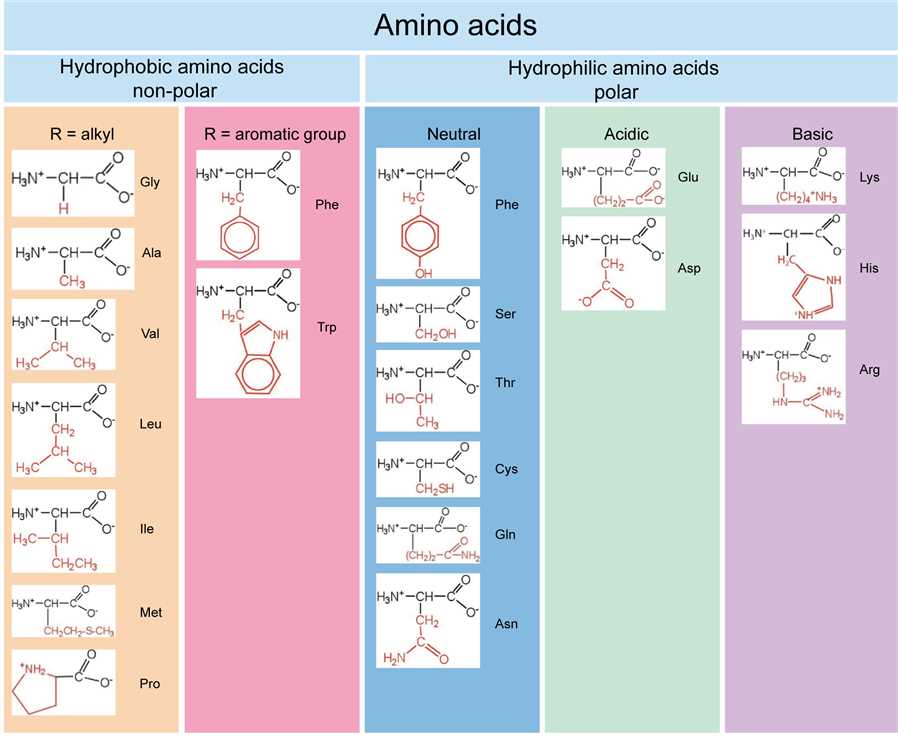
Imagine all 20 amino acids start with the exact same basic structure. This is called the amino and carboxyl group. It’s like they all wear the same uniform: a standard issue “amino acid” T-shirt and jeans.
But then comes the fun part: the R-group! This is like each amino acid gets to customize their outfit with a crazy hat, a funky backpack, or maybe even a pair of sparkly roller skates.

The R-group is the part of the amino acid that's unique. It's what distinguishes one from another. It’s where the magic happens!
Think of it like this: you and your best friend both have two arms, two legs, a head, and a torso. But you have different hair, different eyes, different clothes, and maybe even a different quirky way of laughing. Those differences are your "R-group," and they make you, you!
Polar vs. Nonpolar: Water's Opinion Matters
One of the most important things the R-group determines is whether an amino acid is polar or nonpolar.
Polar means "water-loving" (hydrophilic). Nonpolar, on the other hand, means "water-fearing" (hydrophobic).
Imagine a group of kids at a pool party. Some kids (the polar amino acids) are splashing around, having a blast in the water. Others (the nonpolar amino acids) are huddled on the side, avoiding getting wet at all costs!

This "water preference" has HUGE implications for how proteins fold and function. It's like organizing a dance: you need to pair up the wallflowers and the social butterflies to get everyone in the right place.
If a protein has a lot of nonpolar amino acids on its surface, it might huddle together with other nonpolar molecules, creating a greasy blob. If it has a lot of polar amino acids, it'll happily dissolve in water.
Size and Shape: From Tiny Tots to Big Bouncers
R-groups also come in different sizes and shapes. Some are tiny and simple, like a single hydrogen atom (that's Glycine, the minimalist of the group). Others are big and bulky, like rings and chains of carbon atoms.
This size and shape matters because it affects how amino acids interact with each other within a protein. It's like building with blocks: a tiny square block can fit into tight spaces, while a giant, oddly shaped block might stick out and prevent other blocks from fitting.
The shapes of the R-groups can cause proteins to bend, twist, and fold in specific ways, creating unique 3D structures.

Charge: Positive, Negative, or Neutral Party?
Some R-groups have an electrical charge – either positive or negative. These charged amino acids are like magnets. They can attract or repel other charged molecules, influencing protein structure and function.
For example, imagine two positively charged amino acids trying to get close to each other. They'll repel each other like magnets with the same poles facing. But a positively charged amino acid will happily snuggle up to a negatively charged one.
This electrostatic interaction can be crucial for enzyme activity and protein-protein interactions. Think of it like a puzzle where only certain pieces fit together because of their shapes and charges.
Special Guests: The Unique Amino Acid Characters
Let’s spotlight a few of our favorite amino acid personalities:
- Glycine: The smallest and most flexible. It's like the contortionist of the amino acid world, allowing proteins to bend in ways others can't.
- Proline: The rigid one. Its R-group loops back and connects to the amino acid's backbone, creating a kink in the protein chain. It's like a speed bump, forcing the protein to change direction.
- Cysteine: The bond-maker. It has a sulfur-containing R-group that can form strong covalent bonds with other cysteine molecules. These bonds are like super glue, holding different parts of the protein (or even different proteins!) together.
These are just a few examples. Each amino acid has its own unique properties that contribute to the overall structure and function of proteins.
The Big Picture: From Amino Acids to You!
So, what does all this R-group business mean for you? Well, everything! The specific sequence of amino acids in a protein, dictated by your DNA, determines how that protein folds, what it interacts with, and ultimately, what job it performs in your body.
Enzymes, which speed up chemical reactions; antibodies, which fight off infections; structural proteins, which provide support and shape - they all rely on the precise arrangement of those 20 amino acids.
Think of amino acids as letters in an alphabet. You can create different words, sentences, and stories from these letters. With only 20 amino acids, the possibilities for protein structure and function are virtually limitless!
The differences in amino acids are so minor, but they makes a huge difference.
Next time you're eating a protein-rich meal, remember the amazing diversity and versatility packed into those tiny amino acids. They're the unsung heroes of the biological world, quietly working to keep you alive and kicking.
They’re the building blocks of you, me, and everything in between! And it's all thanks to those quirky, characterful R-groups.