
Tense Chart With Rules And Examples Pdf

Okay, let's talk about something thrilling: the tense chart. I know, I know, you're already reaching for the nearest escape route. But hear me out! We've all stared blankly at those little boxes, haven't we? Past Perfect Continuous... what even is that?
It's supposed to be our roadmap to grammatical glory. A neat little PDF, often adorned with rules and examples. Supposedly, mastery awaits within. But does it actually work? Or is it just a beautifully formatted source of existential dread?
The Good, the Bad, and the Utterly Baffling
The good: it attempts to bring order to chaos. Think of it as Marie Kondo for your verb tenses. If everything is in its place, you should be able to find it. "Aha! I need to describe an action that started in the past and continued until another point in the past! Time for Past Perfect Continuous!"
Must Read
The bad: it's often overwhelming. Look at all those boxes! Each with its own name, formula, and quirky personality. And honestly, who remembers the formula for Future Perfect anything? It's like remembering the quadratic equation. You learn it for the test, and then... poof!
The utterly baffling: the examples. They're frequently so contrived. "By the time the rain stopped, she had been studying for three hours." Okay, that's nice, but when am I ever going to need to say that? Couldn't she have been doing something more interesting? Like, I don't know, plotting world domination? At least that would keep my attention.

My Unpopular Opinion: They're Kind of Overrated
Brace yourselves. I'm about to say something controversial. I think tense charts, with all their rules and examples, are a bit... overrated.
Now, before you grammar enthusiasts come at me with pitchforks, let me explain. I'm not saying grammar isn't important. It is! But language is fluid. It's alive. It evolves. And sometimes, the strict rules of a tense chart can feel like trying to put a wild river in a teacup.
Think about how you actually speak. Do you meticulously analyze every verb tense before you open your mouth? Do you consult a PDF before sending a text message? I highly doubt it. You just… talk. You go with what sounds right.

Intuition Trumps Formulas (Usually)
Here's the secret: most native speakers rely on intuition. We've heard the language enough to develop a sense of what's correct. We might not be able to explain why something sounds wrong, but we know it does.
Of course, intuition isn't foolproof. We all make mistakes. But I'd argue that immersion and practice are far more effective than memorizing formulas. Read books, watch movies, listen to podcasts. Surround yourself with the language. Let it soak in.
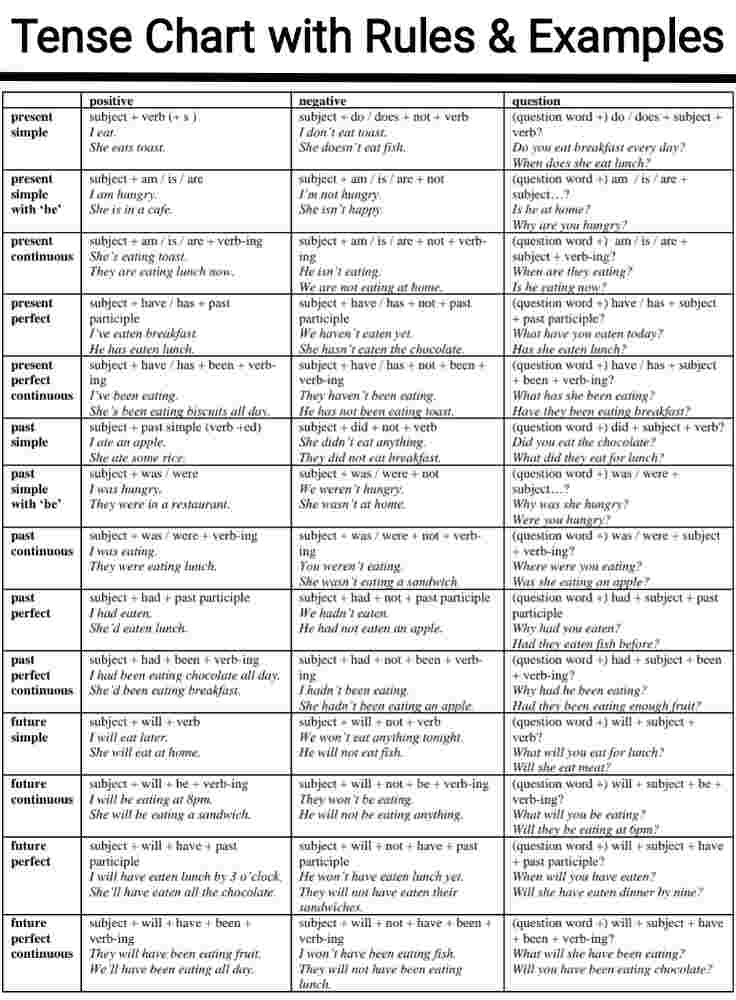
And yes, keep that tense chart PDF handy. It can be a useful reference. But don't let it intimidate you. Don't let it make you feel like you're not good enough. It's just a tool, not a judge.
Embrace the Imperfect
Ultimately, communication is about being understood. It's about connecting with other people. A few grammatical errors aren't going to derail that, usually.
So, next time you find yourself sweating over the Subjunctive Mood (another beast entirely), remember this: relax. Embrace the imperfect. And maybe, just maybe, burn that tense chart. Just kidding… mostly.

But seriously, focus on using the language. Get comfortable. Make mistakes. Learn from them. And don't let a rigid set of rules stifle your creativity. After all, who needs the Past Perfect Progressive when you can just say, "I was busy"?
Now, if you'll excuse me, I'm going to go be imperfectly awesome.