
Surface Area Of A Right Circular Cylinder
Alright, let's talk cylinders. Not the kind that go "vroom" in your car (although, fun fact, they are related, conceptually!). We're talking about those perfectly symmetrical, can-shaped things that are probably lurking in your kitchen right now. Soup cans, Pringles tubes, even that fancy candle you got for your birthday and haven't lit yet – all cylinders!
And what we really want to chat about is the surface area. Now, that sounds intimidating, doesn't it? Like something your math teacher threatened you with back in high school. But trust me, it's not that scary. Think of it this way: the surface area is just the total amount of "stuff" it takes to cover the whole cylinder. Like, if you wanted to gift-wrap that Pringles can (why would you?), the surface area is the amount of wrapping paper you'd need.
Basically, we are calculating how much material it takes to build this thing.
Must Read
Dissecting the Beast: Breaking Down the Cylinder
Okay, so how do we actually calculate this surface area? Well, first, let's imagine we're peeling off the cylinder's "skin" like it's a giant, delicious orange. What do we get? We get two circles (the top and bottom) and a rectangle (the middle part that wraps around).
Each of those components plays a crucial part in how we determine the overall surface area.

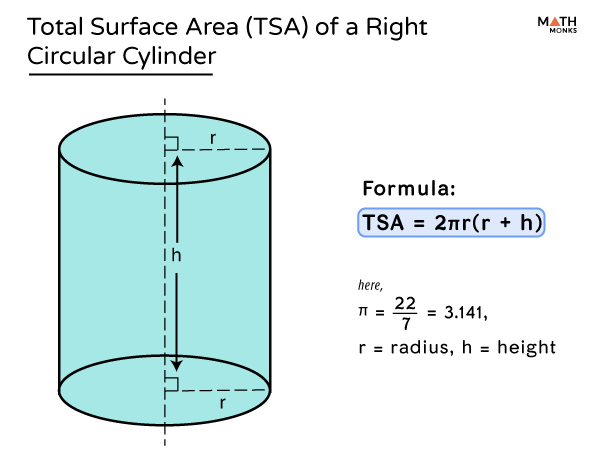
The two circles are pretty straightforward. We all remember the area of a circle, right? πr², where 'r' is the radius (half the diameter, which is the distance across the circle through the center). So, for two circles, we have 2πr². Easy peasy.
Now, for the rectangle. This is where it gets a tiny bit trickier, but stick with me. The height of the rectangle is just the height of the cylinder. Makes sense, right?
But what about the width? This is the part that wraps around the circles. Which means, the width of the rectangle is the circumference of the circle! Remember that one? It's 2πr. So, the area of the rectangle is its length * its width. In this case, 2πrh. Where ‘h’ is the height of the cylinder.

And that’s it for the rectangle. Not too bad once you understand the connection to the circles on either end.
Putting it All Together: The Grand Finale (Formula!)
Ready for the magic? The surface area of a right circular cylinder is simply the sum of the areas of those three pieces we just figured out: the two circles and the rectangle.
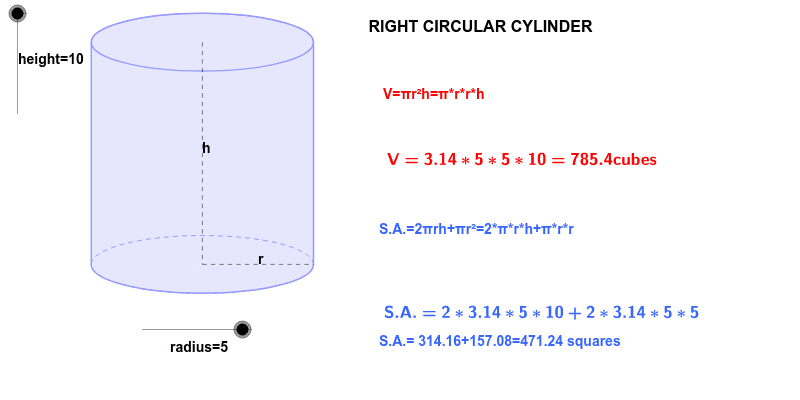
So, the formula is: Surface Area = 2πr² + 2πrh

Boom! That's it! Seriously. You can now officially impress your friends at parties with your newfound cylinder-surface-area-calculating superpowers. (Okay, maybe not parties, but definitely at math club gatherings. If those exist.)
Real-World Applications (Because Why Else Would We Learn This?)
Okay, so maybe you're thinking, "Yeah, yeah, formulas are great, but when am I ever going to use this in real life?" Good question! Let's brainstorm:
- Painting a Tank: Need to figure out how much paint to buy for that giant cylindrical water tank in your backyard? (Okay, maybe you don't, but someone does!)
- Designing a Can: If you're designing packaging for a new product, knowing the surface area helps you estimate the cost of materials.
- BBQing: Seriously! Consider the surface area when calculating the material cost of your grill for slow and even cooking.
- Insulating Pipes: Determining how much insulation you need to wrap around a pipe to keep your water warm.
These examples should show you that this formula is actually used out in the wild.
Basically, anything that involves wrapping or covering a cylindrical object will probably benefit from this formula!
The Takeaway
So, the next time you see a cylinder – a can of beans, a flagpole, a rolling pin – remember that you now have the power to calculate its surface area! It's not some abstract, scary math concept; it's a practical tool that can help you solve real-world problems (or at least sound really smart at trivia night).
And remember, math isn't about memorizing formulas, it’s about understanding the relationships between things. So, embrace the cylinder, conquer the surface area, and go forth and calculate!