
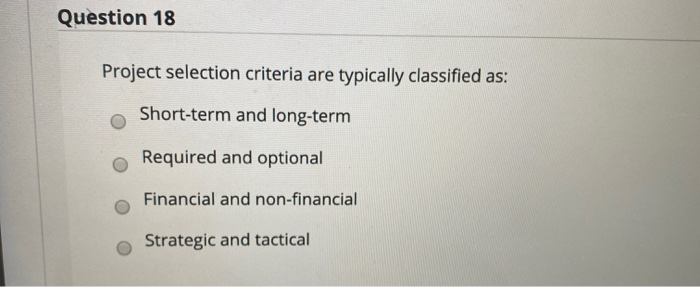
Project Selection Criteria Are Typically Classified As
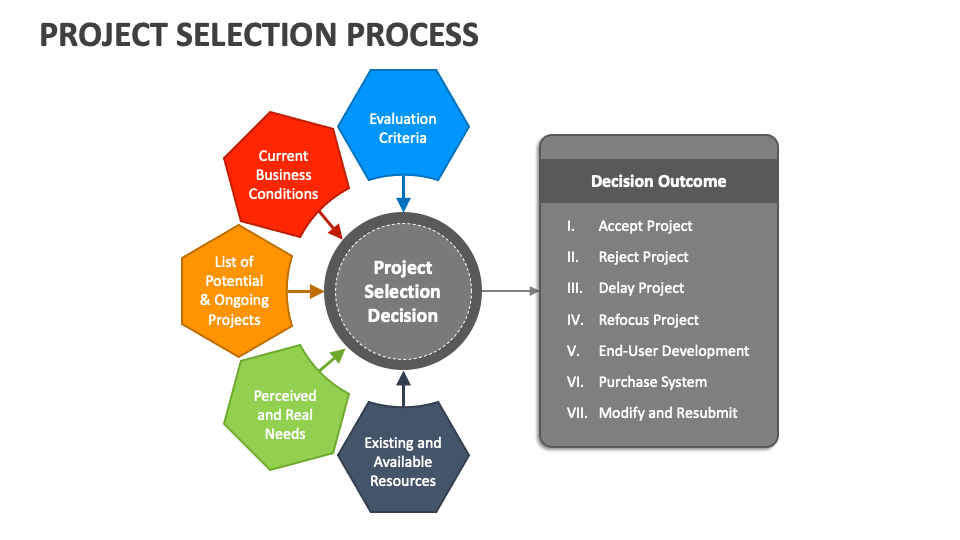
Ever wondered how big companies (or even small teams!) decide which shiny project to chase after? I mean, there are always so many ideas swirling around, right? It’s not like they just pick the one with the coolest name or the prettiest PowerPoint. There's actually a system to the madness, and it all boils down to project selection criteria. Think of it like online dating for projects - you gotta have standards!
Classifying the Criteria: Why Bother?
So, why even bother classifying these selection criteria? Good question! Imagine you're a chef. You wouldn't just throw all your ingredients in a pot and hope for the best, would you? Nope! You'd organize them: veggies here, meats there, spices in another spot. Classifying project selection criteria is kind of the same. It helps us understand what's really important, make better decisions, and avoid a culinary (or project!) disaster.
Plus, it makes things easier to communicate. Instead of saying, "We need a project that makes money and is kinda cool and doesn't take forever," you can say, "This project aligns strongly with our strategic goals and offers a high return on investment." See? Much clearer and more professional!
Must Read
The Usual Suspects: Common Classifications
Okay, let's dive into some of the common ways these criteria are classified. Think of these as different lenses you can use to evaluate a potential project. Which one is "best"? Well, that depends on your priorities and your organization's goals, of course!
1. Financial Criteria: Follow the Money!
This is probably the most obvious one. Does the project make us money? How much? How quickly? We're talking about things like Return on Investment (ROI), Net Present Value (NPV), and Payback Period. These metrics basically try to predict how profitable the project will be. It's like trying to predict the future, but with spreadsheets! Are we going to see a great ROI or NPV from this project?
If you're a start-up scraping by, financial criteria might be your top priority. Can't afford to do that awesome AI-powered cat feeder if it's going to bankrupt you, right?
2. Strategic Criteria: Does It Fit the Plan?
Think of your company as a ship sailing towards a destination (your strategic goals!). A strategic project is one that helps you reach that destination faster and easier. Does this project align with our long-term vision? Does it support our core values? Does it help us enter a new market? If the answer is "yes," then you're on the right track.
This is about the "big picture." It’s the "why" behind the project. You wouldn't build a race car if your goal was to deliver packages, would you? Well, maybe you would… but it wouldn't be very strategic!
3. Operational Criteria: Can We Actually DO It?
So, the project looks great on paper, and it promises riches beyond your wildest dreams. But... can you actually pull it off? That's where operational criteria come in. Do we have the right skills? Do we have the necessary resources? Is it even technically feasible?
Imagine trying to build a rocket to Mars in your garage. You might have the vision (strategic!), and maybe even a few spare parts (financial!). But unless you're Elon Musk (or at least have access to his resources), you're probably not going to succeed. Consider this before moving forward with any project.

4. Risk-Related Criteria: How Bumpy Will the Ride Be?
Every project has risks. The question is, how big are they, and can you manage them? This category looks at factors like market volatility, technology changes, and regulatory hurdles. Is it a safe bet, or a wild gamble?
Think of it like choosing a hiking trail. A well-maintained path with clear signs is low-risk. Scaling a sheer cliff face with no ropes? High-risk. You need to understand the risks involved before you commit.

5. Compliance Criteria: Following the Rules!
Is the project meeting all the requirements with laws and regulations? This is particularly important for industries like healthcare, finance, and government. This criteria focuses on factors like data privacy, environmental impact, and ethical considerations. It isn't enough to just make money, you need to be able to make money legally!
Mixing and Matching: The Real World
In reality, you'll probably use a combination of these criteria. You might weigh them differently depending on your priorities. For example, a non-profit might prioritize strategic and social impact criteria over financial ones.
It's all about finding the right balance and using the classifications as a framework for making smart, informed decisions. So, next time you're faced with a pile of potential projects, remember these categories. It might just save you from a project (or culinary!) catastrophe!