
Monotonic Queue Vs Priority Queue
Hey there, code curious friends! Ever stumbled upon the terms "Monotonic Queue" and "Priority Queue" and felt a little… lost? No worries, you're not alone! These data structures might sound intimidating, but trust me, they're actually pretty cool. Let's break them down in a way that's easy to understand, and maybe even a little fun!
So, what exactly are we talking about?
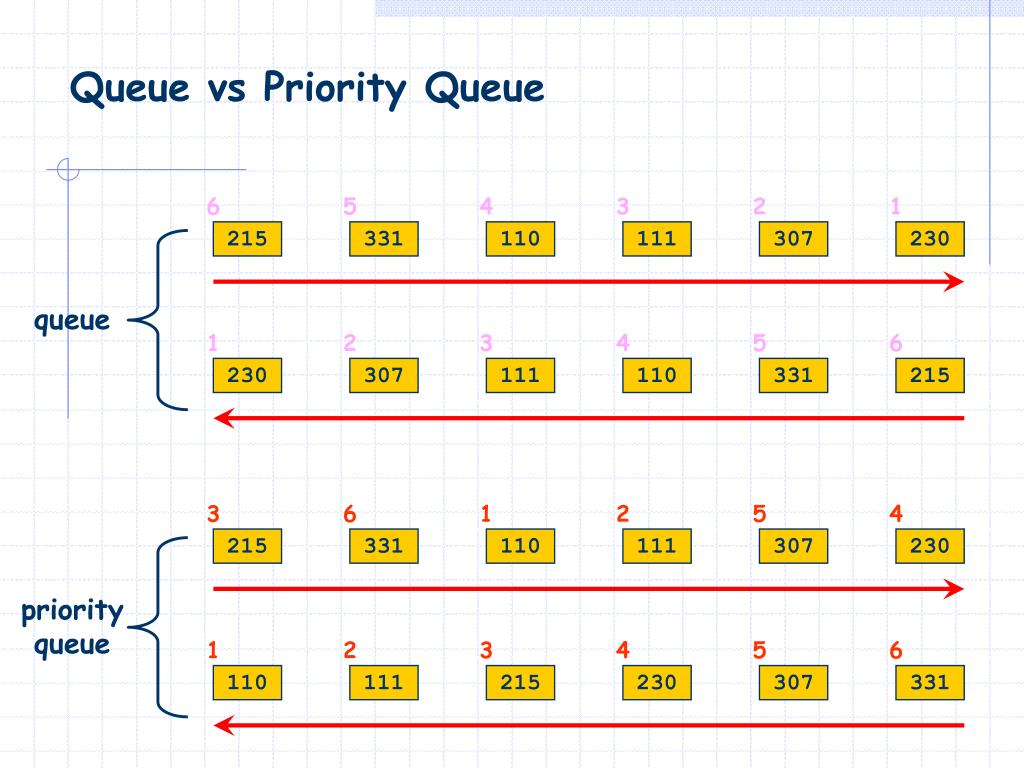
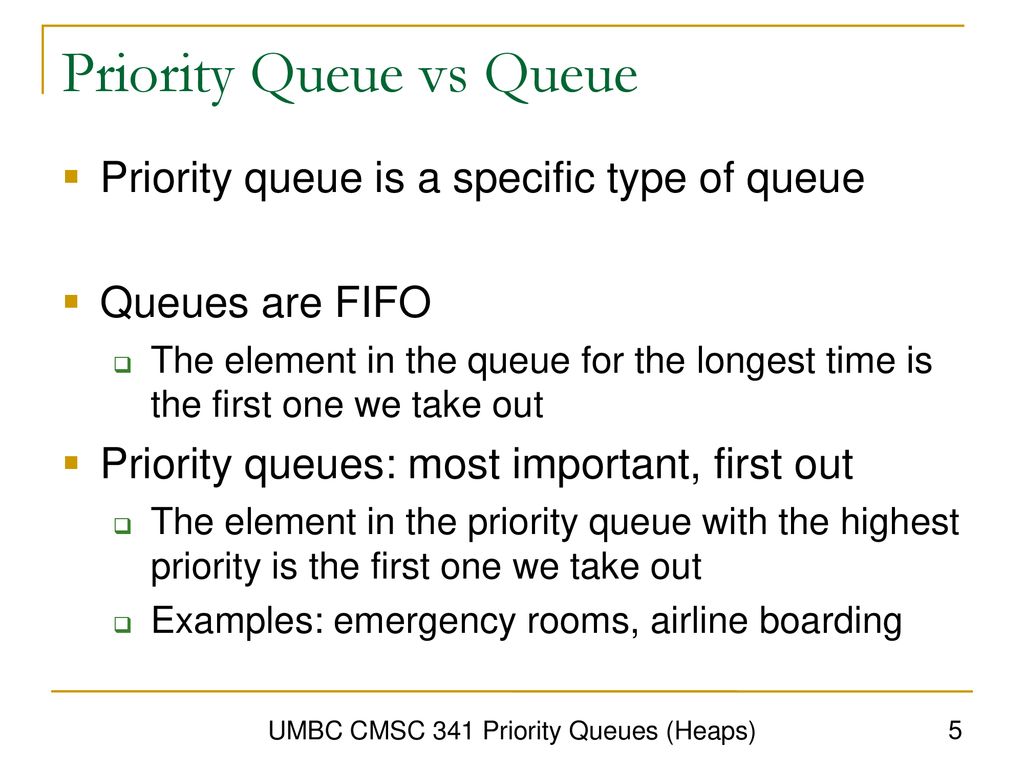
Imagine you're waiting in line for the best ice cream in town. A Priority Queue is like a VIP line. The person with the highest "priority" (maybe they pre-ordered the double-scoop waffle cone extravaganza) gets to cut to the front. The order isn't necessarily based on when they arrived, but on their priority level.
Must Read
A Monotonic Queue, on the other hand, is a bit more…organized. Think of it as a line where the "coolest" people are always at the front, and everyone else in the line is, well, less cool (in a strictly comparative sense, of course!). This "coolness" is based on a specific criteria that's always increasing (monotonic increasing) or always decreasing (monotonic decreasing). Think of it like a line to meet the biggest celebrity ever and everyone else is progressively less famous.
Priority Queues: The VIP Treatment
Priority queues are all about prioritization. You throw a bunch of elements in, and when you ask for something back, you get the one with the highest (or lowest, depending on how you set it up) priority. Need the highest priority task from a list of errands? Priority queue. Want to find the shortest path through a network? Priority queue to the rescue!
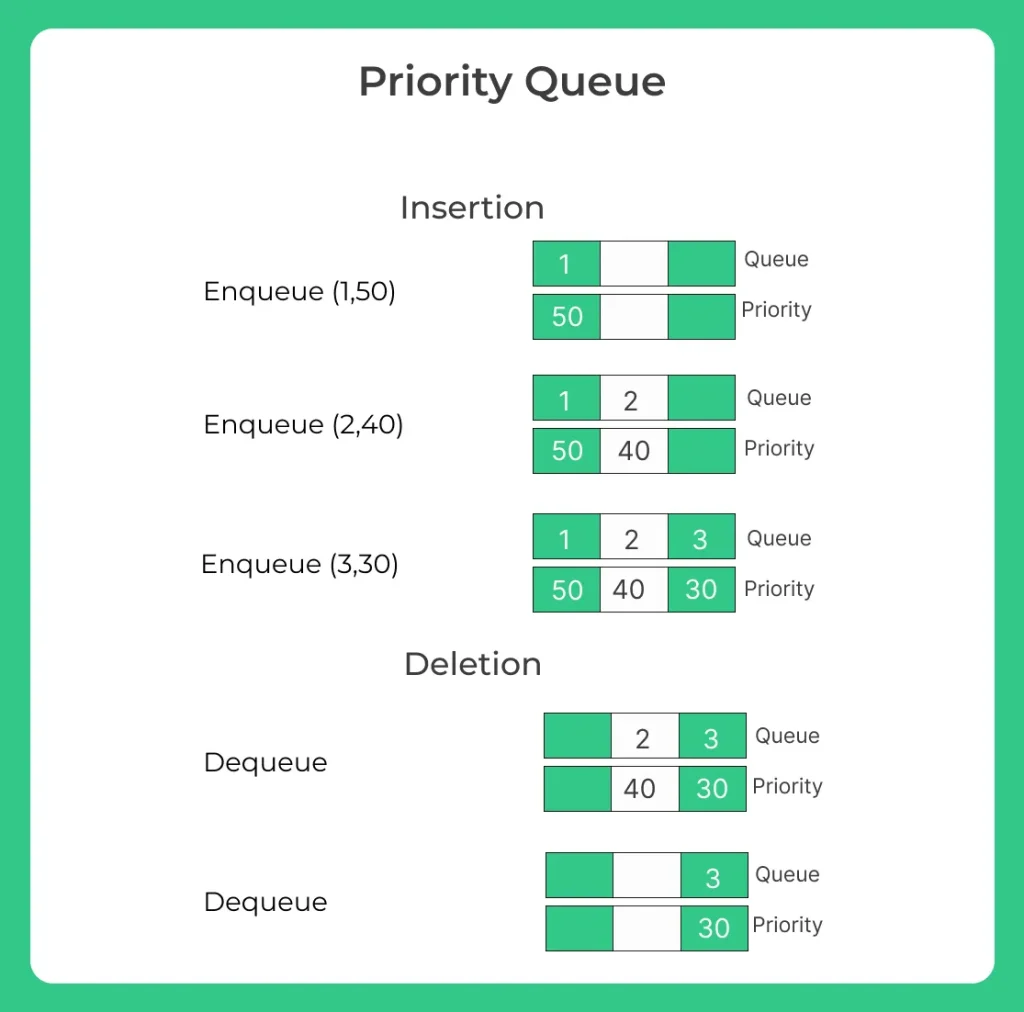
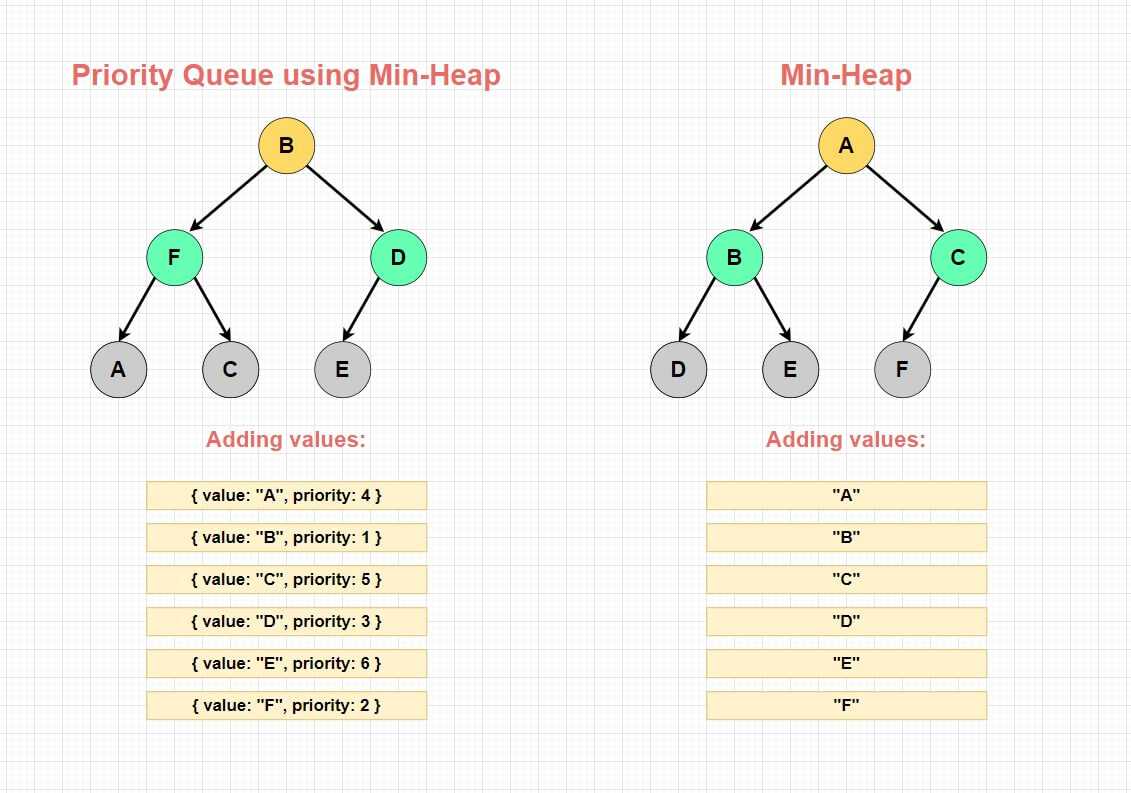
Technically, priority queues are usually implemented using something called a heap. Don't let that scare you! Just picture a neatly organized pile where the most important item is always easily accessible on top. Why is that useful? Well, you can quickly grab the most important thing without having to sort through the whole pile every time. Pretty neat, huh?
Monotonic Queues: Keeping it Sorted (and Special)
Now, let's dive into the world of Monotonic Queues. These queues maintain a special property: their elements are always in either increasing or decreasing order. So, what is the buzz about Monotonic Queues?
They're incredibly useful when you need to efficiently find the maximum or minimum element within a sliding window. What's a sliding window? Imagine you're looking at a series of data points, and you want to know the biggest value in each consecutive chunk of a certain size.
Let’s say you want the maximum temperature from a list of daily temperatures in each three-day period. With a monotonic queue, you don’t need to check the entire three days every time. You just keep the queue in decreasing order and the element at the front will always be the largest value in the current window! How awesome is that!
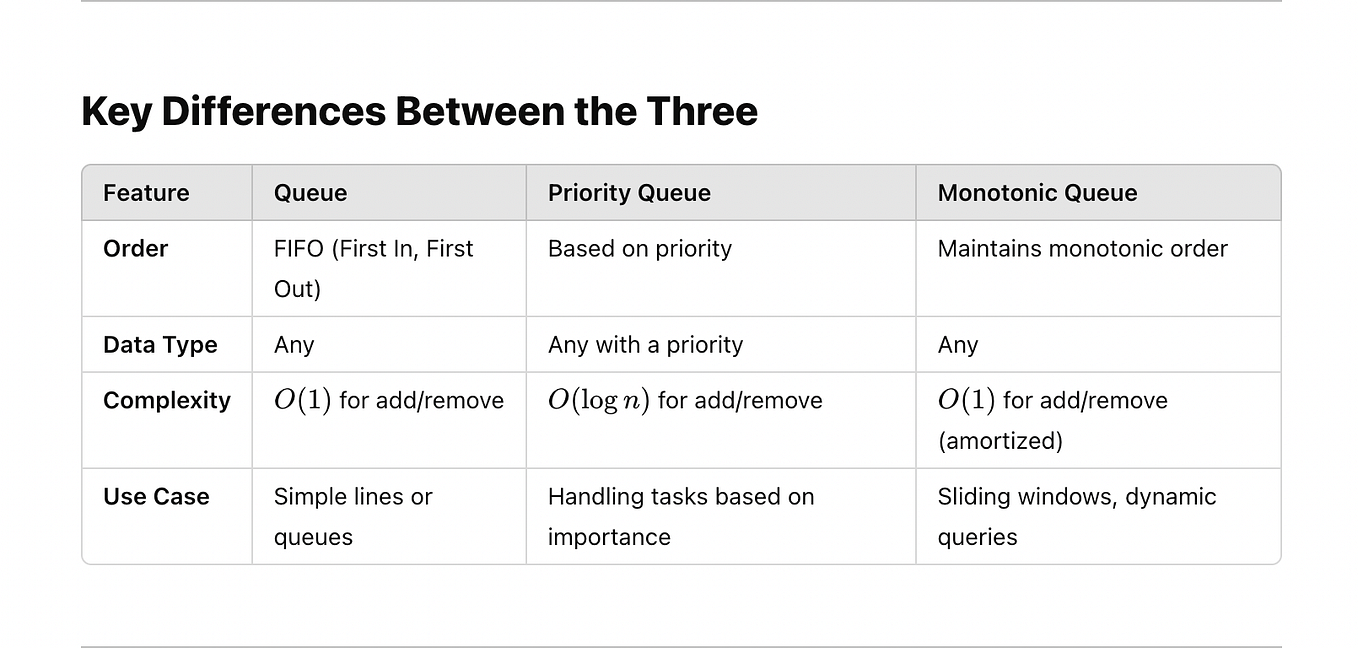
The Key Differences: A Quick Recap
Let's break down the fundamental differences:
- Purpose: Priority queues are all about retrieving the highest (or lowest) priority element, while monotonic queues are about maintaining order and efficiently finding maximums or minimums within a sliding window.
- Order: Priority queues order elements based on priority; monotonic queues maintain a strictly increasing or decreasing order.
- Implementation: Priority queues are often implemented using heaps; monotonic queues can be implemented using deques (double-ended queues).
Think of it this way: a priority queue is like a hospital emergency room – patients are seen based on the severity of their condition. A monotonic queue is like a perfectly curated art gallery - the paintings are arranged in a very specific sequence.
Why Should You Care?
Okay, so these sound cool, but why bother learning about them? Because they can significantly optimize your code!. These data structures can help you solve certain problems much more efficiently than traditional approaches. Plus, understanding them shows you have a deeper grasp of data structures and algorithms, which is always a good thing!
Plus, who doesn't want to impress their friends (or interviewers!) with their knowledge of obscure-yet-powerful data structures?
So, there you have it! A friendly introduction to the Monotonic Queue vs. the Priority Queue. Hopefully, this has demystified these concepts and sparked your curiosity to explore them further. Happy coding!