Is C2h2 Polar Or Nonpolar
Ever wonder why oil and water don't mix? Or why certain smells linger while others disappear quickly? A lot of it comes down to whether a molecule is polar or nonpolar. It might sound complicated, but it's a fundamental concept in chemistry with fascinating real-world implications! Today, we're diving into a specific molecule, acetylene (C2H2), also known as ethyne, to figure out: is it polar or nonpolar?
So, why is understanding polarity important? Imagine molecules as tiny magnets. Polar molecules have a positive and negative end, like a magnet. Nonpolar molecules, on the other hand, are more evenly distributed, with no strong positive or negative charges. This "magnetic" nature dictates how molecules interact with each other. It influences everything from solubility (will it dissolve in water?) to boiling points (how easily does it turn into a gas?). Knowing whether a molecule is polar or nonpolar helps us predict its behavior and its usefulness in various applications.
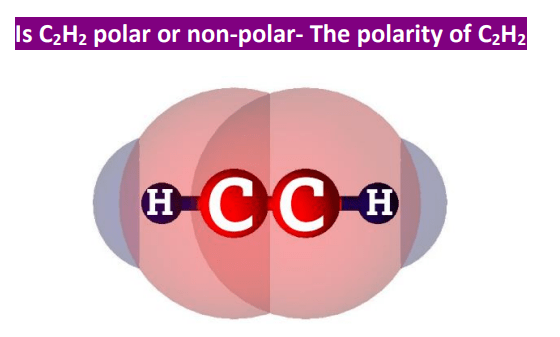
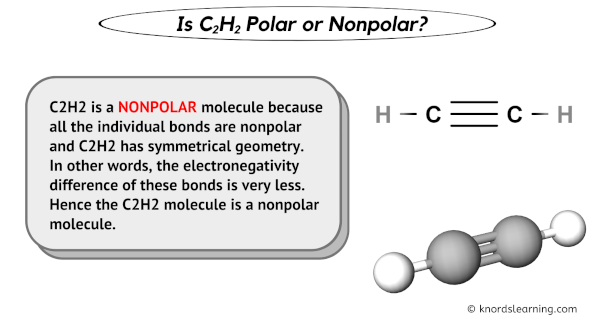
Acetylene (C2H2) is a simple molecule consisting of two carbon atoms triple-bonded together, with each carbon also bonded to a hydrogen atom. The purpose of determining its polarity helps us understand its chemical properties. For example, it can affect how it reacts with other chemicals, its physical state at room temperature, and its use in industrial applications. Ultimately, understanding acetylene's polarity allows us to control and leverage its characteristics for specific needs.
Must Read
So, the big question: is acetylene polar or nonpolar? The key here is to consider both the electronegativity of the atoms and the geometry of the molecule. Electronegativity refers to an atom's ability to attract electrons in a chemical bond. Carbon and hydrogen have relatively similar electronegativities. More importantly, acetylene is a linear molecule. The C-H bonds are arranged symmetrically around the carbon-carbon triple bond. Because of this symmetry, the small dipoles (differences in charge) created by the slight difference in electronegativity between carbon and hydrogen cancel each other out. This means there's no overall net dipole moment for the molecule. Therefore, acetylene is considered a nonpolar molecule.

Acetylene has many uses. One major application is in welding and cutting metals. When burned with oxygen, it produces an extremely hot flame. In education, acetylene is often used as an example in chemistry classes to illustrate concepts such as bonding, hybridization, and, of course, polarity. In daily life, while you might not directly encounter pure acetylene, it's a key ingredient in the production of various plastics and other chemicals found in everyday products.
Want to explore this further? A simple way to get a feel for polarity is to experiment with different liquids. Try mixing oil and water (nonpolar and polar, respectively – they won't mix!). Then, try mixing water and rubbing alcohol (both polar – they will mix!). You can also look up the electronegativity values of different elements online and try to predict the polarity of simple molecules using their Lewis structures. Understanding the principles of polarity allows you to better understand the world around you!