
Is 101 A Prime Or Composite Number
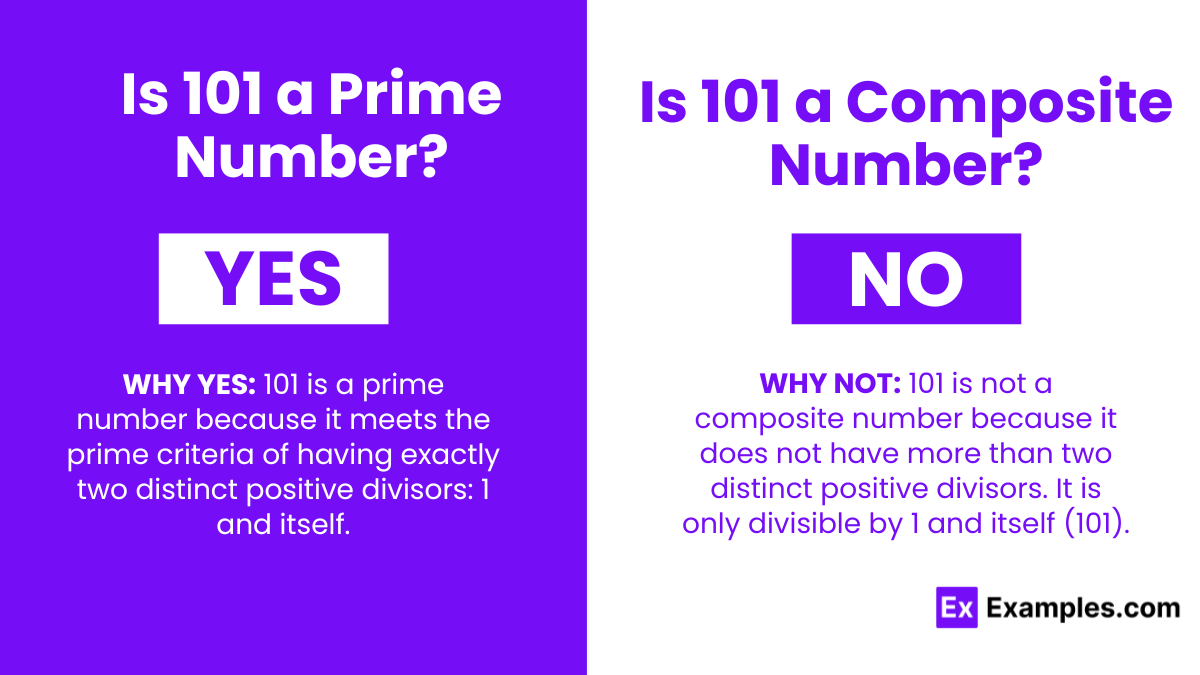
Hey there, math adventurer! Ever find yourself staring at a number, wondering about its secret life? Well, today we're diving into the fascinating world of numbers to uncover the truth about 101. Is it a prime number, shining in its solitary glory, or is it a composite number, a team player with multiple factors? Let's find out!
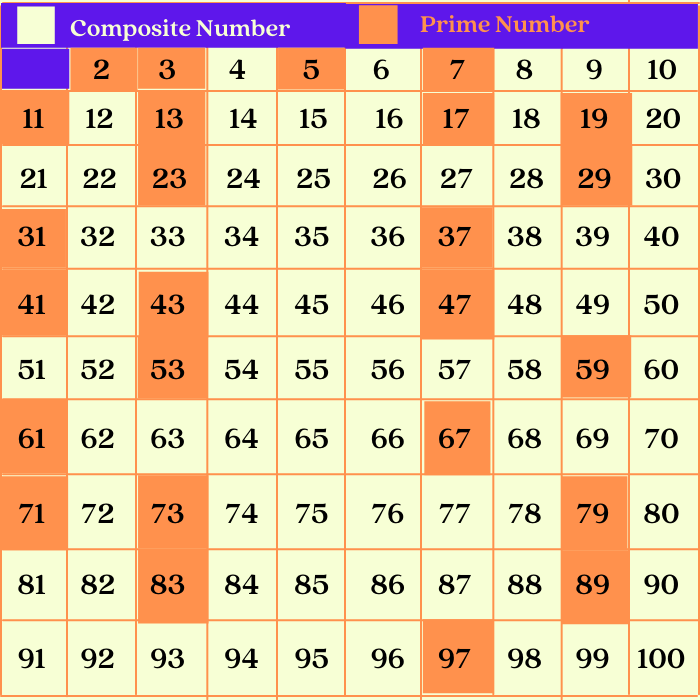
Now, before your eyes glaze over at the thought of numbers (don't worry, it's not as scary as that calculus textbook from college!), let's quickly recap what prime and composite numbers actually are. Think of it like this: a prime number is like a fiercely independent individual, only divisible by 1 and itself. It doesn't share its factors with anyone else! Think 2, 3, 5, 7, 11… solo artists of the number world.
On the other hand, a composite number is more of a social butterfly. It loves having factors beyond just 1 and itself. For example, 4 is divisible by 1, 2, and 4. It's part of a team, a community of factors! You following me? Good!
Must Read
So, is 101 Prime or Composite? The Big Reveal!
Alright, drumroll please… da-da-da-dum! The answer is… 101 is a prime number!
That's right! It's a loner, a maverick, a number that only hangs out with 1 and 101. You can try dividing it by 2, 3, 5, 7, or any other number less than its square root (approximately 10), and you'll find that it doesn't divide evenly. No integer results here, folks!
"But why does this even matter?" I hear you ask. Well, understanding prime numbers is like having a secret key to the universe of mathematics. They're the building blocks of all other numbers! They're used in cryptography (keeping your online data safe!), computer science, and all sorts of other cool applications.
Think of it this way: prime numbers are like the atoms of the number world. Everything else is built from them. It’s pretty mind-blowing when you think about it!

Why Should You Care About Prime Numbers? Because Math is Fun! (Seriously!)
Okay, I know what you're thinking: "Math? Fun? You're pulling my leg!" But hear me out. Exploring numbers, patterns, and the relationships between them is like solving a puzzle. It's engaging your brain, sharpening your mind, and uncovering hidden beauty in the world around you.
Finding that 101 is a prime number isn't just some abstract fact; it's a moment of discovery! It's a little victory for your brain. And the more you learn about math, the more you'll see it everywhere, from the Fibonacci sequence in nature to the golden ratio in art and architecture.
Plus, knowing things like this can impress your friends at parties. Imagine casually dropping, "Did you know 101 is a prime number?" Instant intellectual status! (Okay, maybe not instant, but you get the idea.)
![Is 101 a Prime Number or Composite Number [Why & Why not Detailed Guide]](https://images.examples.com/wp-content/uploads/2024/03/Is-101-a-Composite-Number.png)
It’s about appreciating the elegance of numbers and how they fit together. Each prime number is unique and special. Who wouldn’t want to learn more?
Embrace the Joy of Learning!
So, we've conquered the mystery of 101. But don't stop there! There's a whole universe of mathematical wonders waiting to be explored. Delve into number theory, explore different types of numbers, and discover the patterns that connect them all. You might be surprised at how much you enjoy it!
Think of learning as an adventure, a quest for knowledge that will enrich your life in unexpected ways. Never stop being curious. Never stop asking questions. And never stop exploring the amazing world of mathematics.
Who knows, maybe you will be the one to discover the next big prime number! Or, at the very least, you'll have a fascinating conversation starter at your next gathering. Either way, you've gained something valuable: a deeper understanding of the world around you.
So go forth and explore! Embrace the joy of learning, and remember that even the simplest questions can lead to the most profound discoveries. And now, go find another number and see if it's prime or composite. The number world awaits!