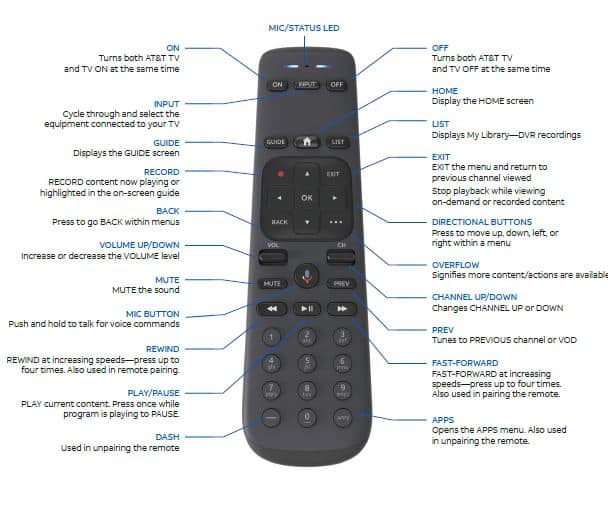
Ah, the humble remote control. It sits there, usually nestled between couch cushions or precariously balanced on a coffee table. Most of the time, it’s a silent servant, merely a conduit to your favorite reality show or that movie you've been meaning to watch. But then comes the day. The day you need it to do more. The day it asks you to program it. Specifically, an AT&T remote control.
Now, some might tell you this is a straightforward process. A few button presses, a quick code, and boom, you're controlling your whole entertainment empire. And to those people, I say: Are we even living on the same planet? Because in my experience, programming an AT&T remote feels less like a task and more like a sacred, ancient ritual.
The Sacred Text (a.k.a. The Manual)
It usually starts with the manual. Or rather, the desperate search for it. You know, that thin pamphlet filled with minuscule text, printed in a font so small it feels like a test of your ocular fortitude. It's often tucked away in a junk drawer, mingling with expired coupons and a single, lonely battery. Once found, you hold it like an archaeologist uncovering a lost scroll. The wisdom within! The secrets of universal control!
"Press MENU, then SETTINGS, then REMOTE CONTROL..."
It reads like a prophecy, doesn't it? Each step is a gateway. Each instruction, a cryptic clue. You follow along, finger hovering over the specified buttons, a mixture of hope and deep-seated skepticism brewing in your soul. Because you've been here before. You've answered the call of the remote, only to be met with silent, blinking defiance.
How To Program the AT&T UVerse Remote
The Enigmatic Codes
Then come the codes. Oh, the glorious, bewildering codes! A list of four or five-digit numbers, each one supposedly the digital DNA of your television or audio receiver. You're told to try them, one by one. It’s like being a digital locksmith, patiently trying a myriad of keys in a stubborn lock. You input the first code, holding your breath, pressing the power button on the remote, aiming it at the television like a seasoned marksman. Nothing. Not a flicker. Not a sigh of recognition.
Okay, deep breaths. This is part of the journey. The manual, in its infinite wisdom, usually has a disclaimer: "If the first code doesn't work, try the next one." It’s the remote control equivalent of "if at first you don't succeed, try, try again." Except here, "again" might mean trying twenty times, with increasing levels of muttered frustration.
How to Program an AT&T U-verse Remote Control
You try the second code. Still nothing. The third. A faint glimmer of hope, quickly extinguished. By the fourth or fifth code, you’re no longer merely pressing buttons; you’re performing a highly choreographed dance, a ritualistic offering to the tech gods. Your posture changes. Your brow furrows. You might even start talking to the remote, reasoning with it, pleading.
"Come on, little plastic rectangle. We can do this together. Just one tiny signal, that's all I ask!"
How to Program an AT&T U-verse Remote Control
The Moment of Truth (or Defeat)
And then, sometimes, it happens. After what feels like an eternity of digital incantations, after a series of button presses that would baffle a secret agent, the television responds! It powers on! Or the volume adjusts! A wave of triumph washes over you. You've done it! You've tamed the wild beast of home entertainment. You are a wizard, a programmer, a master of your domain!
Other times, well, other times you just give up. You decide that two remotes are fine. Three remotes, even. Why fight fate? Why argue with a piece of plastic that clearly has a mind of its own? The programming quest is abandoned, not because you failed, but because the remote simply wasn't ready to be programmed. It wasn't its time.
Here’s my "unpopular" opinion, the one nobody wants to admit: Programming an AT&T remote isn’t about following instructions logically. It's about cosmic alignment. It’s about being in the right mood, at the right time, with the right amount of desperate optimism. The codes are merely suggestions, and the manual? A loose framework for a spiritual journey. We don't program the remote; the remote programs us. It teaches us patience. It teaches us humility. And occasionally, it teaches us the profound satisfaction of making a tiny light blink in response to our will. So next time you embark on this grand adventure, remember: You’re not just programming a remote. You’re engaging in a time-honored tradition of technological mystery.