
How To Calculate Kw Hours

Ever stared at your electricity bill and wondered if tiny energy gremlins were having a disco party in your house? You’re not alone! But what if I told you that understanding how much power your gadgets consume is not just easy, it’s downright fun?
No more mysteries, no more head-scratching! We're about to embark on a thrilling adventure to decode the secret language of your appliances. Get ready to become an energy wizard!
Step 1: Meet the Mighty Watt!
First things first, let's talk about Watts. Think of Watts as the "muscle" of your appliance. It's how much oomph it needs to get the job done.
Must Read
A little light bulb might just sip a tiny bit of power, showing off its delicate Wattage. But that mighty toaster, turning bread into crispy perfection? Oh, it flexes some serious Watt power!
Where do you find this magical number? It’s usually printed right on the appliance itself! Look for a label, often near the power cord or on the back. It might say "W" or "Watts."
Pro Tip: If you can't find it on the gadget, a quick online search for "[Appliance Name] Wattage" will usually give you the answer faster than you can say "electrocution!" (Just kidding, it's perfectly safe!)
Finding Your Appliance's "Power Punch"
Let's grab a few examples! Your trusty desktop computer, maybe running a super-intense game, could be a hearty 300 Watts. Your coffee maker, brewing that morning magic, might be a robust 1000 Watts.
And that little LED light bulb, just softly illuminating your reading nook? It’s probably a super-efficient 10 Watts or less! See? Different gadgets have different "muscles."
Jot down the Wattage of a few items you're curious about. This is your first clue in solving the energy mystery!
Step 2: Tick-Tock! How Many Hours?
Now that we know how much "muscle" your appliance has, let's figure out how long it's actually working. This is the Hours part of our equation!
It’s simple: how many hours is the gadget switched on and doing its thing? Your fridge, for example, is basically on 24/7 (though it cycles its compressor).
Your hairdryer, on the other hand, might only scream to life for a glorious 15 minutes each morning. We need to convert that into hours!
Remember: 15 minutes is 0.25 hours (15/60). 30 minutes is 0.5 hours. Easy peasy!
Measuring the "Party Time" of Your Gadgets
Think about your favorite Netflix binge. If you watch a whole season of your current obsession, that TV might be on for 8 solid Hours! That's a lot of screen time!
Or what about your charging phone? It might be plugged in overnight for 7-8 Hours. Even when fully charged, some chargers still draw a tiny trickle of power.
This step requires a little bit of detective work and honest observation. How long do you really use that gaming console, or keep your fan whirring?
The Dynamic Duo: Watt-Hours (Wh)
Alright, we have our two heroes: Watts (the muscle) and Hours (the time). Now, let's bring them together for their grand debut!
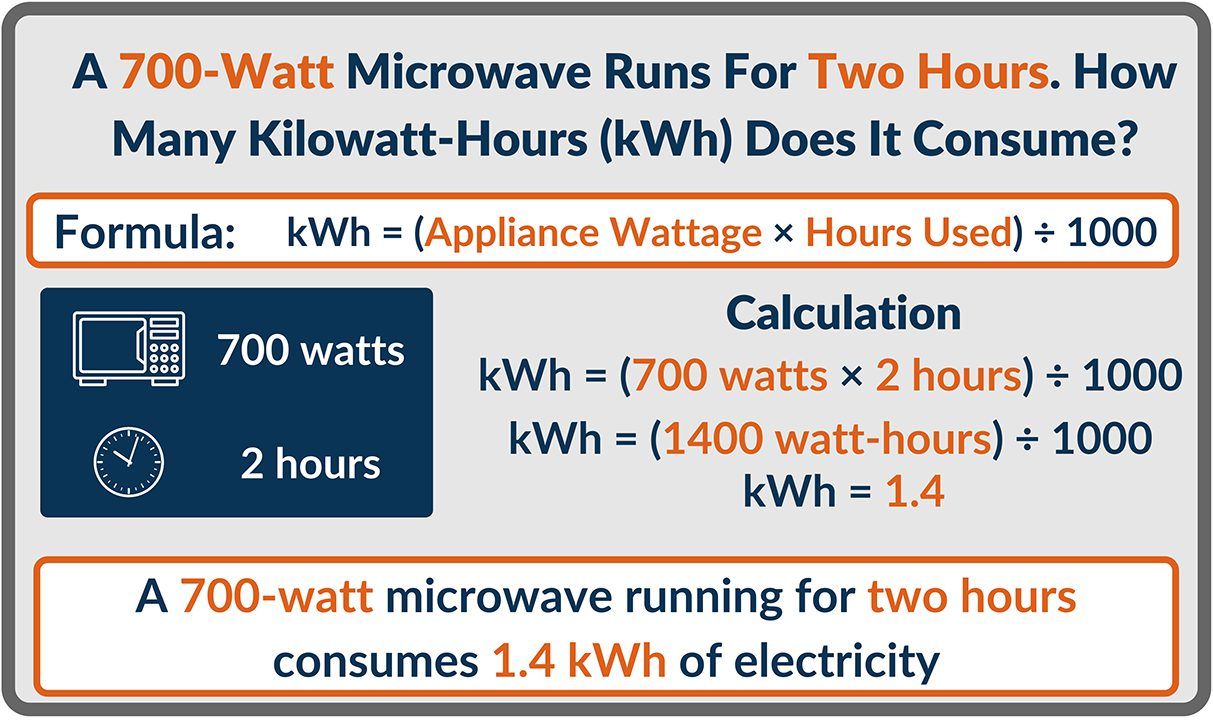
To find the total Watt-Hours (Wh) an appliance uses, you simply multiply its Wattage by the number of Hours it’s on. It’s like magic, but with math!
So, if your coffee maker is 1000 Watts and you use it for 0.5 Hours (30 minutes) every morning, that’s 1000 W * 0.5 h = 500 Wh.
When Watts and Hours Become Best Friends
Let's try another one! Your super-bright reading lamp with a 60 Watt bulb (the old kind!) stays on for 4 Hours every evening.

That's 60 W * 4 h = 240 Wh. Not too shabby, right? You're practically an energy accountant now!
This Watt-Hour number tells you the raw energy consumption for that specific usage period. It's a fantastic stepping stone!
Enter the Kilo! (The "K" Factor)
Sometimes, when we talk about energy, these Watt-Hour numbers can get a little... BIG. We're talking hundreds, thousands, even millions!
To make things easier to manage, we introduce a special little helper: the Kilo! "Kilo" simply means "a thousand."
Think of it like this: 1000 grams is 1 kilogram. 1000 meters is 1 kilometer. And you guessed it, 1000 Watt-Hours is 1 Kilowatt-Hour.
Taming the Big Numbers with a Tiny "k"
This little "k" is our secret weapon for shrinking those enormous energy numbers into something much more friendly and easy to read on your bill.
It saves us from having to write out "500,000 Watt-Hours" and lets us say "500 Kilowatt-Hours" instead. Much neater, isn't it?
Remember: Kilo is just a fancy way of saying "divide by 1000." So simple!
Behold! The Glorious Kilowatt-Hour (kWh)!
And now, for the grand finale! This is the unit your electricity company uses to charge you. It’s the famous Kilowatt-Hour, or kWh for short.
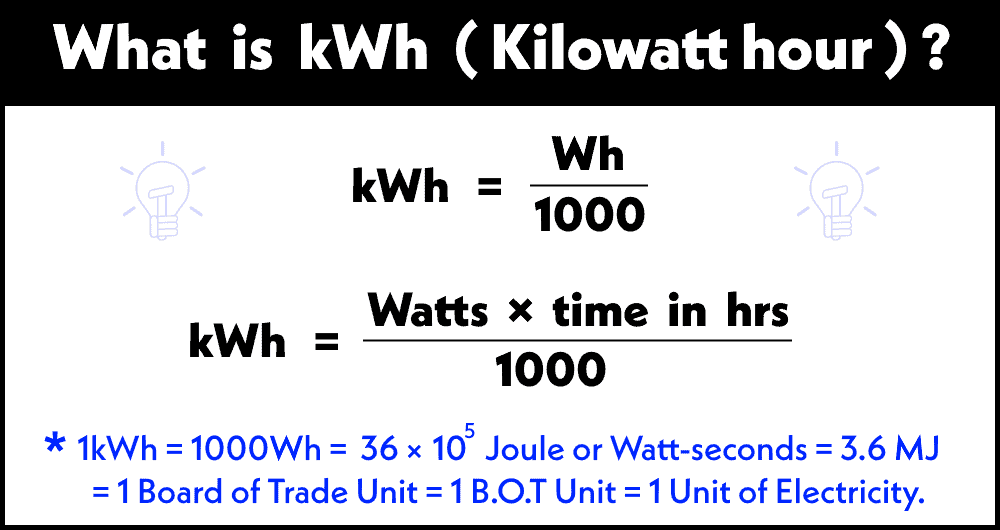
To get from our chunky Watt-Hours to the sleek Kilowatt-Hours, we just take our Wh number and divide it by 1000. That’s it!
So, if your coffee maker gave us 500 Wh, dividing that by 1000 gives us 0.5 kWh. Ta-da!
Your Magical Energy Unit Revealed!
Let’s try another example. Our ancient 60 Watt lamp running for 4 Hours generated 240 Wh.
Divide 240 by 1000, and you get 0.24 kWh. You've just calculated the magic number your utility company uses!
You are now officially fluent in the language of electricity bills. Feel the power!
Putting It All Together: A Grand Adventure!
Let's imagine your awesome monster gaming PC, sucking down a magnificent 500 Watts when it's running full throttle.
And let's say you game like a champion for 6 Hours every day after work. That's some serious dedication!
First, the Watt-Hours: 500 Watts * 6 Hours = 3000 Wh. That's a lot of little energy bites!

Your Fridge, Your Gaming Rig, Your Savings!
Now, for the big reveal in Kilowatt-Hours: 3000 Wh / 1000 = 3 kWh.
So, your epic gaming session uses 3 kWh of electricity. You can then multiply that by the rate your electricity company charges per kWh (check your bill!) to see its daily cost.
What about your ever-present refrigerator? Let's say it's 150 Watts and runs about 12 Hours a day (it cycles on and off).
That’s 150 Watts * 12 Hours = 1800 Wh. Divide by 1000, and you get 1.8 kWh.
It’s truly empowering to know these numbers! You can start to spot your own personal energy "superstars" and "energy hogs."
You Are Now an Energy Wizard!
See? It wasn't scary at all! You've just mastered the art of calculating Kilowatt-Hours. Give yourself a pat on the back!
Now you can look at your appliances with a newfound understanding, knowing exactly what's ticking away on your energy meter.
Go forth, informed and enlightened energy wizard, and amaze your friends with your newfound powers!