
How Many Gallons Of Gas Are In A Barrel

We all know the drill, don't we? That familiar sight of the gas pump. Watching the numbers climb, often with a slight sigh.
You’re just trying to get from A to B. Filling up the tank is a necessity, a modern ritual.
But have you ever paused to think about where that magical liquid comes from? Not just the station, but its origins?
Must Read
There's a term you hear bounced around a lot in the news: the barrel. Oil prices are always quoted per barrel.
It sounds so straightforward, doesn't it? A barrel of oil. You picture a big, wooden cask, full to the brim.
So, here’s the million-dollar question, the one that probably keeps you up at night: How many gallons of gas are in a barrel?
You might think, "Well, a barrel is a barrel, right? So it must be a full barrel of gas!"
Spoiler alert! If only it were that simple. The truth is, it's a bit more complicated, and frankly, a little confusing.
This is where my slightly "unpopular opinion" comes in. The whole barrel thing is a bit of a misdirection.
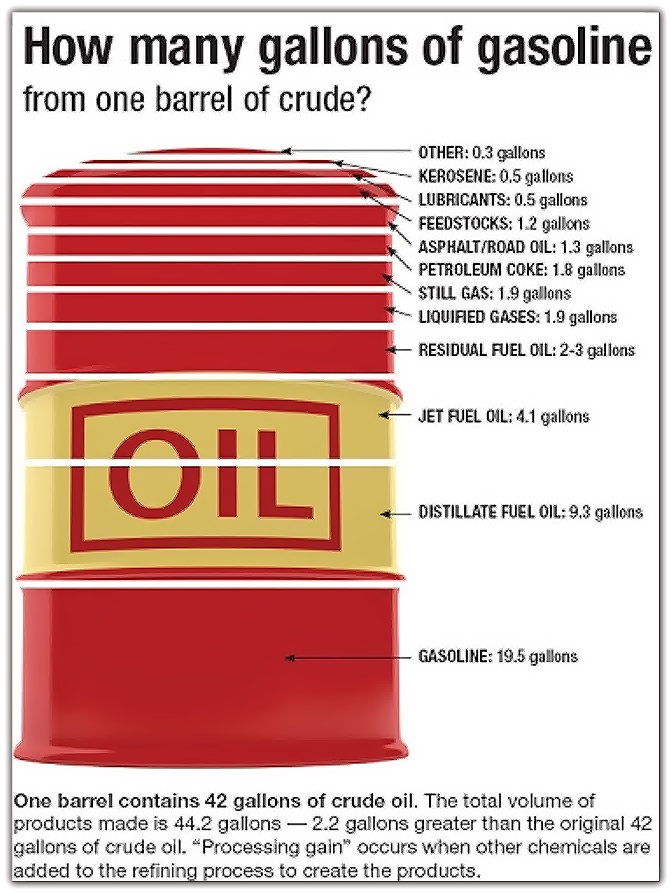
Ready for the first big reveal? A barrel, in the oil world, is a unit of measurement. Specifically, it's 42 U.S. gallons.
But here's the kicker: it’s 42 gallons of crude oil. Not the refined, ready-to-use gasoline that powers your engine.
![How to Convert Gallons to Barrels [Conversion Chart] – PowerSportsGuide](https://powersportsguide.com/wp-content/uploads/2021/02/gasoline-weight-per-gallon-1024x683.jpg)
Imagine buying a big sack of flour. You wouldn't say, "How many cookies are in this sack of flour?" You need to do some baking first!
That crude oil is the raw ingredient. It’s a thick, dark, gloopy substance. Not exactly something you'd want to pour into your tank directly.
It's a mix of all sorts of hydrocarbons. Some good for gasoline, some better for other things. Think of it as nature's own mystery cocktail.
So, if a barrel is 42 gallons of crude, where does the gasoline come from? This is where the real magic, or rather, science, happens.
Enter the oil refinery. These are the modern-day alchemists. They take that barrel of crude and work wonders with it.
They heat it up. They cool it down. They separate its components through a process called fractional distillation.
Sounds fancy, doesn't it? Basically, they're sorting out all the different bits and pieces inside that crude barrel.
And what a treasure trove that barrel turns out to be! It doesn't just give us gasoline.
Oh no, that humble barrel contributes to so much more. It's a true multi-tasker of the petroleum world.
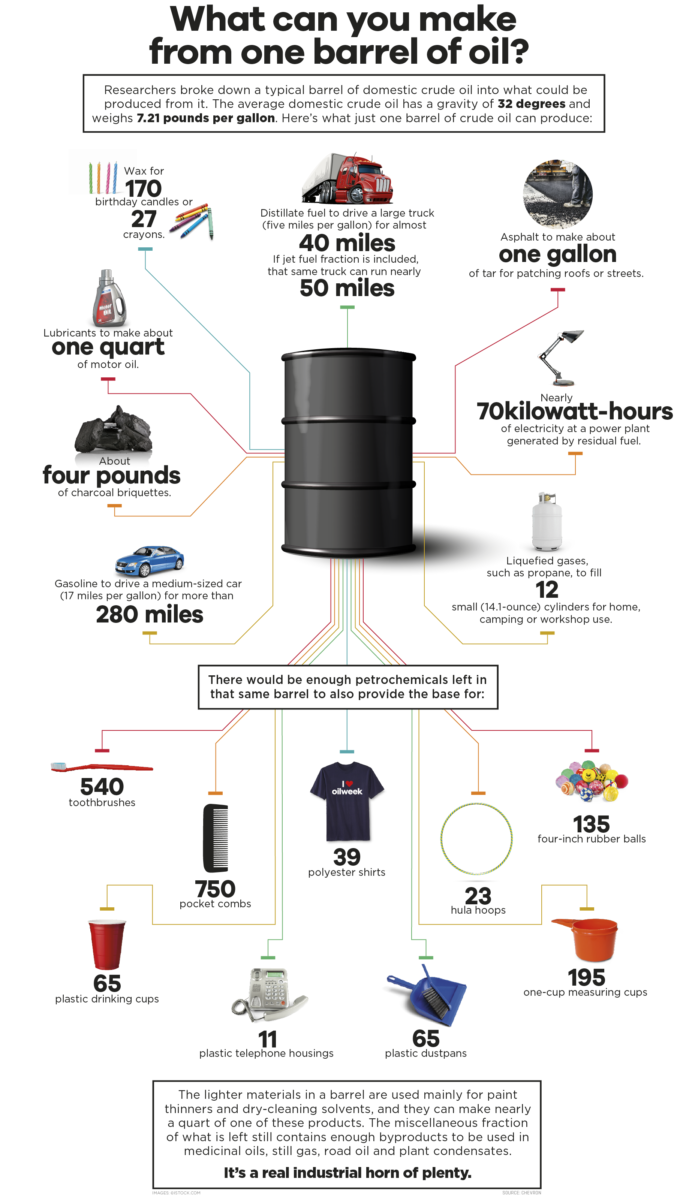
From one barrel of crude oil, you get many different products. Each one essential in its own way.
There's diesel fuel, powering our trucks and buses. There's jet fuel, sending planes soaring into the sky.
You also get heating oil for keeping homes warm. And lubricants to keep our machines running smoothly.
Even things like asphalt for our roads come from that same barrel. And petrochemicals, the building blocks for plastics and other materials.
Yes, your toothbrush, your phone case, even some of your clothes. They might owe a tiny bit of their existence to that crude barrel.
So, let's get back to our original question: How many gallons of gas are in a barrel? The specific, refined stuff for your car?
Are you ready for the big reveal? It’s not 42 gallons. Not even close.
From that initial 42-gallon barrel of crude oil, you get approximately 19 to 20 gallons of gasoline.
Let that sink in for a moment. Less than half! It's like ordering a whole pizza and only getting two slices of actual pepperoni goodness.
This is precisely where my "unpopular opinion" flares up. Why do they call it a barrel if less than half is actually gasoline?
It feels a bit like a sleight of hand, doesn’t it? A term that sounds big and plentiful, but the actual gas yield is much smaller.
Why can't we just talk about gallons of gasoline yield per barrel of crude? It would be so much clearer for us regular folks.
Imagine if bakeries said, "We process a barrel of flour!" when they mean they make a few dozen loaves.
It’s confusing! We consumers are constantly trying to understand gas prices. And this "barrel" terminology adds an unnecessary layer of mystery.
It’s not just an academic point either. When you hear "oil prices per barrel are up," you naturally think more gallons of gas are costing more.
But it's actually just the price of the raw ingredient going up. The processed end product is still only those precious 19-20 gallons.

It's like a grand illusion. The "barrel" is the star of the show. But the true hero for your car is just a fraction of it.
So, the next time you're at the pump, take a moment to appreciate those hard-working 19-20 gallons.
They've been on quite the journey. Separated from their crude siblings, purified, and transformed into the fuel that powers your life.
It's a testament to incredible engineering and chemistry, for sure. Turning thick, black goo into clean-burning go-go juice.
But still, a part of me wishes for simpler terms. Something less misleading than "the barrel."
Perhaps "the crude source unit that yields approximately 19-20 gallons of gasoline." Not quite as catchy, I suppose.
Or maybe, we should just agree that the world of oil measurement is wonderfully complex and slightly theatrical.
Regardless, now you know the secret! The next time someone mentions a "barrel of oil," you can confidently nod, knowing the real story of the gasoline within.
It’s not 42 gallons of gas. It's much less. And that's okay, as long as we understand the magic and the mystery behind it all!