
Guitar How To Play Chords

So, you want to play the guitar, huh? That’s fantastic! You're not alone; millions have picked up this instrument, hoping to become the next Jimi Hendrix, or at least impress their significant other around a campfire. Forget scales for now. We're diving straight into chords, the building blocks of almost every song you've ever heard.
Chord Chaos: A Beginner's Baptism
Let's be honest, seeing a chord diagram for the first time can feel like deciphering ancient hieroglyphics. A grid of lines, numbers, and circles... it’s enough to make anyone reach for a Netflix binge instead. Don't panic! It's much simpler than it looks.
Think of those diagrams as a map to treasure – a musical treasure, that is. Each line represents a string on your guitar, and each dot shows you where to place your finger.
Must Read
The first chord most people learn is E minor (Em). Why? Because it only needs two fingers! It’s the gateway drug to guitar playing. Get this one down, and you'll feel like a rockstar (even if you're just playing to your cat).
Em: The Moody Introvert
Place your middle finger on the 2nd fret of the A string (that's the second thickest string). Then, put your ring finger on the 2nd fret of the D string (right next to the A string). Strum all six strings. Boom! You're playing Em.
It's a slightly melancholic chord, perfect for those introspective moments or covering The Cure. It's the musical equivalent of a rainy day and a cup of hot cocoa.
A Major Revelation (A Major Chord, That Is)
Next up, let’s tackle A major (A). This one's a little trickier, requiring three fingers bunched together. Imagine them as tiny, cramped roommates in a particularly small apartment.
Place your index finger on the 2nd fret of the D string. Then, your middle finger goes on the 2nd fret of the G string (next to the D string). Finally, your ring finger squeezes onto the 2nd fret of the B string (next to the G string). Strum everything but the thickest string (the E string).

A major is a bright, happy chord, the musical equivalent of sunshine and lemonade. It’s the chord that makes you want to tap your foot and sing along, even if you don't know the words.
D Major: The Cheerful Companion
Now for D major (D). This chord is like a friendly hug – warm and welcoming. It involves a bit of finger gymnastics, but it's worth the effort.
Place your index finger on the 2nd fret of the G string. Your middle finger goes on the 2nd fret of the high E string (the thinnest one). Finally, your ring finger lands on the 3rd fret of the B string. Strum everything but the two thickest strings (the E and A strings).
D major is an optimistic chord, perfect for singalongs and campfire tunes. It's the musical equivalent of a puppy wagging its tail.
Chord Changes: The Dance of the Fingers
Learning chords is only half the battle. The real challenge is changing between them smoothly. This is where things can get a little… awkward.
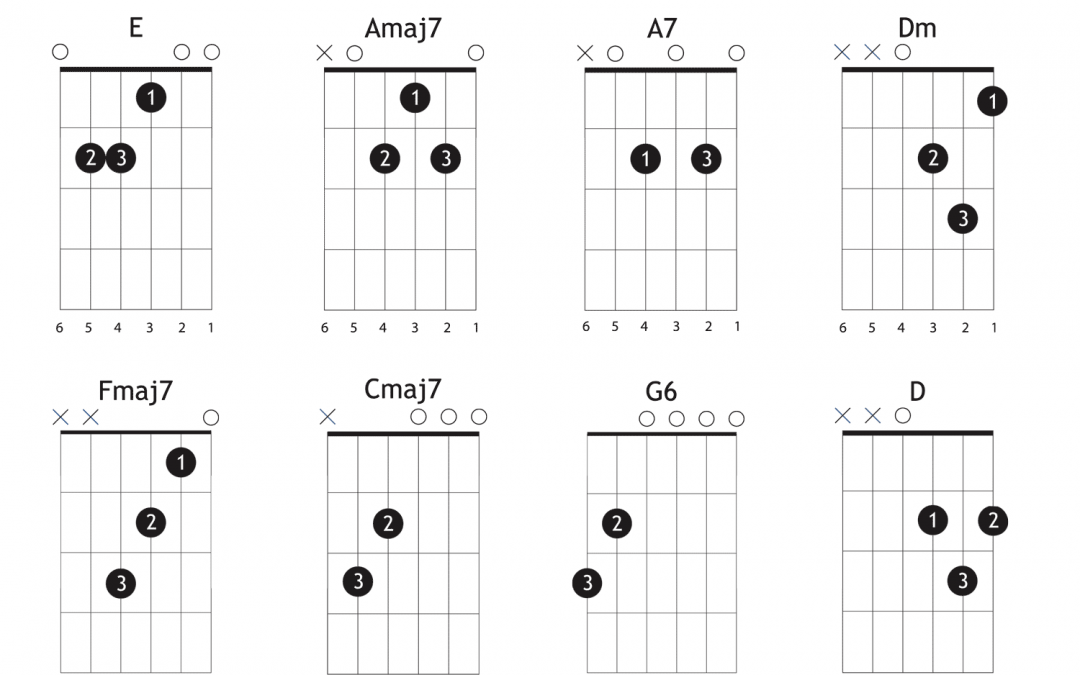
Imagine trying to pat your head and rub your stomach at the same time. That’s what switching between chords can feel like at first. Your fingers will fumble, your wrist will ache, and you'll probably utter a few choice words.
The key is practice, practice, practice! Start slow. Really, really slow. Focus on getting your fingers into the right positions, even if it feels like you're moving in slow motion.
Think of it as learning a dance. You wouldn't expect to be waltzing gracefully after just one lesson, would you? Chord changes are the same – they take time and repetition to master.
The Universal Language: Chord Progressions
Once you've got a few chords under your belt, you can start stringing them together to create chord progressions. This is where the magic really happens! A chord progression is simply a sequence of chords played one after another.
Some chord progressions are so common, they've been used in countless songs. The most famous of these is probably I-V-vi-IV. (Don't worry about the Roman numerals; just think of it as a recipe.)

In the key of G, this would be G - D - Em - C. Try playing these chords in that order. You'll be surprised at how familiar it sounds! You've probably heard it in dozens of songs without even realizing it.
"Music is the universal language of mankind." – Henry Wadsworth Longfellow
Experiment with different chord progressions. Try changing the order of the chords, or substituting different chords in their place. You might stumble upon something truly amazing!
Strumming Patterns: Adding Rhythm to the Mix
Now that you can play chords and change between them, it's time to add some rhythm. This is where strumming patterns come in. A strumming pattern is simply a sequence of upstrokes and downstrokes used to create a rhythmic feel.
Start with a simple down-down-up-up-down-up pattern. This is a common strumming pattern that works well for many songs. Don't be afraid to experiment with different patterns! The key is to find something that feels natural and sounds good.
Listen to your favorite songs and try to identify the strumming patterns they use. Then, try to replicate those patterns on your guitar. This is a great way to learn new techniques and expand your musical vocabulary.

The Joy of Creation: Writing Your Own Songs
Once you've mastered the basics of chords, chord progressions, and strumming patterns, you're ready to start writing your own songs. This is where things get really exciting!
Don't be afraid to be creative and experiment. There are no rules in songwriting! Write about your experiences, your feelings, or anything else that inspires you.
Don't worry if your first few songs aren't masterpieces. The important thing is to keep writing and keep learning. The more you write, the better you'll become.
Playing guitar is a journey, not a destination. There will be times when you feel frustrated and want to give up. But don't! Keep practicing, keep learning, and most importantly, keep having fun.
So, grab your guitar, find a comfortable spot, and start strumming. Who knows? You might just write the next great American song. Or, at the very least, you'll have a lot of fun trying.
And remember, even Eric Clapton started with an E minor chord.