
Greatest Common Factor Of 75 And 45
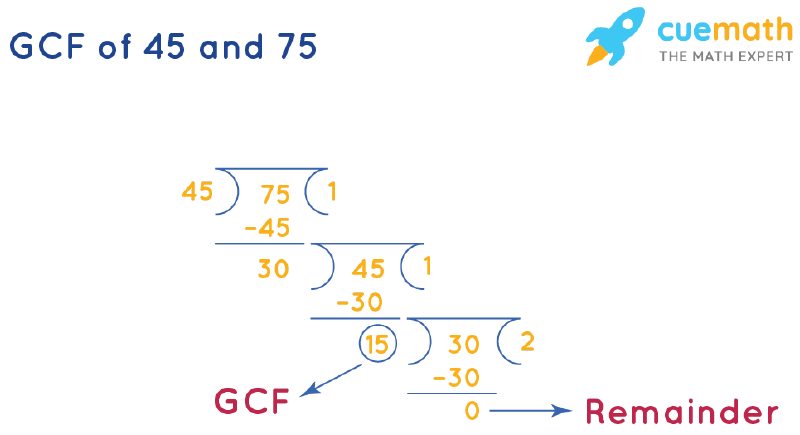
Okay, so picture this: I'm at a bake sale (because, you know, who doesn't love a good bake sale?), and there are these two trays of cookies. One tray has 75 chocolate chip cookies, and the other has 45 oatmeal raisin cookies. (Don't judge my oatmeal raisin preference!). The lady running the sale wants to divide the cookies into identical bags, each with the same number of chocolate chip and oatmeal raisin cookies. She wants the biggest possible bags so she doesn't have a million tiny bags. What's she gonna do? That’s where the Greatest Common Factor (GCF) comes to the rescue!
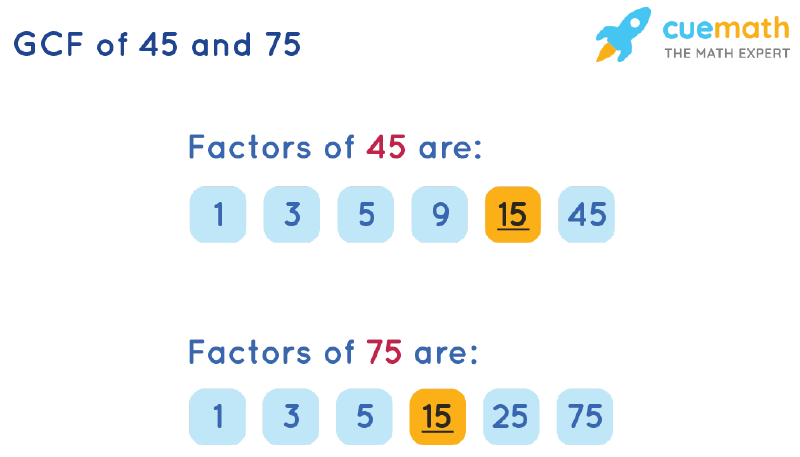
Basically, the GCF is like finding the biggest common link between two or more numbers. It's the largest number that divides evenly into all the numbers you're working with. So, in our cookie conundrum, it's the largest number that divides evenly into both 75 and 45. Think of it as a detective searching for the biggest clue!
Finding the GCF: The Prime Factorization Method
Alright, let's get down to business! One popular way to find the GCF is through prime factorization. Don’t let the name intimidate you; it’s easier than it sounds! Remember prime numbers? Those are numbers only divisible by 1 and themselves (like 2, 3, 5, 7, 11, and so on). We’re going to break down 75 and 45 into their prime number building blocks.
Must Read
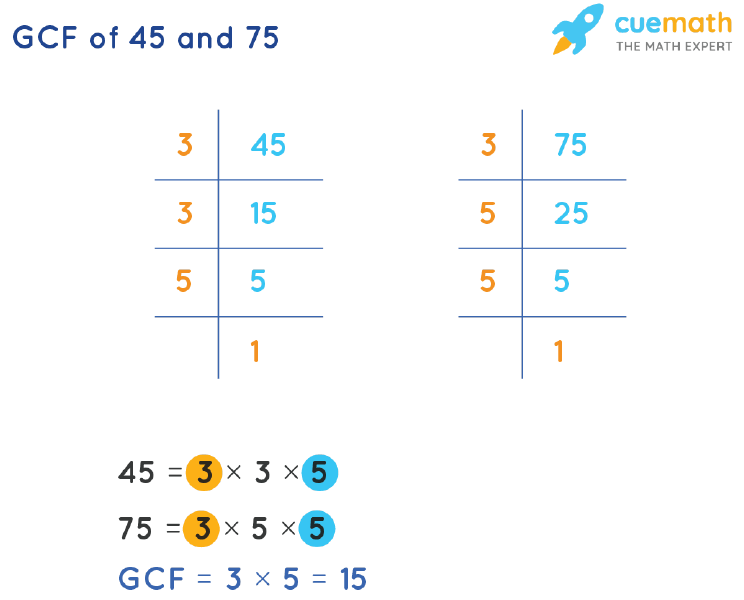
Let's start with 75:
- 75 is divisible by 3: 75 = 3 x 25
- 25 is divisible by 5: 25 = 5 x 5
So, the prime factorization of 75 is 3 x 5 x 5 (or 3 x 52). We can write it down so we won’t forget!
Now, let's tackle 45:
- 45 is divisible by 3: 45 = 3 x 15
- 15 is divisible by 3: 15 = 3 x 5
The prime factorization of 45 is 3 x 3 x 5 (or 32 x 5). Getting the hang of it? I sure hope so!
Putting It All Together
Now, we have:
75 = 3 x 5 x 5
45 = 3 x 3 x 5
The next step is to identify the common prime factors – those that appear in both factorizations. In this case, both 75 and 45 share a '3' and a '5'. Notice there is two 3's in the number 45 but only one 3 in the number 75, so you can only take one 3. Also notice the same thing applies for the number 5.
To find the GCF, we multiply these common prime factors together. So, GCF (75, 45) = 3 x 5 = 15.
Ta-da! The Greatest Common Factor of 75 and 45 is 15. This means the bake sale lady can make 15 bags of cookies, each with 5 chocolate chip cookies (75 / 15 = 5) and 3 oatmeal raisin cookies (45 / 15 = 3). Everyone wins! (Especially those who appreciate a good oatmeal raisin cookie.)
Why Does the GCF Matter?
You might be thinking, "Okay, cool. I can divide cookies now. But what's the big deal?" Well, the GCF isn't just about cookies (though that is a pretty compelling application!). It's a fundamental concept in math that pops up in all sorts of places.
It's useful for:
- Simplifying fractions
- Solving certain types of algebraic equations
- Dividing objects fairly into equal groups (like our cookies!)
So, the next time you're faced with a dividing dilemma, remember the GCF. It's your secret weapon for solving problems and impressing your friends with your newfound mathematical prowess. (Or at least, for efficiently distributing cookies at a bake sale.)
And if you happen to be at that bake sale, save me an oatmeal raisin cookie. I’ll be the one mumbling about prime factorizations. ;)