
Barrels Of Oil To Gallons

Alright, settle in, grab another coffee. I've got a story for you today, and it’s about something utterly bonkers that governs our modern world: oil. Specifically, how we measure the stuff. Because, let’s be honest, it’s a system only a mad Hatter on a caffeine drip could love.
You see, we talk about "barrels of oil" all the time, don't we? Prices go up, prices go down, always by the barrel. But have you ever stopped to think about what that actually means? Do we, like, have giant wooden casks rolling around everywhere? Are oil executives wrestling actual barrels onto ships? The mental image alone is hilarious, isn't it?
The Great Barrel Mystery: Why Not Just Gallons?
So, here’s the first surprising fact that will either delight you or make you want to throw your scone across the room: when we talk about a barrel of oil, we are not talking about a standard 55-gallon drum. Oh no, that would be far too logical, wouldn't it?
Must Read
The standard oil barrel, the one they talk about on the news, the one that dictates global economies, is precisely… drumroll please… 42 US gallons. Forty-two! Not 40, not 50, not 55. A perfectly random-sounding 42.
And if you’re a fan of sci-fi, you might already be thinking, "42? Isn't that the Answer to Life, the Universe, and Everything?" Yes, my friends, it seems the universe's ultimate answer also dictates the volume of oil. Coincidence? I think not. Or maybe just a delightful cosmic prank.

A Blast from the Past (and a Dash of Whales)
Why 42? Well, like many of life's charming eccentricities, it's historical. Back in the good old days of the 19th century, before oil was all polished and standardized, folks were storing and shipping crude in whatever barrels they could get their hands on. And those barrels often came from—wait for it—the whaling industry. Yep, barrels that once held whale oil. Talk about a glow-up for a container!
These barrels were usually around 40 gallons. But then, in Pennsylvania, where the first commercial oil wells were struck, the oil producers were a bit clever. They wanted to make sure they weren't getting shortchanged when their precious crude was transported. So, they started filling barrels to 42 gallons. This extra couple of gallons accounted for any spillage, leakage, or evaporation during transport. Think of it as a historical "spill allowance" built right into the measurement. By 1866, the 42-gallon barrel was officially adopted as the standard for crude oil.
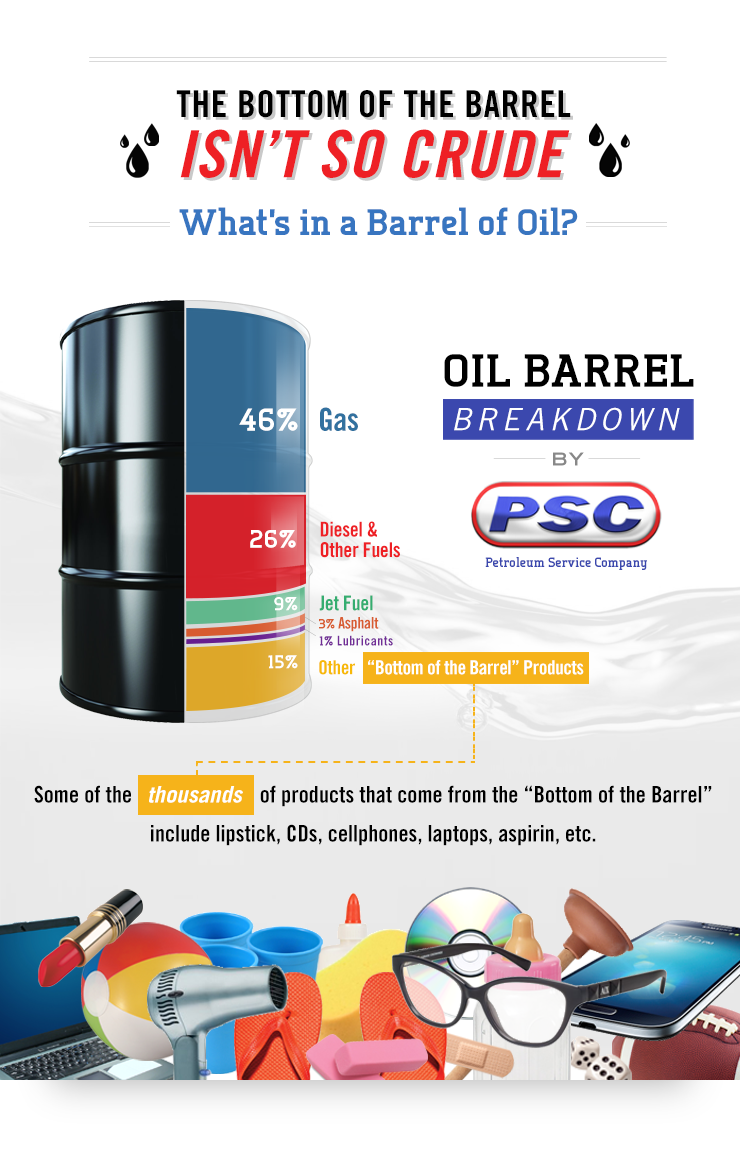
So, What’s in a 42-Gallon Barrel?
This is where it gets really interesting. Because that 42-gallon barrel of crude oil doesn't just magically turn into 42 gallons of gasoline, right? If only! We'd all be driving Ferraris to work if that were the case.
Crude oil is like a magical, sludgy cocktail of all sorts of hydrocarbons. When it goes to a refinery, it's processed and broken down into various products. From that one 42-gallon barrel of crude, you actually get… ready for this… about 19 to 20 gallons of gasoline! Mind-blowing, isn't it?

But wait, there's more! The rest of that barrel is transformed into a whole host of other things we use every single day:
- Around 10-12 gallons of diesel fuel and heating oil.
- About 4 gallons of jet fuel (for all those fancy flights).
- And then a whole bunch of other petrochemicals that become plastics, asphalt for roads, lubricants, waxes, propellants, even some fabrics!
So, next time you’re pumping gas, remember that every gallon in your tank is part of a complex, historical, 42-gallon journey from a deep underground source, through a refinery, and into your car. And it’s only a portion of the original crude.

The Humorous Upshot
The main takeaway here, aside from the fact that oil measurement is a delightful historical anomaly, is that the "barrel" is now purely a unit of measurement. It’s a term, a concept, like a "dozen" eggs. You don't get 12 chickens when you buy a dozen eggs, and you don't typically see an actual 42-gallon wooden barrel being hoisted onto an oil tanker these days. They use massive pipelines and storage tanks!
But the tradition stuck. So, the next time someone talks about the price of a barrel of oil, you can nod sagely, sip your coffee, and casually drop the fact that you know it’s exactly 42 US gallons, and only about half of that becomes the gasoline we put in our cars. You’ll sound incredibly smart, a little bit quirky, and probably make everyone else at the table scratch their heads and wonder if they need another coffee too.
It’s a peculiar world we live in, isn't it? Full of charmingly archaic measurements dictating our incredibly modern lives. And that, my friends, is the tale of the oil barrel. Go forth, and amaze your friends with your newfound, utterly useless, yet endlessly entertaining knowledge!