
54k A Year Is How Much An Hour

Okay, so picture this: You're at a barbeque, awkwardly balancing a paper plate overflowing with potato salad and a veggie burger (because you're trying to be healthy...sometimes). Someone you barely know, let's call him Chad, sidles up and says, “So, what do you do?” You mumble something about spreadsheets and “data analysis” and he, without missing a beat, asks, “Yeah, but like, how much do you make?”
Ugh, right? The ultimate cringe question. No one actually wants to answer that at a barbeque. But it got me thinking...it's a question we all secretly wonder about each other. And more importantly, it's a question we need to figure out for ourselves when negotiating a new job or planning our budget.
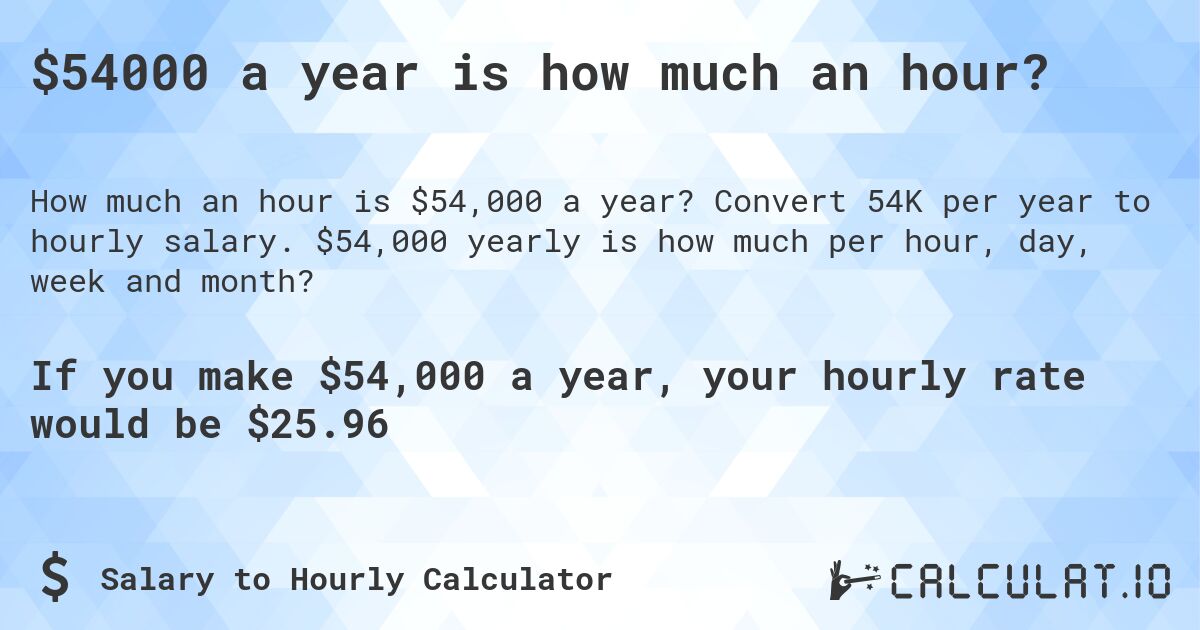
Which brings us to the burning question: If you're pulling in a cool $54,000 a year, how much is that actually per hour? Let’s break it down, shall we?
Must Read
The Straightforward Math (But Is It Really?)
The simplest way to calculate your hourly rate is to divide your annual salary by the number of hours you work in a year. Standard full-time employment is based on a 40-hour work week.
So, here's the equation:
$54,000 / (40 hours/week * 52 weeks/year) = $25.96 per hour

Ta-da! Chad would be semi-impressed, maybe. (Okay, probably not Chad. He’s probably making six figures selling crypto NFTs or something.)
But hold on! Before you go celebrating with a fancy coffee (maybe two at that rate!), there’s a bit more to consider. This is just the gross hourly rate. Remember taxes, insurance, and that pesky little thing called reality?
The Reality Check: Net vs. Gross
That $25.96 per hour? That’s before Uncle Sam (and your state, and possibly your local government) take their cut. Depending on your location and deductions, your take-home pay could be significantly lower.

You also need to factor in the cost of benefits. Does your employer offer health insurance? Retirement contributions? Paid time off? All of these things have a monetary value that isn't always immediately obvious but drastically changes your real compensation.
Think about it: Two jobs might offer the same salary, but one with amazing health insurance and generous vacation time could be way more valuable in the long run. It’s not just about the hourly rate; it's about the total package.
Don't Forget the Unpaid Hours
Okay, let's be honest. How many of us actually work exactly 40 hours a week? Raise your hand if you haven't stayed late finishing a project, answered emails on the weekend, or stressed about work during your "off" time. Didn’t think so.
If you're consistently putting in extra hours without getting paid, your true hourly rate is actually lower than $25.96. Something to keep in mind when asking for that raise!
Here's a slightly cynical (but realistic) example: If you regularly work 45 hours a week and are only being paid for 40, your real hourly rate drops to roughly $23.07. That's a significant difference!
The Freelancer's Perspective (Because Why Not?)
If you’re a freelancer aiming for a $54,000 annual income, things are even more complicated. You have to factor in self-employment taxes, health insurance costs (which you're likely paying entirely on your own), and the time you spend on administrative tasks like invoicing and marketing.

Suddenly, $25.96 per hour looks a whole lot less appealing, doesn’t it? Freelancers often need to charge a higher rate to account for these extra expenses and the lack of benefits that come with traditional employment.
So, Is $54,000 a Year a Good Salary?
The answer, as with most things in life, is: it depends. It depends on your location, your cost of living, your lifestyle, and your career goals. In some areas, $54,000 might be a comfortable living wage. In others, it might barely cover rent.
Ultimately, knowing your hourly rate is just one piece of the puzzle. It's important to consider the bigger picture: your overall financial health, your job satisfaction, and whether or not you can avoid awkward barbeque conversations with Chads of the world.
And hey, even if Chad is making more, you're the one who knows how to calculate your true hourly rate. You’re basically a math wizard now. Go forth and prosper!