Which Of The Following Elements Has The Smallest Atomic Radius

Ever wondered why some things are so dense, while others are light as a feather? A lot of it boils down to the tiny, almost unimaginably small, world of atoms. And within that world, a key player is the atomic radius – essentially, how big an atom is. Figuring out which atom is the smallest can be a fun little puzzle, and understanding this concept unlocks secrets about how elements behave and interact.
Why should you care about the size of an atom? For beginners, it's the first step to understanding the Periodic Table and how it's organized. Seeing the trends in atomic size helps you predict how elements will react with each other. For families, imagine explaining to your kids why a balloon filled with helium floats while one filled with air doesn't (hint: helium atoms are smaller and lighter!). And for hobbyists, especially those interested in chemistry or material science, knowing the atomic radius is crucial for understanding the properties of different materials. For example, it helps explain why some metals are stronger or more conductive than others.
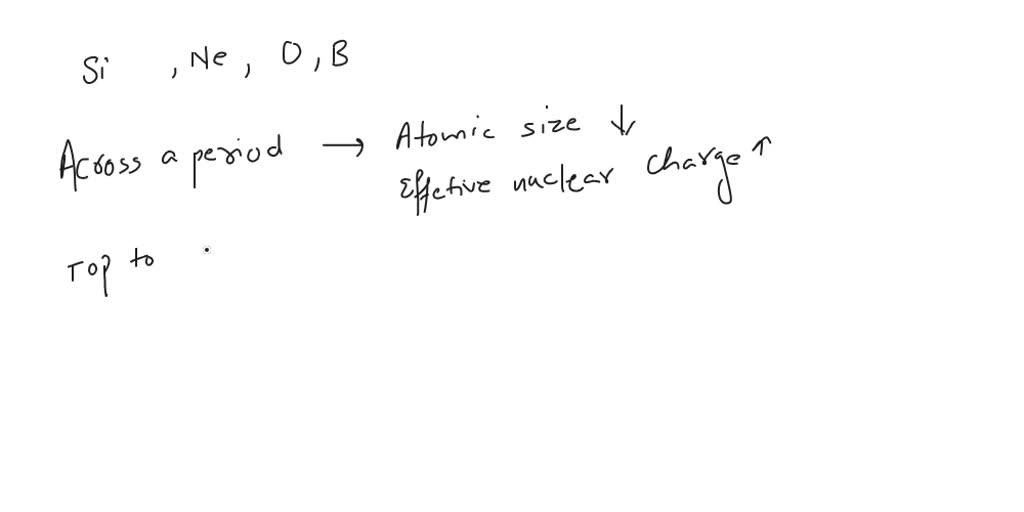
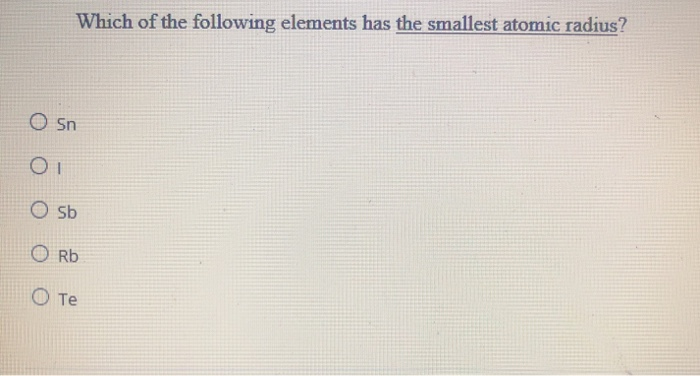
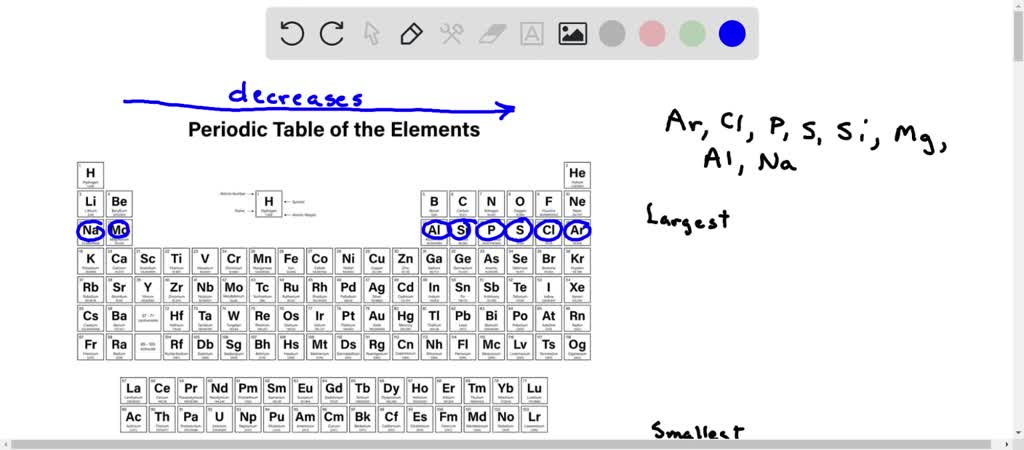
So, let's say you're faced with the question: "Which of the following elements has the smallest atomic radius?" To answer this, you need to remember a couple of key trends on the Periodic Table. Generally, atomic radius decreases as you move from left to right across a period (a row), and it increases as you move down a group (a column). Think of it like this: as you add more protons to the nucleus (moving right), the positive charge pulls the electrons in tighter, shrinking the atom. As you add more electron shells (moving down), the atom gets bigger.
Must Read
Let's consider a few examples. If you're comparing Sodium (Na) and Chlorine (Cl), both in the same period (row 3), Chlorine will have the smaller atomic radius because it's further to the right. If you're comparing Lithium (Li) and Potassium (K), both in the same group (group 1), Lithium will have the smaller atomic radius because it's higher up. You might even encounter variations involving elements like Fluorine (F) and Oxygen (O), where Fluorine, being to the right of Oxygen, would have the smaller atomic radius.
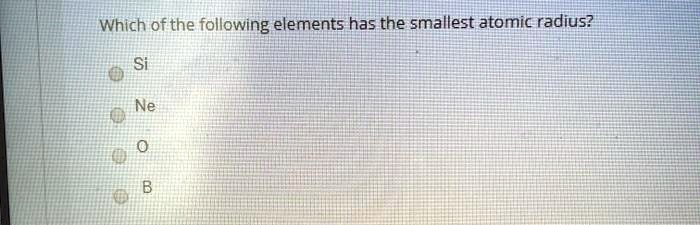
Here are a few simple, practical tips for getting started with this concept: Memorize the general trends on the Periodic Table: left to right, radius decreases; top to bottom, radius increases. Use a Periodic Table as a visual aid. Most Periodic Tables online or in textbooks will show the atomic radius of each element, or at least hint at relative sizes. Finally, practice with examples. Start with simple comparisons of elements in the same period or group, and then move on to more complex scenarios.
Unraveling the mysteries of the atom doesn't have to be daunting. Understanding the concept of atomic radius and how it changes across the Periodic Table is a foundational step in appreciating the fascinating world of chemistry. It's a little bit like detective work, using clues to figure out the properties of the universe at its most fundamental level. So, embrace the challenge, have fun exploring, and remember that even the smallest things can have a big impact!