
Which Is Not A Property Of An Acid
Hey there, curious minds! Ever wondered about the sneaky science happening all around us, especially when it comes to those tangy, sometimes-corrosive things called acids? We encounter them every day, from the lemon juice in your lemonade to the vinegar you use to make salad dressing. But what exactly makes something an acid? And more importantly, what isn't a property of an acid?
Acids: More Than Just Sour Pusses
Think of acids as the grumpy old men of the chemical world. They're a bit reactive, like to donate things (specifically, protons, but let's not get too technical!), and have a definite personality. We know they're sour, right? That puckering feeling when you bite into a lemon is a dead giveaway. But acidity is about more than just taste.
One of the key properties of acids is their ability to donate protons (H+). Imagine them as little givers, always ready to share their positive energy (in the form of a proton, of course!). When an acid dissolves in water, it releases these protons, increasing the concentration of H+ ions. This is what makes a solution acidic.
Must Read
Another telltale sign? Acids can conduct electricity. This is because those released protons, or H+ ions, are charged particles that can carry an electrical current. So, while you definitely shouldn't go sticking a fork in a lemon (seriously, don't!), the citric acid within does have the potential to conduct electricity.
And let's not forget the classic: acids react with metals. Remember those science fair volcanoes erupting with baking soda and vinegar? That fizzing action is a chemical reaction where the acid (vinegar) is reacting with a base (baking soda). Similarly, acids can corrode certain metals, like iron, which is why we need to protect things like car parts from acid rain.

Acids also have the ability to turn blue litmus paper red. Litmus paper is a pH indicator; it changes color depending on how acidic or alkaline (basic) a substance is. If you dip blue litmus paper into an acid, it will turn a vibrant red. This is a quick and easy way to test for acidity.
The Imposter: What Acids Aren't About
Okay, so we've covered the acid's greatest hits. But what's something that's not a property of an acid? Drumroll please... Feeling slippery to the touch.
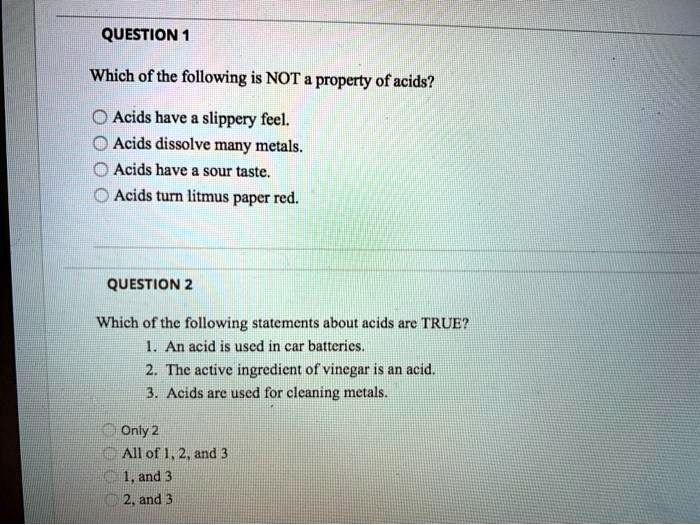
Yep, you read that right. That soapy, slippery sensation? That's actually a characteristic of bases, the acid's chemical opposites. Think of soap, bleach, or even baking soda dissolved in water. These are all bases, and they feel slippery because they react with the oils on your skin to create a soapy film.
Acids, on the other hand, generally don't have that same slippery quality. While concentrated acids can be corrosive and feel unpleasant on the skin, they don't create that same soapy feeling. Instead, they often feel more like a sting or a burn.
So, the next time you're whipping up a vinaigrette or marveling at the power of battery acid, remember this simple distinction: acids are sour, can donate protons, conduct electricity, react with metals, and turn blue litmus paper red. But they definitely aren't slippery!
Why Should You Care? (It's More Fun Than You Think!)
Why bother knowing about acids and their properties? Well, for starters, it helps you understand the world around you! Knowing the difference between an acid and a base can help you safely use household cleaners, understand why your stomach sometimes feels acidic, and even appreciate the science behind cooking.
Imagine you're cleaning your kitchen and accidentally mix bleach (a base) with vinegar (an acid). Knowing that these two substances react can prevent a dangerous chemical reaction that releases toxic chlorine gas. Pretty important, right?
Or think about your stomach. When it produces too much hydrochloric acid, you might experience heartburn. Understanding that antacids are bases helps you see why they neutralize the excess acid and provide relief.
And let's not forget the culinary arts! Acids play a crucial role in cooking, from tenderizing meat with marinades to creating the perfect tangy flavor in your favorite dishes. So, a little knowledge of acids can go a long way in the kitchen!
So, there you have it! Acids: sour, proton-donating, electricity-conducting, metal-reacting, litmus-paper-changing substances that are definitely not slippery. Now go forth and impress your friends with your newfound knowledge of the acidic world! And remember, science is everywhere, even in your lemon-flavored water.