
What Are The Prime Factors Of 294

Ever feel like numbers are just… there? Like wallpaper? But what if I told you they held secrets? Intrigue? Maybe even a little numerical drama? Let's peek behind the curtain, shall we? We're going to dive into the number 294. Prepare for some prime-time factorization!
First things first, what's a prime factor anyway? Think of prime factors as the super-secret ingredients that, when multiplied together, create a particular number. These ingredients are special because they can only be divided evenly by 1 and themselves. They are the building blocks of numbers! Examples include 2, 3, 5, 7, 11 and so on. They're like the VIPs of the number world.
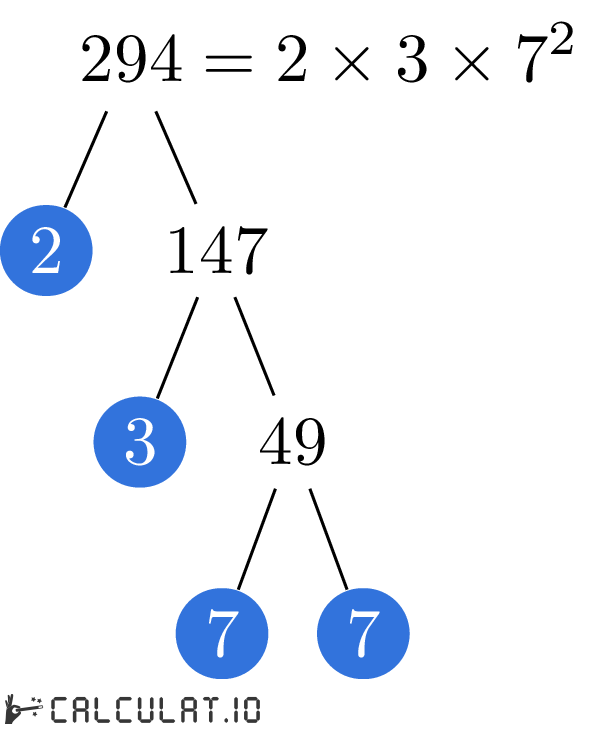
So, how do we unearth the prime factors of 294? Well, it's a bit like playing detective. We start looking for clues – numbers that divide evenly into 294. Let's start with the easiest one – 2. Is 294 divisible by 2? You bet! 294 / 2 = 147.
Must Read
Okay, so we know that 2 is a prime factor of 294. Now, let's look at 147. Is 147 divisible by 2? Nope. Let's try the next prime number, 3. Is 147 divisible by 3? Bingo! 147 / 3 = 49.
So far, we have 2 and 3 as prime factors. What about 49? Can we divide 49 by 3? No, we cannot. What about 5? Nope. But wait! 49 is divisible by 7. 49 / 7 = 7. And guess what? 7 is also a prime number!
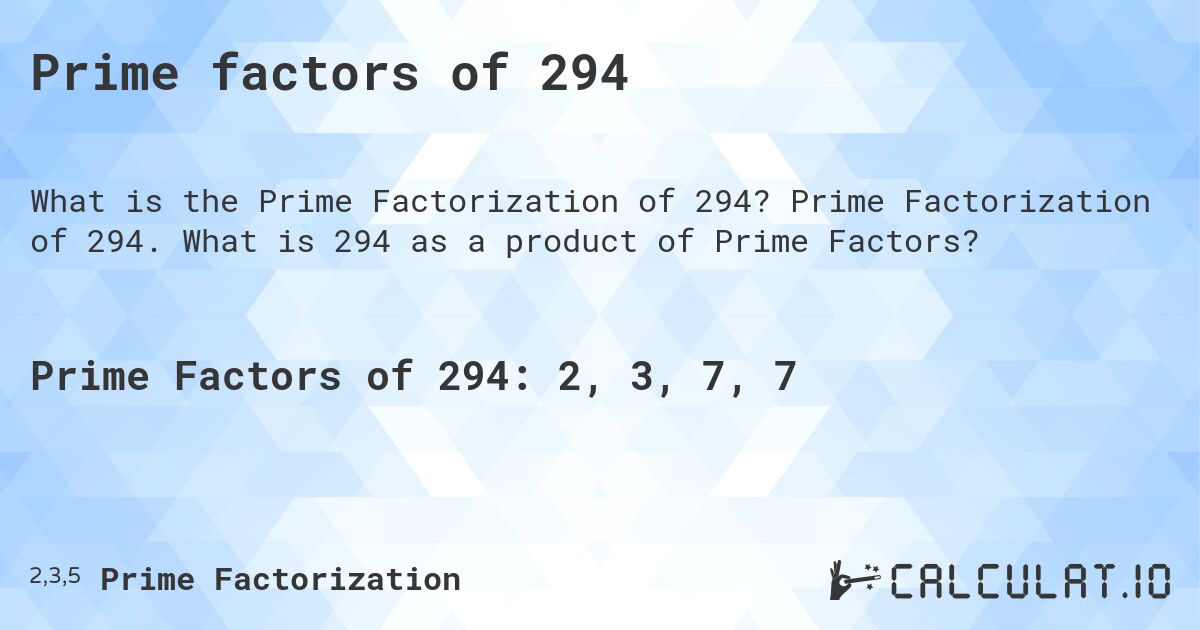
Hold on to your hats! We're almost there. We've broken down 294 into 2, 3, 7, and 7. Since 7 appears twice, we can say the prime factors of 294 are 2, 3, and 7. See? We cracked the code!
The prime factorization of 294 can be written as 2 x 3 x 7 x 7 (or 2 x 3 x 72, if you're feeling fancy). It's like a number's DNA fingerprint! Every number has its own unique set of prime factors.

Why is this cool? Well, prime factorization is used in all sorts of surprising places. From cryptography (keeping your online information safe) to simplifying fractions (making math problems easier), prime numbers are the unsung heroes of the mathematical universe. Knowing the prime factors of a number is like knowing its secret identity.
Imagine you're trying to build a structure using only prime-numbered blocks. The way these blocks combine determines the strength and uniqueness of the structure. That's kinda how prime factorization works in math.
Why Bother?
So why should you care about the prime factors of 294 (or any number, for that matter)? Well, it's a bit like understanding how your car engine works. You don't need to know to drive, but it gives you a deeper appreciation for the machine. In the same way, knowing how numbers break down into their prime components gives you a better sense of how the whole mathematical world fits together.

Plus, it's just plain fun! It's like a little puzzle, a little detective work, and a little bit of mathematical magic all rolled into one.
Consider 294 a training ground. You can take this skill and apply it to bigger, more complex numbers. Can you find the prime factors of 126? Or 510? Each number presents a new challenge, a new puzzle to solve.
Numbers aren't just random digits. They are fascinating, complex entities with hidden layers and surprising relationships. Prime factorization is one way to unlock these secrets and appreciate the beauty and elegance of mathematics.
So, go forth and factorize! Explore the world of numbers. You might be surprised at what you discover. You might even find that you enjoy the thrill of the chase – the hunt for those elusive prime factors.
Who knew 294 could be so interesting?