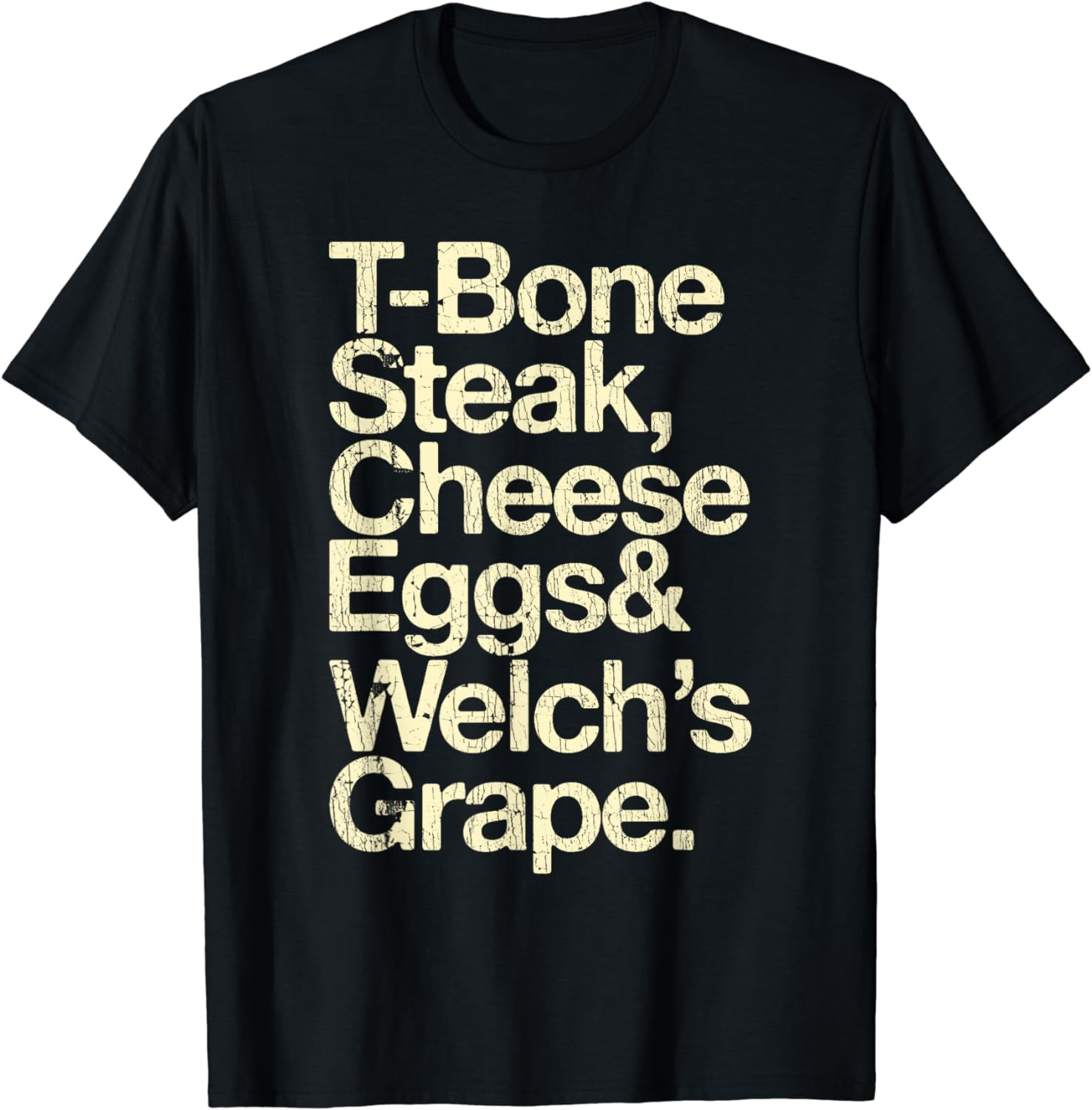
T Bone Steak Cheese Eggs And Welch's Grape Shirt

Okay, let's talk about something a little… random. T-bone steak, cheese, eggs, and a Welch's grape shirt. Sounds like a bizarre shopping list, right? Or maybe a very specific, and slightly confusing, sartorial statement. But bear with me, because unpacking this seemingly nonsensical combination can actually be a fun exercise in connection, association, and even a bit of creativity. Why is that relevant? Because in a world overflowing with information, the ability to find patterns and make unexpected links is a superpower.
The "purpose" of this exercise isn't to find some hidden, universal truth about steak, cheese, eggs, and purple shirts. Instead, it's about sparking curiosity and demonstrating how our brains naturally seek meaning and connection. We're pattern-seeking creatures, and even in the most arbitrary combinations, we can often find threads that tie things together. The "benefit" is in the mental flexibility and creative thinking it encourages. It’s a playful way to challenge yourself to think outside the box.
So, how could this be used in education? Imagine a writing prompt in an English class. "Write a short story that connects these four seemingly unrelated items." Suddenly, students are forced to think creatively. Maybe the T-bone steak is a reward for a hard-working farmer, the cheese is his daughter's favorite snack, the eggs are gathered for a celebratory breakfast, and the Welch's grape shirt is what he wears on special occasions. Or perhaps it's a still life painting exercise in art class. Students have to arrange these items in an interesting and visually appealing way, considering texture, color, and composition. The possibilities are endless!
Must Read
In daily life, thinking this way can help you become a better problem solver. Let's say you're struggling with a coding bug. Instead of banging your head against the keyboard, try associating the error with something completely different – say, a T-bone steak. (Stick with me!) The steak needs careful preparation; similarly, your code needs careful debugging. The cheese represents the 'cheese' in your code, the unnecessary or hacky elements. The egg might be a fragile part of the system, easily broken by a change. And the Welch's grape shirt? Maybe that’s the unifying brand color of the company whose API you're using. By shifting your perspective, you might stumble upon a new way of thinking about the problem.
Want to explore this further? It's simple! The next time you're waiting in line, pick three or four random items you see around you. A newspaper, a coffee cup, a child's toy, and a street sign. Then, try to create a story or find a common thread that connects them. Or, try the "random word generator" approach. Use a website to generate four random words and challenge yourself to find connections. The point isn't to find the "right" answer, but to exercise your creative muscles and see the world in a slightly different, more interconnected way. Who knew a T-bone steak, cheese, eggs, and a Welch's grape shirt could be so thought-provoking?