Molecular Geometry Of Ph3

Alright, gather 'round, chemistry newbies and seasoned molecule-wranglers! Today, we're diving into the fascinating, slightly chaotic, and surprisingly well-behaved world of... PH3! Yes, the humble phosphine. Don't let the name fool you; it's got a geometrical secret waiting to be unleashed.
Imagine you're at a ridiculously nerdy cocktail party (you brought the periodic table-themed snacks, right?). Suddenly, someone asks you, "Hey, what's the molecular geometry of PH3?" You don't want to stammer and spill your Bohr model cupcakes all over yourself, do you? Of course not! You want to confidently declare its shape like you're describing your favorite yoga pose (Downward-Facing Dog...molecule?).
The Central Character: Phosphorus
First things first, we need to understand our leading man – phosphorus (P). Think of phosphorus as the life of the party, always ready to make three connections. Why three? Because phosphorus has five valence electrons, and it wants to get to the magical number eight, the number of valence electrons in noble gases. That number makes it stable.
Must Read
Now, these electrons are not distributed like a neat solar system. They're more like toddlers at a birthday party – bouncing around with unpredictable energy. This chaotic behavior is governed by something called the Valence Shell Electron Pair Repulsion (VSEPR) theory. Basically, electron pairs – whether they're in bonds or just chilling as lone pairs – repel each other like magnets set up wrong. They want to be as far away from each other as possible.
Hydrogen's Humble Role
Enter our supporting actors: hydrogen (H) atoms. These little guys are happy to form single bonds with phosphorus. They're basically the "plus ones" at this molecular party, content to attach to the star and contribute to the overall vibe.

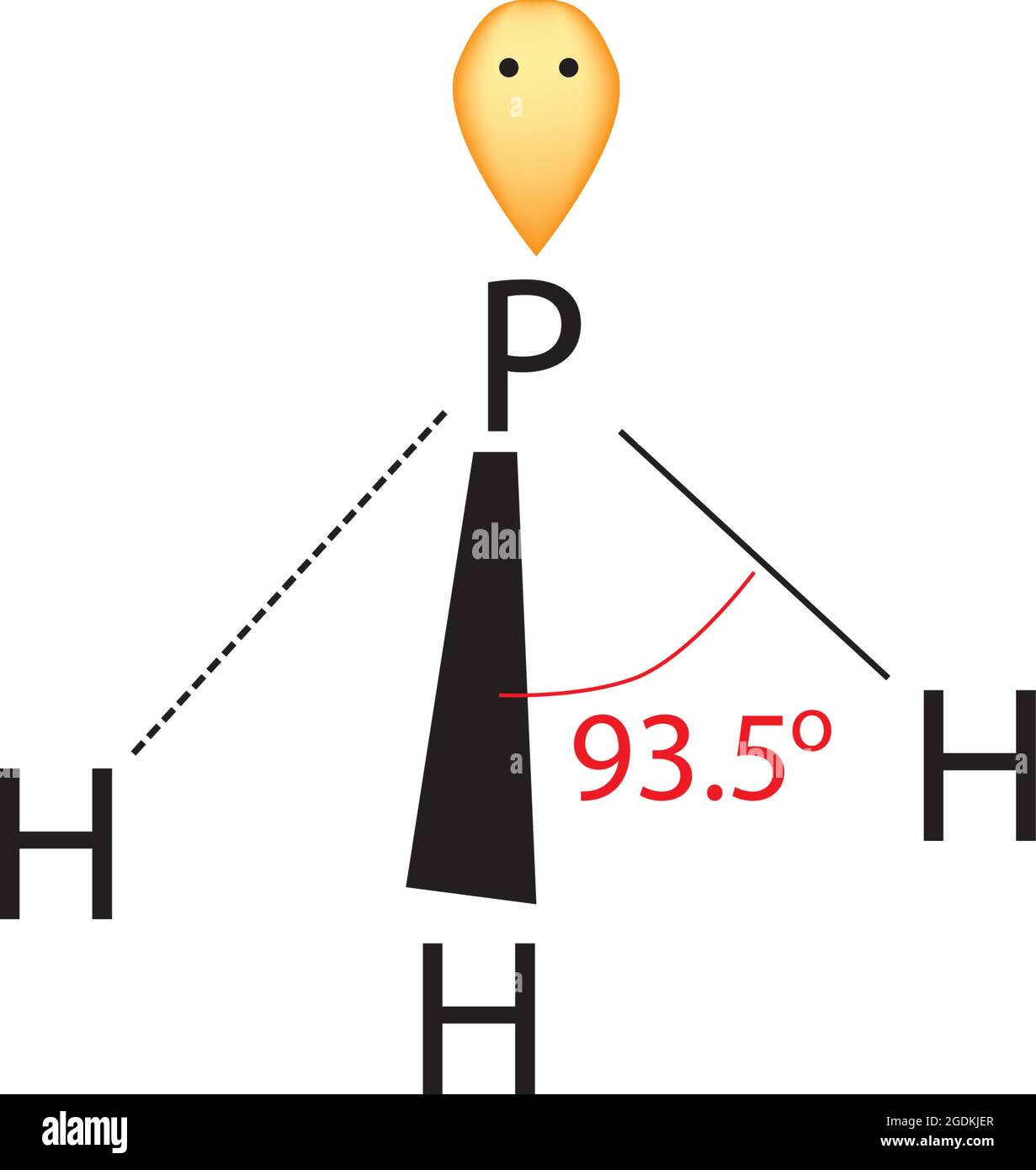
So, we have three hydrogen atoms vying for phosphorus's attention. But there's a catch! Phosphorus also has a lone pair of electrons. This lone pair is like that one friend who didn't bring a date, but is somehow still the most demanding person at the party. It's got a bigger personal space bubble than the bonded pairs. Why? Because it's only attached to the phosphorus nucleus on one side, which means its electron cloud is more diffuse and exerts a stronger repulsive force.
The Shape of Things: Trigonal Pyramidal
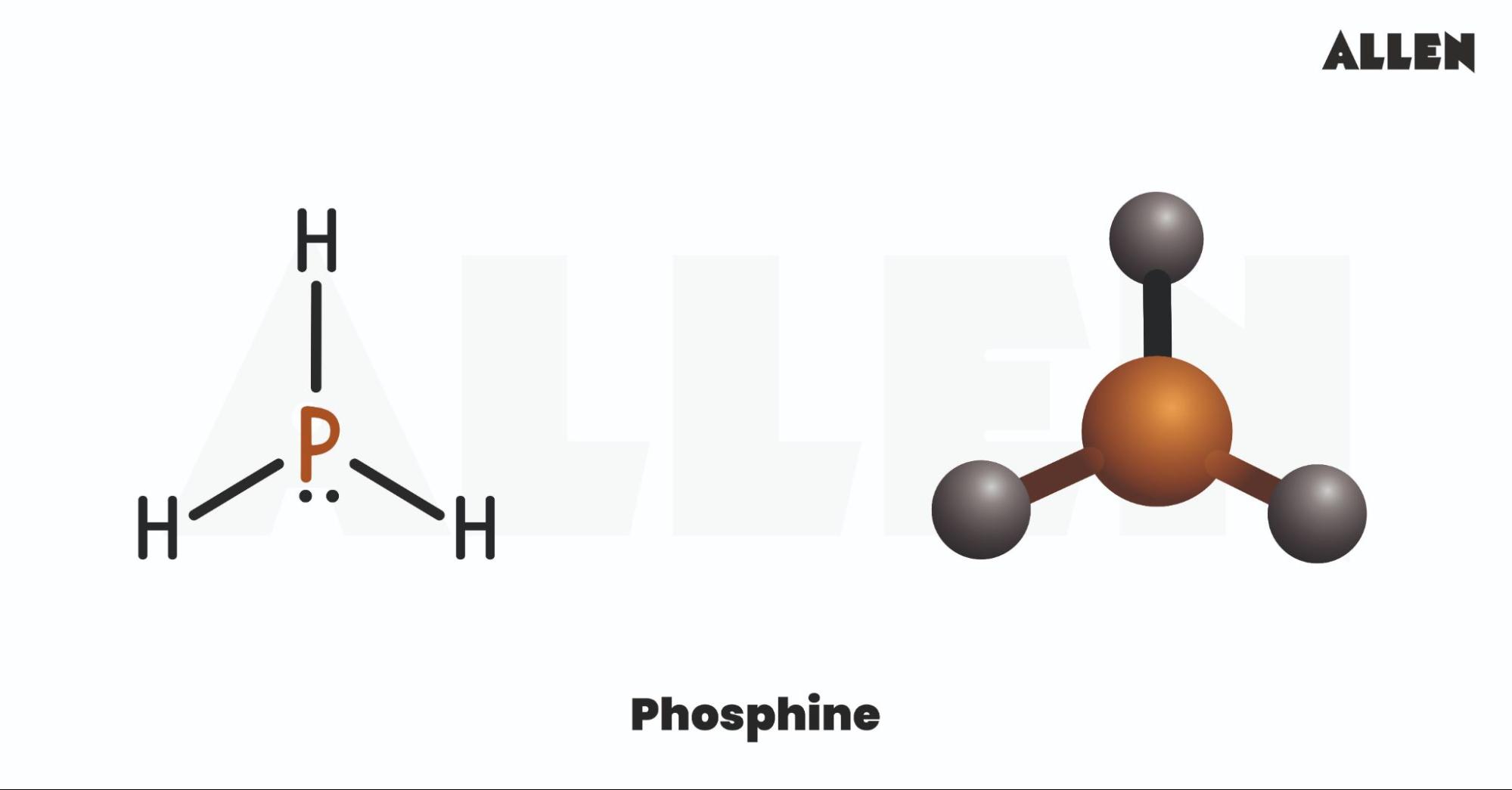
This whole electron-pair repulsion shenanigans leads us to the grand reveal: the molecular geometry of PH3 is trigonal pyramidal. "Trigonal pyramidal?" I hear you ask, maybe with a hint of bewildered terror. It sounds intimidating, but picture this:

Imagine a pyramid. At the bottom corners, you have your three hydrogen atoms, forming a triangle (hence, "trigonal"). And perched at the apex, like a tiny, demanding king on his throne, is our phosphorus atom. The lone pair, which is not part of molecular geometry, doesn’t show up when you describe the actual shape that the atoms form.
Now, because that lone pair is hogging space up top, it squeezes the H-P-H bond angles a bit. Instead of being perfectly tetrahedral (which would be 109.5 degrees), the angles are slightly smaller, around 93.5 degrees. It's like everyone's trying to give the lone pair extra room to breathe (and complain about the music).
Why It Matters (Besides Impressing People at Parties)
So, why should you care that PH3 is trigonal pyramidal? Well, molecular geometry dictates a molecule's properties. The shape of PH3 makes it a polar molecule. Since the molecule has a lone pair, this pulls electrons towards one side making it unevenly charged. This polarity influences how it interacts with other molecules, affecting its boiling point, solubility, and reactivity. It even makes it a good ligand, meaning it can bond to metal ions and play a role in catalysts and other chemical processes!
In short, understanding the molecular geometry of PH3 helps us predict how it will behave in various chemical scenarios. And that, my friends, is pretty darn cool. It's like knowing the secret handshake to the universe! Okay, maybe that's a slight exaggeration, but you get the idea.
So next time you see PH3, remember the trigonal pyramid, the demanding lone pair, and the power of electron repulsion. And if anyone at that chemistry party asks you about it, you'll be ready to blow their minds with your newfound geometrical knowledge!