
Molar Mass Of Phosphoric Acid
Ever wondered what makes your soda tangy or helps your plants grow lush and green? The secret often lies in the world of chemistry, and one key player is phosphoric acid (H3PO4). Now, "molar mass" might sound intimidating, like something reserved for lab coats and bubbling beakers. But trust me, understanding the molar mass of phosphoric acid is surprisingly accessible and can unlock a deeper appreciation for the science all around us. It's like knowing the weight of a secret ingredient that adds a special flavor to our lives!
So, what exactly is molar mass, and why should we care about phosphoric acid's in particular? Simply put, molar mass is the mass of one mole of a substance, expressed in grams per mole (g/mol). Think of a "mole" as a chemist's counting unit – a really, really big one! Knowing the molar mass of phosphoric acid is crucial because it allows us to accurately measure and work with this compound in various applications. It's the foundation for calculating how much phosphoric acid we need for a specific reaction, solution, or product.
The purpose and benefits of understanding molar mass extend far beyond the chemistry lab. It's a fundamental concept in stoichiometry, the branch of chemistry that deals with the quantitative relationships between reactants and products in chemical reactions. This knowledge is essential for anyone studying chemistry, biology, or related fields. By knowing the molar mass, we can predict the amount of product we'll obtain from a reaction or determine the amount of reactants needed to produce a specific quantity of product. It's all about precise calculations and understanding the proportions involved.
Must Read
Phosphoric acid itself has numerous uses in both education and daily life. In education, it's a common reagent used in titrations and other experiments to illustrate acid-base chemistry. You might encounter it in a chemistry lab when neutralizing a base or creating a buffer solution. In daily life, it’s a key ingredient in fertilizers, providing plants with the phosphorus they need for healthy growth. It's also used in food and beverage production, lending that characteristic tartness to cola drinks. Ever notice that ingredient list? You might just spot phosphoric acid. Furthermore, it serves as a rust remover, cleaning agent, and even in dental products!

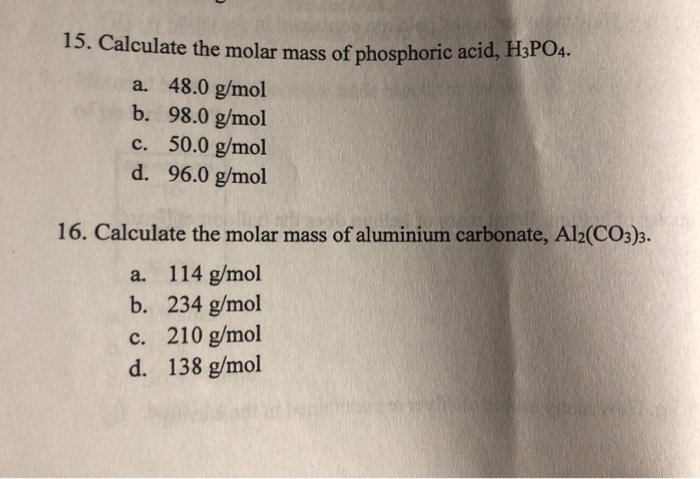
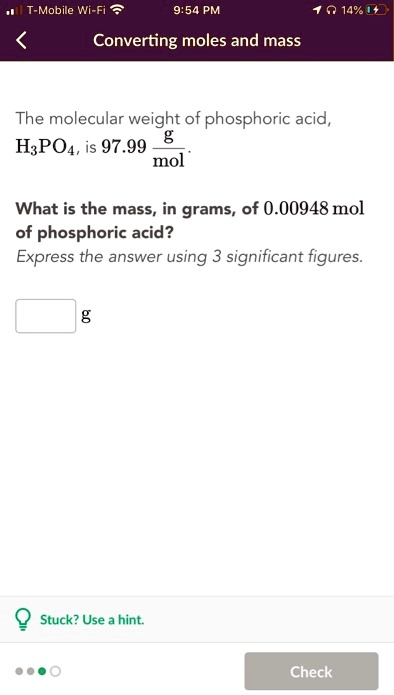
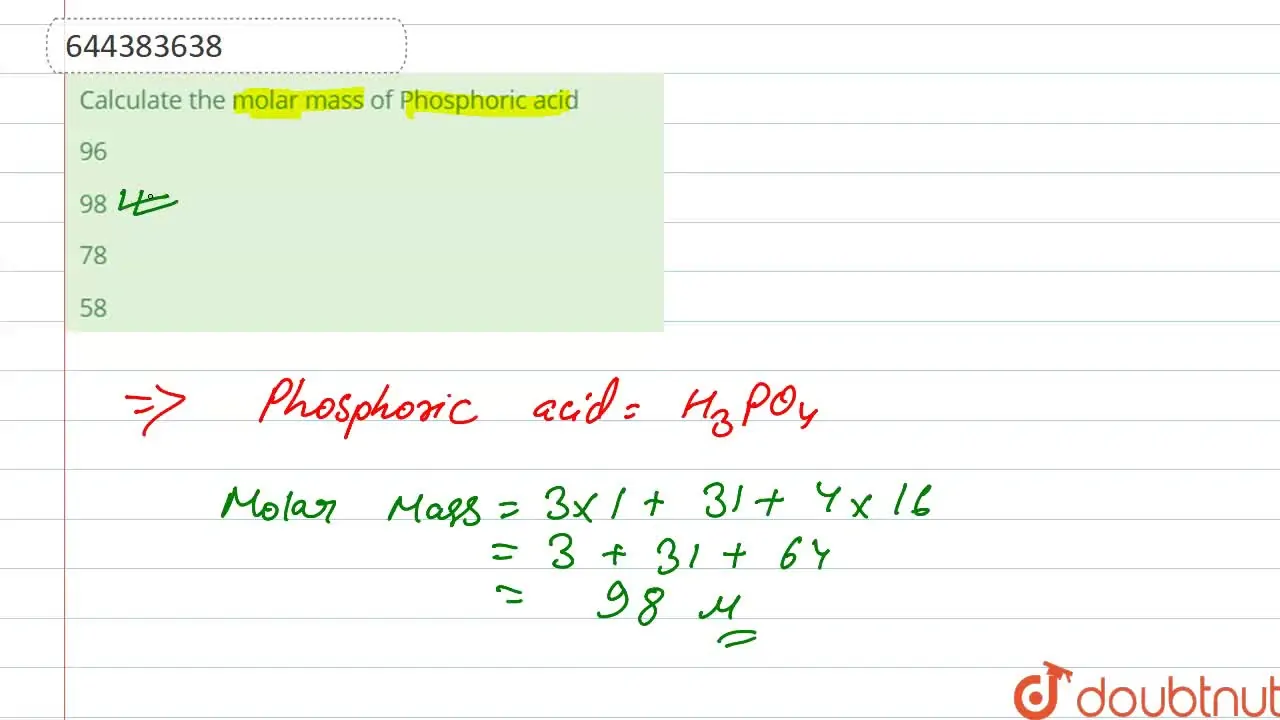
Ready to explore the molar mass of phosphoric acid on your own? It’s easier than you might think! First, you'll need a periodic table. Find the atomic masses of hydrogen (H), phosphorus (P), and oxygen (O). The atomic masses are typically located below the element symbol. Next, multiply each atomic mass by the number of atoms of that element in the chemical formula (H3PO4). So, you'd have 3 times the atomic mass of hydrogen, plus the atomic mass of phosphorus, plus 4 times the atomic mass of oxygen. Finally, add those values together, and you'll have the molar mass of phosphoric acid! Grab a periodic table and give it a try. You can check your answer online using a molar mass calculator to verify your calculations.
Another simple way to explore this concept is to research different applications of phosphoric acid and try to understand how the molar mass plays a role. For example, investigate how the concentration of phosphoric acid in a fertilizer is calculated, or how it's used to adjust the pH of a solution. By connecting the molar mass to real-world examples, you can gain a deeper appreciation for its significance. The more you explore, the more you'll realize that understanding molar mass isn't just about memorizing numbers; it's about understanding the fundamental building blocks of our world and how they interact. It's a journey of discovery, one atom at a time!
+aqueous+solution+of+phosphoric+acid+(H+3+PO+4+)..jpg)