
Molar Mass Of Bromobenzene
Ever baked a cake and meticulously measured out the ingredients? Or perhaps you've mixed a cocktail, carefully balancing the ratios for that perfect zing? What you were doing, without even realizing it, was playing with the concept of molar mass! Sounds intimidating, right? Don't worry; we'll make it as easy as sipping a lemonade on a sunny afternoon.
Today, we're talking about the molar mass of a specific molecule: bromobenzene. But before your eyes glaze over, think of bromobenzene as just another ingredient in a recipe, albeit a recipe used in chemistry, not the kitchen.
What Exactly Is Molar Mass?
Think of molar mass as the weight of a mole. Now, a mole isn't a furry little critter; it's a chemical unit, like a "dozen" is for eggs. Just as a dozen always means 12, a mole always means 6.022 x 10²³ things (atoms, molecules, whatever you’re counting). This enormous number is called Avogadro's number, and it's chemistry's way of dealing with the fact that atoms are ridiculously tiny.
Must Read
So, molar mass tells you how much one mole (that giant pile of 6.022 x 10²³ molecules) of a substance weighs. It’s usually measured in grams per mole (g/mol). It's like knowing that one dozen eggs weighs a certain amount - it helps you figure out how much you need for your omelet!
Bromobenzene: Our Star Ingredient
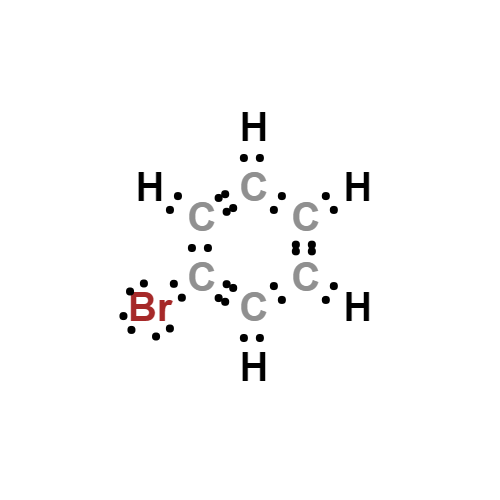
Bromobenzene is a molecule made up of a benzene ring (that's six carbon atoms in a ring, each with a hydrogen attached) with one of those hydrogens swapped out for a bromine atom. So, its chemical formula is C6H5Br.

Imagine benzene as a group of friends holding hands in a circle (the six carbons). Each friend is also holding a balloon (the hydrogen). Then, one of the friends lets go of their balloon and grabs a bowling ball (the bromine) instead. That's bromobenzene in a nutshell!
Calculating the Molar Mass of Bromobenzene: No Calculator Required (Almost!)
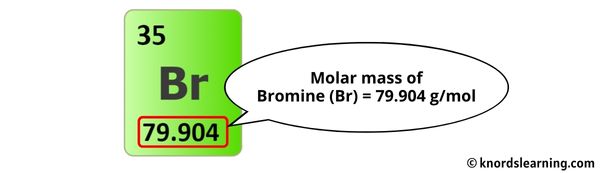
Alright, let's calculate! To find the molar mass of bromobenzene, we need to add up the atomic masses of all the atoms in the molecule. You can find these atomic masses on the periodic table (which is like a giant cheat sheet for chemists!).
Here's how it breaks down:

Now, add them all up: 72.06 + 5.05 + 79.90 = 156.91 g/mol.
So, the molar mass of bromobenzene is approximately 156.91 g/mol. Ta-da!
Why Should You Care? (It's More Interesting Than You Think!)
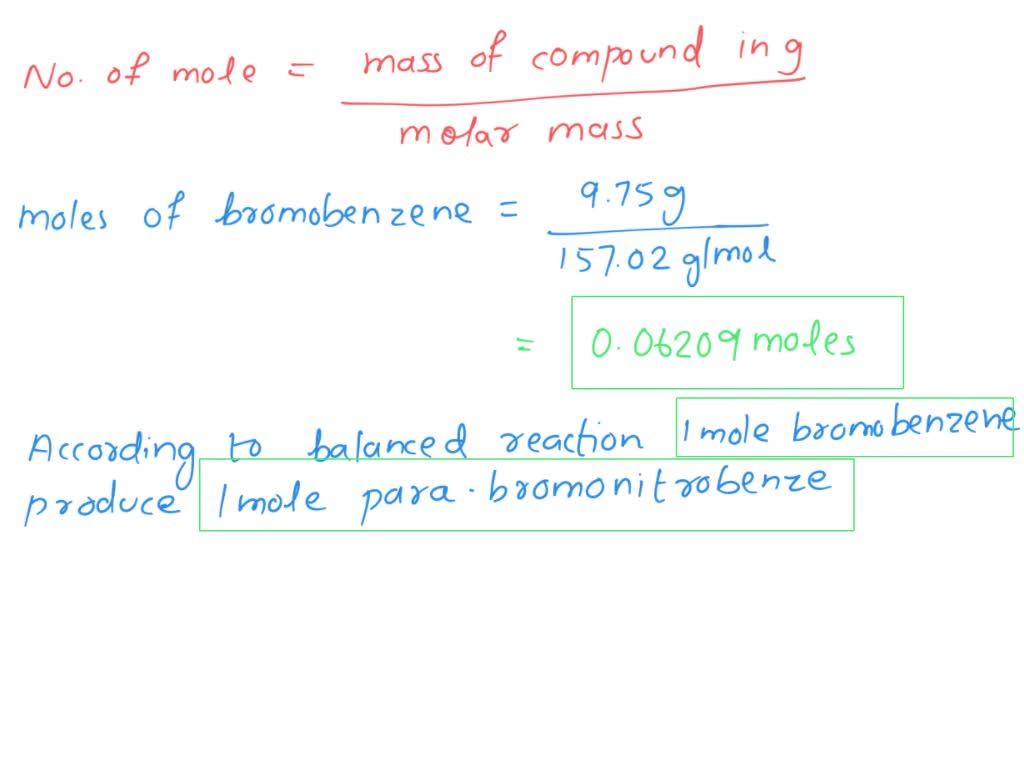
Okay, so you've calculated the molar mass. Big deal, right? Well, actually, it is a big deal! Imagine you are a scientist trying to make a new medicine. You need to know exactly how much of each chemical to use for the reaction to work correctly. Knowing the molar mass allows you to convert from grams (what you weigh on a scale) to moles (the number of molecules you're working with) and vice-versa.
Or, picture this: You're working on a project to clean up a polluted lake. Bromobenzene might be one of the contaminants you're dealing with. Knowing its molar mass helps you calculate how much bromobenzene is present in the water sample, allowing you to determine the best way to remove it.
Molar mass is a fundamental concept in chemistry. It is a key to unlocking understanding about amounts and quantities. It is used in countless applications, from developing new materials to understanding the intricate workings of our bodies.
Think of it as the secret code to the chemical world. Once you crack the code, you can start to understand how everything around you works at a molecular level!
So, the next time you're baking a cake or mixing a drink, remember the concept of molar mass. It’s not just some abstract scientific idea; it's a tool that helps us understand and control the world around us, one molecule at a time.