Ever been in one of those "brain-teaser" conversations where someone tries to trip you up with legal jargon? You know the kind! Well, today, we're tackling a classic legal head-scratcher that trips up even the most seasoned trivia buffs: the difference between larceny and robbery.
It sounds super serious, and it is in the courtroom, but we're going to break it down with some laughs. Get ready to feel like a legal eagle, but a really fun, casual one!
Larceny: The Art of the Sneaky Grab!
So, here's the big reveal, the juicy nugget of knowledge: Larceny differs from robbery in that larceny is all about taking something without using force, fear, or intimidation against a person. Think of it as the ultimate act of quiet acquisition.
It's a "poof, it's gone!" moment, rather than a "hand it over!" showdown. The key here is the absence of direct confrontation or threat to a person.
When Larceny Does Its Sneaky Dance
Imagine you're at a picnic. You put your favorite artisanal cheese (the one you drove two towns over for!) down on the blanket for just a second. You turn to swat a fly, and poof! The cheese is gone.
If a mischievous squirrel, tail twitching, scurries off with it, that's practically larceny in the animal kingdom! No threats, no claws flashed, just a quick, opportunistic grab.
In human terms, it's often the same. Someone sees your wallet sitting unattended on a park bench and quietly slips it into their bag. No yelling, no pushing, just a smooth, almost invisible transaction.
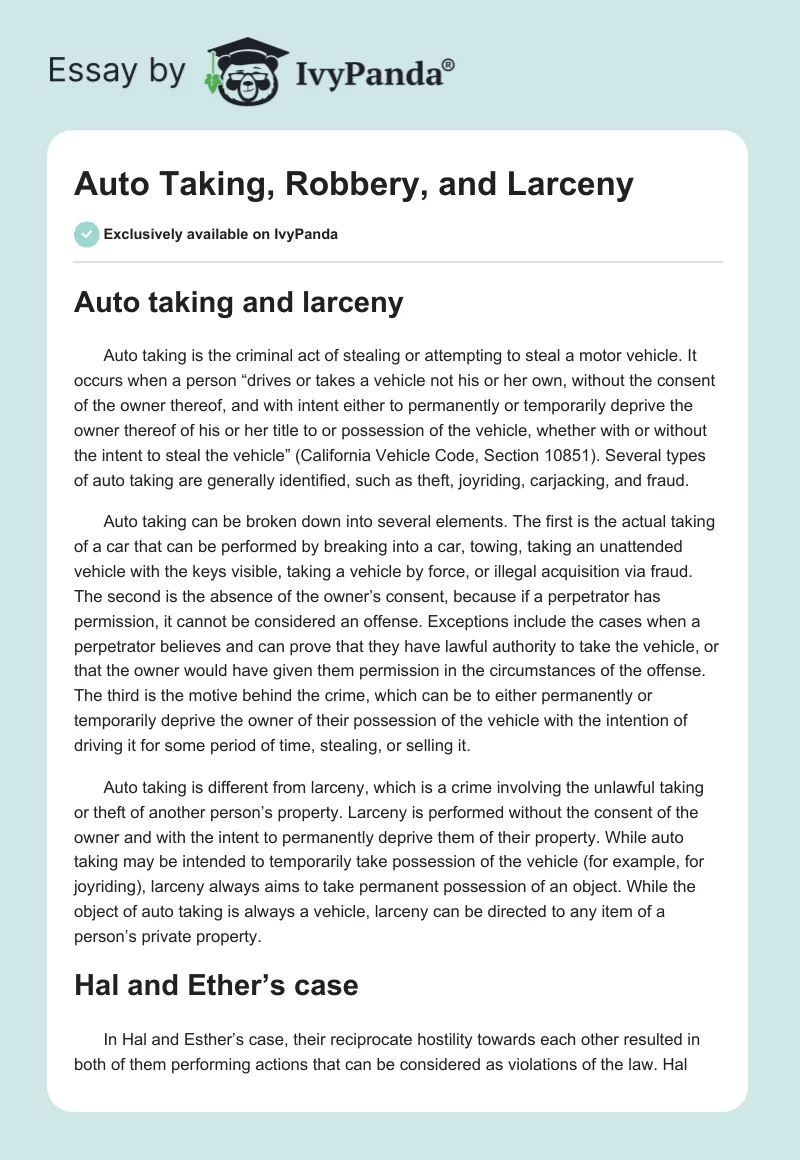
Auto Taking, Robbery, and Larceny - 1100 Words | Essay Example
Larceny is like a ninja – silent, swift, and almost undetectable until the property is already gone.
Consider the classic case of shoplifting. Someone walks into a store, tucks a shiny new gadget under their coat, and walks out without paying. They didn't threaten the cashier, they didn't push anyone aside; they simply took the item.
That sneaky maneuver, that quiet disappearance of goods, is the very essence of larceny. It's about the unlawful taking and carrying away of someone else's property, without their consent, and without the added spice of violence or threats.
Think about someone "borrowing" your super cool pen from your desk, and it mysteriously never makes its way back. While often not a criminal matter, on a grander scale, that's the spirit of larceny!
Or what about car theft? If someone hotwires your car late at night from your driveway, that's a prime example of larceny. They're not confronting you, they're simply taking your property that's sitting there.
Understanding The Key Differences: Robbery Vs. Larceny » Differencess
Robbery: The "Hold Up!" Showdown!
Now, let's swing over to its more dramatic cousin: robbery. If larceny is a whisper, robbery is a shout. It's the action movie version of property crime.
Robbery involves taking property directly from another person, or in their immediate presence, by using force, fear, or intimidation. The key difference? The victim is usually right there, experiencing the threat firsthand.
When Robbery Kicks Down the Door
Imagine the cheese scenario again. This time, as you reach for your artisanal cheese, someone steps in front of you, points a finger (or worse!), and says, "That cheese is MINE now!" You, feeling a mix of fear and indignation, let them take it.
That, my friends, is robbery. The cheese-snatcher used intimidation against you, the person, to get the property. It's not just about the cheese anymore; it's about the threat to your person.
Robbery is like a pirate – bold, in your face, and demanding that you surrender your treasures!
Robbery, theft, burglary, heist, larceny icon - Download on Iconfinder
Picture a bank heist in a movie. The masked figures burst in, wave their (toy) guns, and yell for everyone to hit the floor. They are intimidating the bank employees and customers to get access to the money.
That intense, fear-inducing interaction is the hallmark of robbery. The property is taken, but it's the method—the force, the threats, the fear—that makes it robbery.
Another classic example is a mugging. Someone confronts you on the street, shoves you, and snatches your purse or phone. The physical contact and the immediate threat make it robbery, not just a simple taking.
Even carjacking is a form of robbery. It's not just taking a parked car; it's taking a car from the driver, often at a stoplight, using threats or force to make them surrender the vehicle.
The Big, Beautiful, Brain-Boosting Distinction
So, to wrap up our little legal adventure: the difference boils down to how the property is obtained. Was it a sly, no-contact disappearance, or a "your money or your life" moment?
Robbery and Larceny in New York- NY Criminal Defense Lawyer
Larceny is a crime against property, pure and simple. It's about taking things when no one is really around to be threatened.
Robbery is a crime against both property AND person. It's about terrifying someone to get what you want.
One is a sneaky squirrel; the other is a roaring lion. Both are certainly not good deeds, but their methods are as different as night and day. This distinction isn't just for legal scholars; it actually leads to very different legal consequences, because threatening people is generally seen as a much bigger deal!
Now you're not just a general audience member; you're an informed, enlightened, and downright entertaining conversationalist when this topic comes up. Go forth and impress your friends with your newfound wisdom!
Just remember, whether it's a stolen cookie or a swiped treasure chest, the "how" really matters. Keep those artisanal cheeses safe, and may your knowledge of larceny and robbery shine bright!