Java Coding Interview Questions For Sdet

So, you're thinking about becoming an SDET – a Software Development Engineer in Test? That's fantastic! You're stepping into a world where quality reigns supreme, and you'll be a crucial part of ensuring software works as intended. And if you're eyeing a Java-centric role, brushing up on your Java coding interview skills is a must. Don't let it intimidate you, though! Think of it as a puzzle-solving adventure, where each question is a fun challenge to overcome.
Why Java, you ask? Well, Java is a powerhouse – a robust and versatile language used extensively in enterprise applications. Knowing it opens doors to a wide range of opportunities. The purpose of focusing on Java coding interview questions for SDETs is multifaceted. Firstly, it assesses your fundamental understanding of the language: can you write clean, efficient, and maintainable code? Secondly, it gauges your problem-solving abilities: can you break down complex problems into smaller, manageable pieces and implement effective solutions? And thirdly, it reveals your familiarity with common data structures and algorithms, essential tools in any SDET's arsenal.
The benefits extend far beyond just landing a job. Mastering these concepts sharpens your logical thinking, improves your coding proficiency, and enhances your ability to design effective test cases. Think about it: if you understand how a piece of software should work at a code level, you're much better equipped to identify potential flaws and create tests to catch them.
Must Read
Consider these scenarios to illustrate how these concepts apply in education and daily life. In education, you might use Java to build a simple gradebook application, requiring you to implement data structures (like arrays or lists) to store student information and algorithms to calculate averages. In daily life, imagine designing a testing framework for a smart home device. You'd need to understand object-oriented programming principles (like inheritance and polymorphism) to create reusable and maintainable test code. You might even use algorithms to simulate various user interactions and ensure the device responds correctly.

So, how do you embark on this exciting journey? Start with the basics. Review data structures like arrays, linked lists, stacks, queues, and hash maps. Understand common algorithms like sorting (bubble sort, merge sort, quicksort) and searching (binary search). Practice coding these from scratch! Online platforms like HackerRank, LeetCode, and Codewars offer a wealth of Java coding challenges specifically designed for interview preparation. Don't be afraid to look at solutions and understand the reasoning behind them. The key is to actively engage with the material and try to implement the solutions yourself.
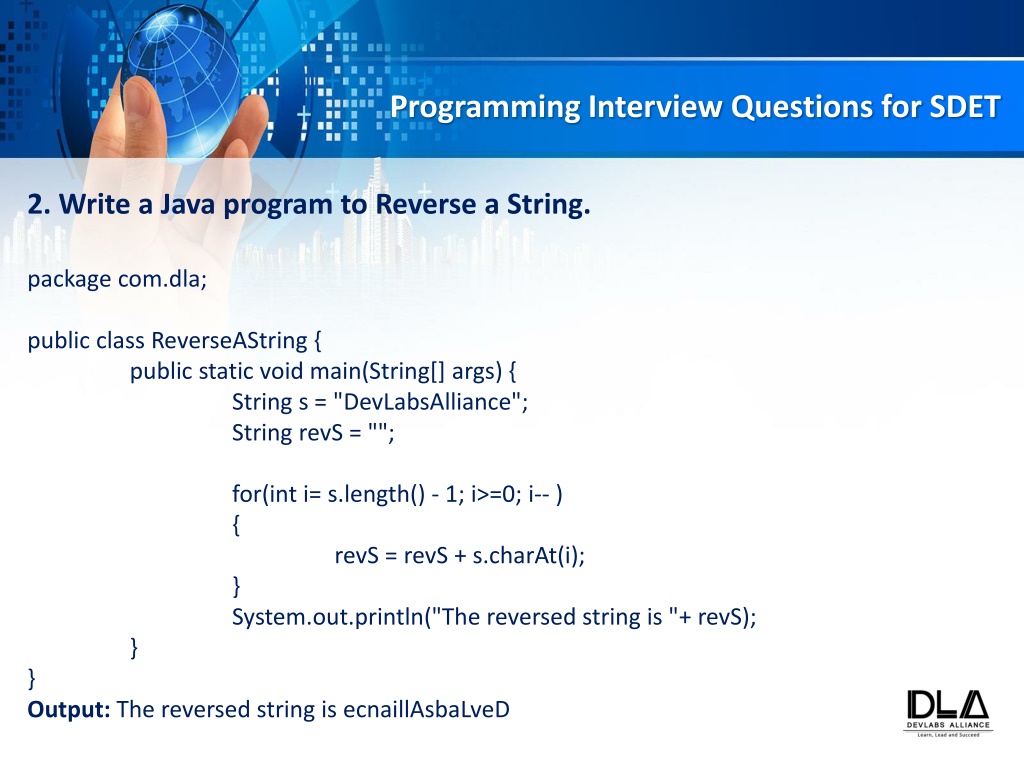
A simple way to explore is to pick a common interview question, like "Reverse a string in Java," and try different approaches. Can you do it with a loop? Recursively? Using built-in Java methods? Experiment and see what works best! Remember, the goal isn't just to memorize solutions, but to develop a deep understanding of the underlying concepts. Embrace the challenge, be persistent, and enjoy the process of becoming a skilled and confident Java SDET!