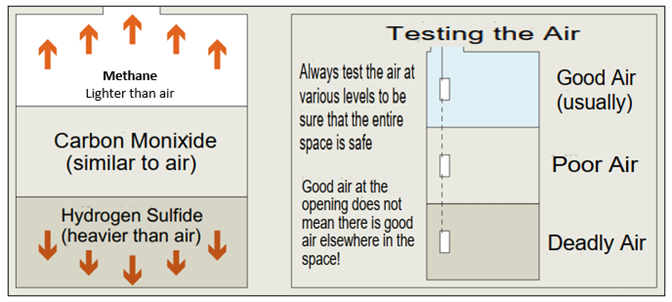
Alright, folks, buckle up for a little gas-related detective work! We’re diving into a question that might just have you scratching your head, or at least wondering if your CO detector is truly playing fair. The big mystery: Is Carbon Monoxide (CO) gas heavier than air? Does it slink along your floorboards like a tiny, invisible slug, waiting to surprise you? Or does it float up to the ceiling like a rogue party balloon?
Let’s unravel this puzzle with the enthusiasm of a puppy chasing its tail! Forget dense scientific jargon and complex equations. We’re going to use good old common sense, a dash of imagination, and maybe a sprinkle of playful exaggeration to get to the bottom of it.
The Big Question: CO vs. Air – Who Wins the Weightlifting Contest?
First, let’s talk about air. What exactly is air? It’s not just one thing, right? It’s like a fantastic cocktail of different gases – mostly nitrogen (about 78%), a good splash of oxygen (around 21%), and then tiny dashes of other cool gases like argon, carbon dioxide, and neon. Think of it as a perfectly blended smoothie, with each ingredient having its own microscopic weight.
Now, enter our contender, Carbon Monoxide (CO). This elusive gas is just one type of molecule, made up of one carbon atom and one oxygen atom chilling together. It’s got a very specific, consistent “weight” or, more accurately, density.
So, when we compare CO to our amazing air-cocktail, who’s heavier? Drumroll please…!
Is Carbon Monoxide Heavier Or Lighter Than Air | Gas Furnace
The answer is a delightful twist: Carbon Monoxide is actually slightly lighter than typical indoor air, or at the very least, so incredibly close in density that you can consider them practically twins in a weightless environment!
Surprised? Many people are! There’s a persistent myth out there that CO is a floor-hugging villain. But oh, how wrong that image is! It’s not some heavy, lead-footed monster that just plops down and stays put.
Why This "Slightly Lighter" Thing Matters (and is kinda fun!)
Imagine you’re at a party. You wouldn't expect the music to just stick to the floor, would you? Or the scent of delicious snacks to stay glued to the table. Gases, much like sounds and smells, love to mix and disperse. And because CO is so close in density to air, it doesn’t settle like a stubborn, heavy fog. Instead, it’s a master of disguise, happily mingling with all the other air molecules, floating, swirling, and spreading throughout the entire space.
Is Carbon Monoxide Heavier Or Lighter Than Air | Gas Furnace
Think of it this way: If you drop a feather and a small pebble, the pebble hits first. But if you have two feathers, one ever-so-slightly fluffier than the other, they both drift down at pretty much the same leisurely pace, gently swaying and mixing with the air around them. That’s our CO and air! They’re the two feathers, not the feather and the pebble.
This is why you can’t simply say, "Oh, CO will just stay low, so I’ll only put my detector near the floor!" Nope! Because it's a fantastic mixer, CO will distribute itself fairly evenly from floor to ceiling within a room. It won’t just pool in the basement while the upstairs remains magically safe. It’s an equal-opportunity gas, reaching every nook and cranny that air can.
Is Carbon Monoxide Heavier Or Lighter Than Air | Gas Furnace
Busting Myths and Embracing the Mix!
So, the idea of CO lurking solely by your pet’s favorite napping spot, or patiently waiting under your bed, is a charming but ultimately false picture. It’s more like a mischievous, invisible pixie that flits about everywhere. It's not a heavy anchor; it's a free spirit, moving with air currents, blending seamlessly into your environment.
This understanding is actually quite empowering! It tells us that we don’t need to play hide-and-seek with our CO detectors. You can mount them at a convenient height, usually eye-level or on the ceiling, where they can effectively detect the gas as it freely mixes within the room. There’s no secret spot where it’s more likely to gather because it prefers to be everywhere that air is.
So, next time someone asks if CO is heavier than air, you can puff out your chest with newfound wisdom and declare, with a twinkle in your eye, that it's actually lighter or, at the very least, a superb mixer! It’s a subtle but important distinction that turns a potential worry into a simple, understandable fact. Knowing this helps us all stay a little bit safer and a whole lot smarter, all while feeling pretty good about our gas-detective skills!