
Is C2h6 Polar Or Nonpolar
Ever wondered about those tiny molecules that make up, well, pretty much everything? Let's dive into the exciting world of chemical bonds and see if we can figure out whether ethane (that's C2H6 for you science buffs!) is a polar party animal or a nonpolar wallflower.
Now, before you start picturing ethane attending wild chemistry raves, let's clarify what we mean by "polar." Think of it like a tiny tug-of-war game happening inside the molecule.
If one side pulls harder on the shared electrons, that side gets a little bit more negative (a slight charge). That's polarity in action!
Must Read
Polar vs. Nonpolar: A Molecular Showdown
So, what exactly makes a molecule polar or nonpolar? It all boils down to electronegativity, which is just a fancy way of saying how much an atom wants to hog electrons.
Imagine two people sharing a pizza. If one person is super hungry and grabs most of the slices, that person is "more electronegative" in the pizza-sharing relationship.
If the electronegativity difference between the atoms in a bond is significant, then the bond becomes polar. If they share the electrons more or less equally, the bond is nonpolar. Simple, right?
The Case of Carbon-Hydrogen Bonds
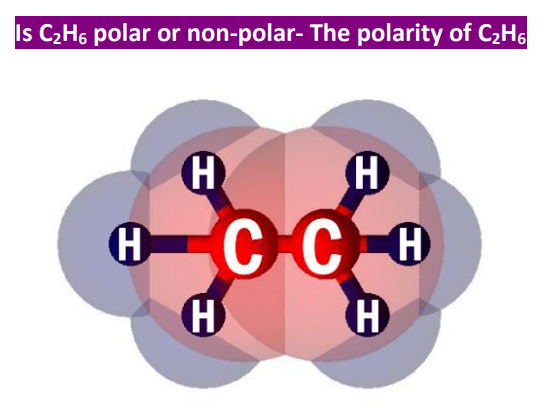
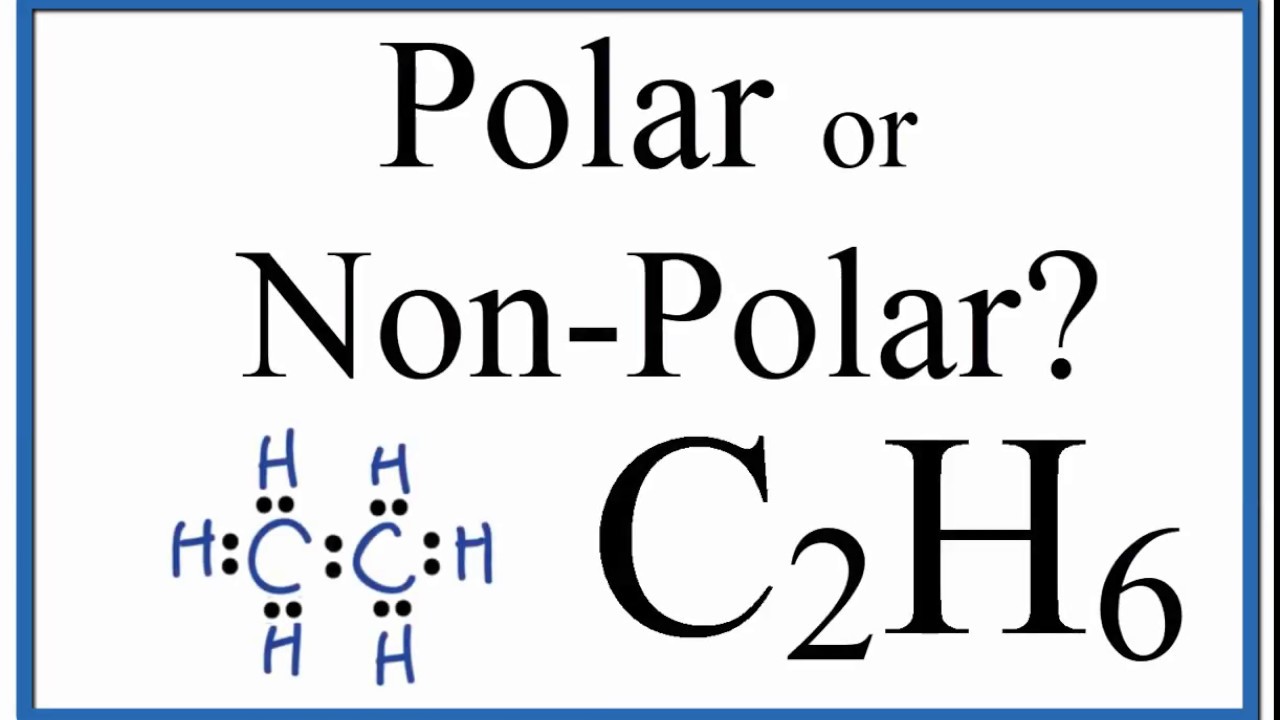
Ethane (C2H6) is made up of two carbon atoms and six hydrogen atoms. Let's first consider a single carbon-hydrogen (C-H) bond.
Carbon and hydrogen have electronegativities that are pretty similar. They are almost like twins when it comes to sharing electrons, so the C-H bond is considered essentially nonpolar.
They share nicely, like good friends, and the electron cloud around them is evenly distributed.
The Carbon-Carbon Connection
What about the bond between the two carbon atoms in ethane? Well, this is where it gets even easier.
Since both atoms are carbon, their electronegativity is exactly the same. There's no tug-of-war at all!
They're holding hands and sharing electrons in perfect harmony, resulting in a perfectly nonpolar bond.
Ethane: A Nonpolar Champion
So, we've established that both the C-H bonds and the C-C bond in ethane are nonpolar. But does that automatically make the whole molecule nonpolar?
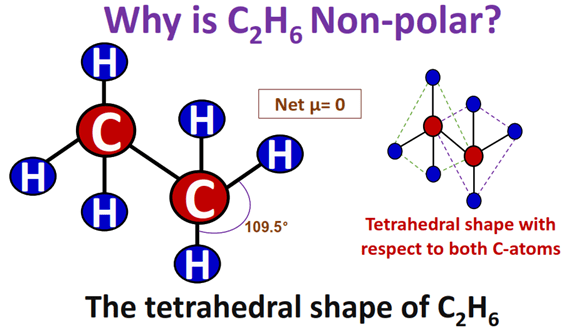
You bet it does! Because the individual bonds are nonpolar, the overall distribution of charge in the molecule is even.
There are no slightly positive or slightly negative regions, so ethane is definitely a nonpolar molecule.
Visualizing Ethane's Nonpolar Nature
Imagine ethane as a perfectly symmetrical, electron-cloudy blob. There's no lopsidedness, no uneven distribution of charge.
It's like a perfectly balanced seesaw, with no one side weighing more than the other. Everything is smooth and even!
Therefore, ethane likes to hang out with other nonpolar molecules, like the cool kids in the molecular world.
Why Does Polarity Even Matter?
Now you might be wondering, "Okay, so ethane is nonpolar. Big deal! Why should I care?" Well, polarity has a huge impact on a molecule's properties and behavior.
It influences things like boiling point, solubility, and how molecules interact with each other. Think of it as the molecule's personality.
For example, polar molecules like water (H2O) are excellent solvents for other polar molecules, while nonpolar molecules like ethane prefer to hang out with other nonpolar substances.
Like Dissolves Like: A Polarity Proverb
There's a handy rule of thumb in chemistry: "like dissolves like." This means that polar solvents dissolve polar solutes, and nonpolar solvents dissolve nonpolar solutes.
Think about trying to mix oil and water. Oil is nonpolar, and water is polar, so they don't mix well.
They stubbornly separate, like two people at a party who have absolutely nothing in common.
Ethane's Nonpolar Applications
Ethane itself is a flammable gas, which means it can burn easily. It's found in natural gas and is used as a fuel.
Because it's nonpolar, it doesn't dissolve well in water. This is important in many industrial processes where you need to separate ethane from water.
Think of it this way: ethane is the cool, detached molecule that just wants to burn brightly and avoid getting wet.
Debunking Ethane Polarity Myths
Sometimes, even with the best explanations, confusion can arise. Let's address some common misconceptions about ethane's polarity.
Myth #1: Because carbon is slightly more electronegative than hydrogen, the C-H bonds must be polar.

Busted: While there's a tiny difference in electronegativity, it's so small that we generally consider the C-H bond to be nonpolar for all practical purposes. It's like saying someone is "slightly taller" but still considered average height.
Myth #2: Since ethane is a hydrocarbon, it must be slightly polar.
Busted: Just because a molecule contains carbon and hydrogen doesn't automatically make it polar. The arrangement of atoms and the electronegativity differences are what truly determine polarity.
Myth #3: All molecules containing the same element are nonpolar.
Busted: Ozone (O3) contains only oxygen atoms, but it is a polar molecule. It is determined by its shape, not its elements alone.
Ethane: Forever Nonpolar?
So, is ethane destined to remain a nonpolar molecule for all eternity? Well, under normal conditions, yes!
Its symmetrical structure and the similar electronegativities of carbon and hydrogen ensure that it will always maintain its nonpolar status.
It's like its destiny is written in the stars (or, you know, in the periodic table).
Beyond Ethane: Exploring Molecular Polarity
Now that you've conquered the mystery of ethane's polarity, you're ready to explore other molecules and their fascinating properties.

Consider molecules like water (H2O), ammonia (NH3), or even more complex organic compounds.
Each molecule has its own unique structure and electronegativity profile, making the world of chemistry a never-ending adventure!
A Parting Thought: Polarity and Life
Polarity plays a crucial role in life itself. From the way water transports nutrients in our bodies to the way proteins fold and interact, polarity is everywhere.
Understanding polarity helps us understand the world around us at a molecular level.
So, embrace your newfound knowledge of polarity and impress your friends with your chemistry skills!
In Conclusion: Ethane's Nonpolar Swagger
Ethane, with its simple structure and equal sharing of electrons, is a proud member of the nonpolar club.
It doesn't hog electrons, it doesn't create charge imbalances, and it prefers to hang out with other nonpolar molecules.
So, the next time you encounter ethane, remember its balanced, nonpolar nature and appreciate its role in the grand scheme of chemistry!
"To be or not to be polar, that is the question." - A Chemist's Hamlet