Ir Spectra Of Cyclohexene
Ever baked a cake and thought, "Hmm, something's not quite right?" You might add a pinch of this or a dash of that, hoping for that perfect flavor. Well, scientists trying to figure out what's in a molecule do something similar, but instead of tasting, they use something called Infrared (IR) Spectroscopy. And today, we're going to explore the IR spectrum of a particular molecule: cyclohexene.
What Even is Cyclohexene? A Ring Around the Rosie of Chemistry
Imagine a bunch of kids holding hands in a circle. That's kind of what a cyclohexane molecule looks like – six carbon atoms linked together in a ring. Now, imagine one of those kids sneakily letting go of one hand and reaching across to grab the hand of the kid two spots down. Boom! You've got a double bond, and you've just made cyclohexene! It's cyclohexane's slightly cooler, more reactive cousin. This double bond is what makes cyclohexene a bit of a chemical rockstar, and it's precisely what we'll be looking for when we check out its IR spectrum.
You might be thinking, "Okay, cool story, but why should I care about some random ring-shaped molecule?" Well, cyclohexene and molecules like it are used in all sorts of things! From pharmaceuticals that help you feel better when you're sick, to materials that make your phone case durable, the chemistry behind these structures is everywhere.
Must Read
IR Spectroscopy: Molecular Fingerprints
Think of IR spectroscopy like shining a special light (infrared light, obviously!) at a molecule. This light makes the molecule vibrate. Different parts of the molecule vibrate at different frequencies, and some vibrations are really good at absorbing certain types of infrared light. It's like each type of bond (like the C-H bond or the C=C bond in our cyclohexene) has its own specific tuning fork. And when you shine IR light at a molecule and record which frequencies of light are absorbed, you get a unique pattern – an IR spectrum.
This spectrum is like a fingerprint for the molecule. No two molecules (except for identical twins, technically called enantiomers which get complicated quickly) have the exact same IR spectrum. That means you can use this technique to identify the different parts of a molecule or even figure out if you have the right molecule in your sample.
Decoding the Cyclohexene IR Spectrum
So, what does the IR spectrum of cyclohexene tell us? Here's a quick rundown:
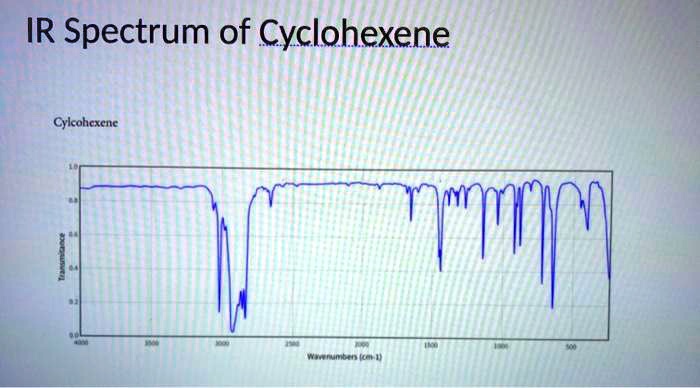
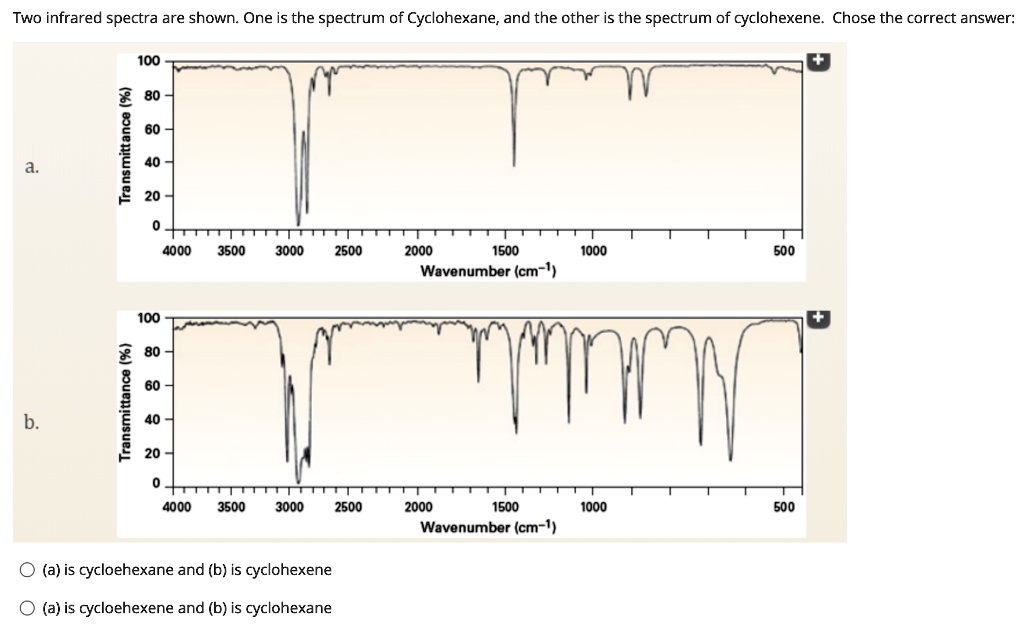
- The C=C Stretch (Around 1650 cm-1): This is the star of the show! The double bond between the carbon atoms is a strong absorber, creating a noticeable peak in the spectrum around 1650 cm-1 (wavenumbers, don't worry about the units too much). Think of it like the bass drum in a band – it's got a powerful, recognizable sound.
- The C-H Stretches (Around 2800-3100 cm-1): All those carbon-hydrogen bonds around the ring vibrate like crazy. The C-H stretches in cyclohexene are a mix of sp2 and sp3 hybridized carbons, due to the alkene and alkane portions respectively. These are your supporting bandmates - present and contributing to the overall melody. The C-H stretches just above 3000 cm-1 come from the carbon-hydrogen bonds directly attached to the double bond (the sp2 hybridized carbons).
- Other Peaks: There will be other smaller peaks representing bending vibrations and other movements within the molecule, but the two mentioned above are the key distinguishing features of cyclohexene's IR spectrum.
Imagine you're looking at a mountain range. The highest peak (the C=C stretch) tells you there's a really important feature present. The other peaks are like smaller hills that give you more details about the landscape. Analyzing all these peaks together helps us identify our cyclohexene!

Why Bother? Real-World Applications
Okay, but who actually uses this stuff in the real world? Well, here are a couple of examples:
- Quality Control: Imagine you're a chemist manufacturing a new drug. You need to make sure that the final product contains the right molecules, and only the right molecules. IR spectroscopy is a powerful tool for checking the purity and identity of your chemical products. This is like ensuring you only have the ingredients you want in your cake and in the right amounts.
- Reaction Monitoring: Scientists can use IR spectroscopy to watch chemical reactions happening in real-time. By monitoring the disappearance of the reactants' characteristic peaks and the appearance of the products' peaks, chemists can understand how the reaction is proceeding and optimize it for better yields.
- Environmental Monitoring: IR spectroscopy is also used to detect and identify pollutants in the air and water. This can help scientists track down the sources of pollution and develop strategies to clean them up. Think of it like identifying the unwanted ingredient in a water supply.
So, the next time you hear about IR spectroscopy, remember that it's not just some complicated scientific technique. It's a powerful tool that helps us understand the world around us, from the medicines we take to the environment we live in. And with a little knowledge, even a molecule like cyclohexene can become a little less mysterious and a little more interesting!