If Y Varies Directly As X

Ever noticed how some things seem to just naturally go hand-in-hand? Like, the more you study, the better your grades get? Or the more you bake, the more cookies you end up with (which, let's be honest, is a win-win)? That's the essence of direct variation, a concept that's surprisingly common and useful in both academics and everyday life. Learning about it isn't just about math class; it's about understanding how the world works a little bit better.
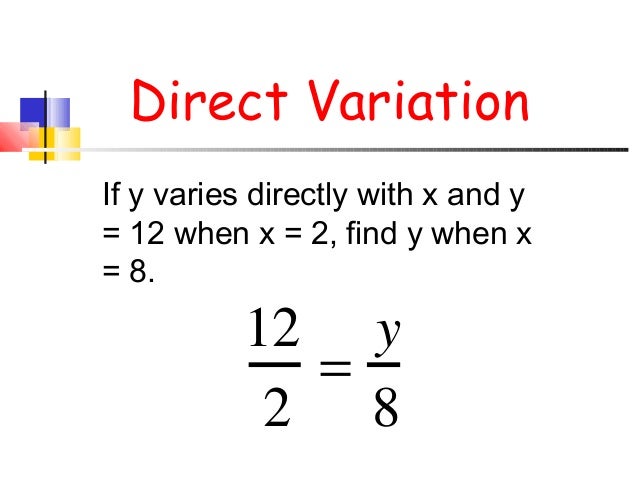
So, what exactly is direct variation? Simply put, when we say "Y varies directly as X," we mean that as X increases, Y increases proportionally, and as X decreases, Y decreases proportionally. There's a constant relationship between them. Think of it like this: Y is always a fixed multiple of X. This multiple is called the constant of variation, often represented by the letter 'k'. We can express this relationship with a simple equation: Y = kX.
The purpose of understanding direct variation is to predict how one variable will change when another variable changes. It's a powerful tool for making estimations and understanding cause-and-effect relationships. The benefits are numerous: it helps us model real-world situations, solve problems, and make informed decisions.
Must Read
Let's look at some examples. In education, a classic example is the relationship between the number of hours you study and your test score (ideally!). The more hours you dedicate to studying, the higher your score is likely to be. We can model this as "Test Score varies directly as Study Hours." Another example could be the number of pages you read in a book over time. If you read at a consistent pace, the number of pages read will vary directly with the time you spend reading.
Direct variation also pops up in daily life all the time. Consider the relationship between the amount of gas you put in your car and the distance you can drive. The more gas, the farther you can travel (assuming consistent fuel efficiency!). Or think about the number of ingredients you need when baking. If you want to double a recipe, you need to double the amount of each ingredient. The amount of each ingredient varies directly with the number of batches you're making.

Want to explore this concept further? Here are a few simple ways to experiment:
- Collect Data: Track two related variables over time. For example, measure how many plants sprout each week after planting seeds. Plot the data on a graph. Does it look like a straight line going through the origin (0,0)? If so, it's likely a direct variation.
- Cook or Bake: Experiment with increasing or decreasing a recipe. Note how the amount of each ingredient changes proportionally.
- Play with Proportions: Look for recipes or instructions where quantities are clearly stated. Can you easily double or triple the amounts while maintaining the correct ratios?
By actively looking for examples and experimenting with data, you'll start to see direct variation everywhere. It's a fundamental concept that helps us understand the interconnectedness of things and make sense of the world around us. So, keep an eye out for those proportional relationships, and you might be surprised at how often "Y varies directly as X" shows up!