
How Much Is A 1953 $5 Silver Certificate Worth

Ever stumbled across an old five-dollar bill and wondered if it's worth more than just, well, five dollars? Specifically, that 1953 $5 Silver Certificate your grandma tucked away in her sock drawer?
You're not alone! Plenty of folks have these tucked away, hoping for a hidden treasure. Let's dive into the curious case of the 1953 five-dollar bill and its potential value.
The Face Value vs. The Real Value
Okay, let's be honest. A 1953 five-dollar bill will always be worth at least five dollars. You can still technically spend it at your local grocery store (though the cashier might give you a funny look!).
Must Read
But the real question is: could it be worth more than that measly Lincoln portrait suggests?
Condition is Key!
Think of your 1953 Silver Certificate like a vintage car. A pristine, untouched 1957 Chevy Bel Air is going to fetch a pretty penny. A rusted-out, dented one? Not so much.
The same principle applies to old currency. If your bill looks like it just came off the printing press – crisp, clean, and with sharp corners – you're in much better shape than if it's been through the washing machine, used as a bookmark, and has crayon marks courtesy of your little brother.
In the world of coin and paper money collecting, "condition" is everything. Collectors use terms like "Uncirculated," "Extremely Fine," "Very Fine," "Fine," and "Good" to describe the state of a bill.
So, What's My Bill Worth?
Alright, alright, I know that's what you really want to know. A well-circulated, heavily used 1953 $5 Silver Certificate is typically worth...well, around $5 to $7. Not exactly retirement money, is it?
However! An uncirculated 1953 $5 Silver Certificate can easily fetch between $10 and $20, and sometimes even more!
The value really depends on how perfect your bill is and who is buying it.

The Allure of Silver Certificates
But why all the fuss about a piece of paper with Andrew Jackson’s face on it? The secret lies in the words "Silver Certificate." These bills were special.
They were essentially receipts for silver held by the U.S. Treasury. You could theoretically walk into a bank back then and exchange your certificate for actual silver! Imagine doing that today!
The government stopped redeeming them for silver in the 1960s, which adds to their historical intrigue and collectibility. It's like holding a tiny piece of monetary history.
Star Power
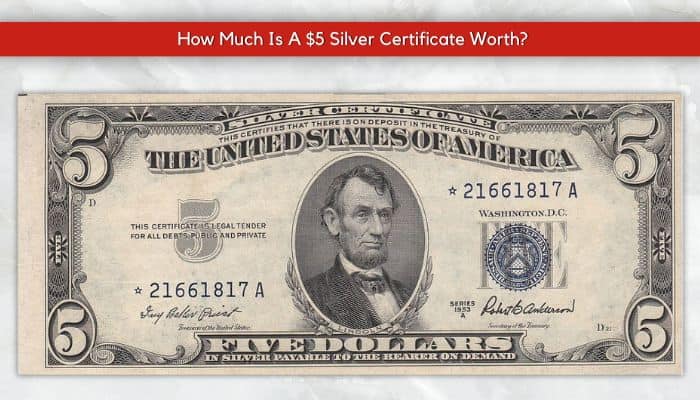
Keep an eye out for a tiny star symbol () near the serial number. This indicates that the bill is a "replacement note."
These star notes were printed to replace damaged or misprinted bills during the original printing process. They are generally rarer and more valuable to collectors.
Even in circulated condition, a 1953 $5 Silver Certificate Star Note can fetch a decent premium, sometimes double or even triple the value of a regular bill.
The "Series" Game
You'll notice a letter after the date "1953." This letter indicates the *series of the bill, like 1953, 1953A, 1953B, etc.

While the series can affect value, it's less significant than condition and the presence of a star. However, collectors sometimes specialize in specific series, so a rarer series might command a slightly higher price.
Think of it like collecting baseball cards. Some years are more desirable than others, even if the players are the same.
Who Signed the Bill?
Each $5 Silver Certificate bears the signatures of the Secretary of the Treasury and the Treasurer of the United States at the time of its printing.
Certain signature combinations are slightly rarer than others, though this usually only affects value for collectors specializing in this niche aspect of currency collecting.
However, knowing who signed your bill can add a touch of personality to your piece of history.
The Fun of the Hunt
Ultimately, the fun of owning a 1953 $5 Silver Certificate isn't always about the monetary value. It’s about the connection to the past.
It’s about imagining the hands that held it, the stores where it was spent, and the stories it could tell if only it could talk.
It's about the thrill of the hunt, the excitement of finding a little piece of history in an unexpected place.
Where to Get Your Bill Appraised
If you truly believe you have a pristine, uncirculated 1953 $5 Silver Certificate (especially a star note!) and want a professional opinion, consider getting it appraised.
A reputable coin and currency dealer can assess the condition accurately and give you a fair estimate of its value.
Just be wary of dealers who promise exorbitant prices upfront – always get a second opinion!
Online Resources
There are also numerous online resources available, such as websites and forums dedicated to coin and currency collecting. These can provide valuable information and help you estimate the value of your bill.
Be sure to compare your bill carefully to photos and descriptions to get a realistic assessment of its condition.
Remember, though, that online appraisals are never as accurate as a professional in-person evaluation.
More Than Just Money
So, is your 1953 $5 Silver Certificate going to make you rich? Probably not. But that doesn't mean it's not valuable.

It's a tangible link to a bygone era, a reminder of a time when money had a more direct connection to precious metals.
And who knows? Maybe it will spark a newfound interest in history, collecting, or even just a deeper appreciation for the stories hidden within everyday objects.
The Gift of Giving (or Keeping!)
Even if your bill is only worth a few dollars over face value, it can still make a thoughtful and unique gift.
Imagine giving it to a history buff, a coin collector, or even just someone who appreciates quirky little treasures.
Or, you could simply keep it as a personal reminder of a simpler time, a small piece of history to cherish and pass down to future generations.
In Conclusion: Check Your Wallets!
The next time you stumble upon an old bill, don't dismiss it right away. Take a closer look!
You might just discover a hidden treasure, a piece of history, or at the very least, a fascinating story waiting to be told.
And who knows? Maybe that 1953 $5 Silver Certificate tucked away in your wallet is worth more than you think!