How Much Gasoline In A Barrel Of Oil

Alright, picture this: You’re standing at the gas pump, right? The nozzle is firmly in place, and you’re watching those numbers spin faster than a hamster on a caffeine rush. Every cent feels like it's being personally extracted from your wallet, and you probably let out a little sigh, maybe a groan, as the total climbs. Sound familiar? Because, let's be real, it's a universal experience.
As I stood there just last week, doing my usual mental math (and failing miserably to justify the cost), a thought popped into my head, clear as day: Where does all this goop even come from? Like, I know it starts as oil, obviously. But how much of that mysterious, gooey black gold actually transforms into the precious liquid fueling my daily commute, grocery runs, and those much-needed road trips?
That, my friends, led me down a bit of a rabbit hole – a fascinating one, if you ask me. We often hear about a "barrel of oil" in the news, especially when they're talking about prices, but what does that actually mean for us, the humble consumers, at the pump? How many gallons of that sweet, sweet gasoline do we actually squeeze out of one of those bad boys?
Must Read
The Magic of a Barrel (and What It's NOT)
First off, let’s clear up a common misconception. When we talk about a barrel of oil, we’re not really talking about a literal, rustic wooden barrel being rolled around. That image, while charming, is a relic from the 19th century when oil was indeed shipped in whiskey barrels. Today, it's just a standard unit of measurement in the oil industry. And how big is it? A barrel of oil contains exactly 42 US gallons. Got it? Good. That's our starting point.
Now, here's where it gets interesting, and frankly, a bit like modern-day alchemy. You don't just crack open a barrel and pour out 42 gallons of gasoline. Oh, if only it were that simple! Crude oil is a complex mixture of hydrocarbons, and it needs a serious glow-up (or, more accurately, a serious refining process) to become useful products.

The Big Reveal: How Much Gasoline?
After crude oil makes its journey from the ground (or sea) to a refinery, it undergoes a process called fractional distillation. Basically, they heat the oil up to incredibly high temperatures, and as it cools, different components separate out at different boiling points. It’s pretty wild, right? Like a super-scientific sorting hat for hydrocarbons.
So, after all that heating, cooling, cracking, and treating, how much gasoline do we get? Drumroll please...
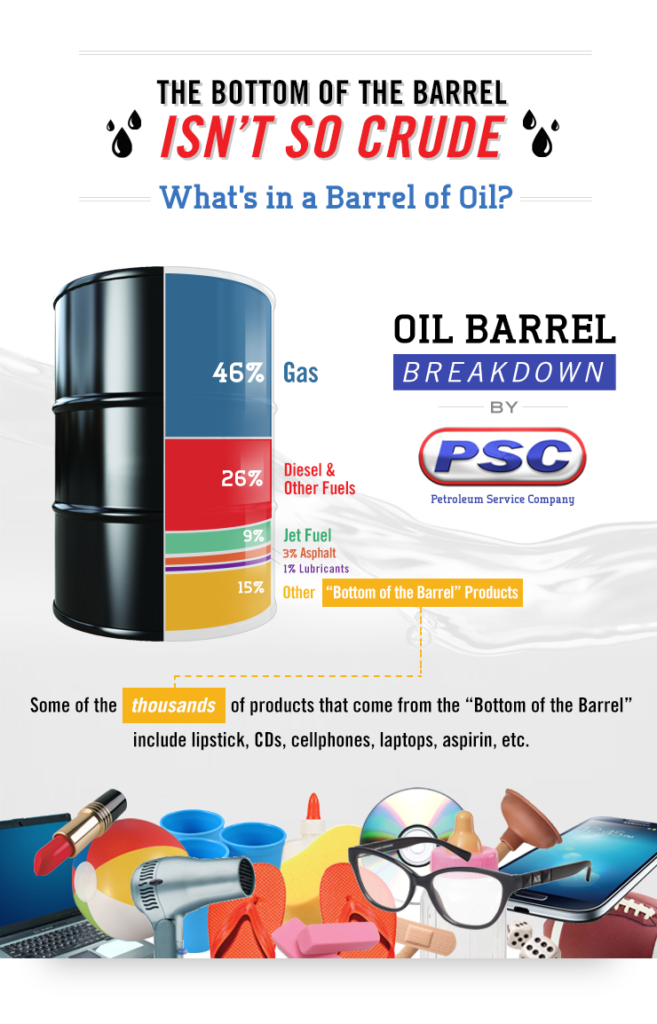
From one 42-gallon barrel of crude oil, refineries typically produce about 19 to 20 gallons of finished motor gasoline. Yeah, you read that right. Almost half! Isn't that wild? You'd think it would be less, considering all the other stuff we hear about.

This number isn't fixed, of course. It can vary slightly depending on the type of crude oil (some are "lighter" and yield more gasoline) and the specific refinery's setup and priorities. But 19-20 gallons is a solid average to keep in your back pocket for your next trivia night.
Wait, There's More! (Because There Always Is)
But hey, if a barrel is 42 gallons and we only get around 20 gallons of gasoline, what happens to the other 22 gallons? Does it just vanish into thin air? Nope! That’s the beauty of refining. Crude oil is a treasure trove of different energy products and materials. It's not a one-trick pony, folks.
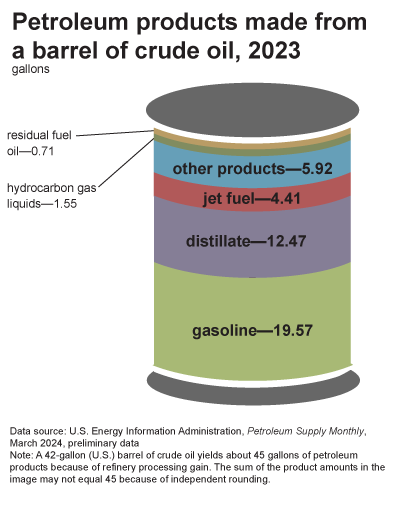
Here’s a quick rundown of what else usually comes out of that same barrel:
- Around 10-12 gallons of diesel fuel and heating oil. So, if you drive a diesel car or heat your home with oil, you’re also part of the barrel club!
- About 3-4 gallons of jet fuel. Next time you're on a plane, remember that a fraction of the oil that fueled your car likely fueled your flight too.
- A couple of gallons of heavy fuel oil (for ships and industrial uses).
- And then there's a smaller but significant amount of other stuff: think asphalt for our roads, lubricants for engines, petrochemical feedstocks (which go into plastics, fertilizers, and countless other products – seriously, look around you right now, chances are you'll spot something derived from oil!), and even propane and other liquid gases.
So, when you consider that a single barrel of crude oil is essentially dissected and transformed into a whole arsenal of products that power our transportation, heat our homes, and even make our everyday items, it’s actually pretty impressive. It’s not just about the gas for your car; it’s about a whole ecosystem of modern life. Pretty mind-boggling, right?
Next time you're at the pump, watching those digits climb, take a moment to ponder the journey. From a 42-gallon barrel of raw crude to the 19-20 gallons of gasoline filling your tank, plus all the other essential components of our world, it’s quite the transformation. And for me, knowing this makes that little groan at the price slightly more tolerable. Okay, maybe just a tiny bit. It's still expensive!