
How Many Watts To Run A House Generator
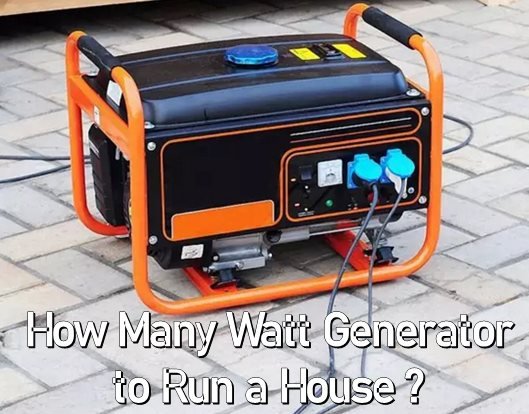
Okay, so picture this: the lights flicker, then BAM! – everything goes dark. Your phone's at 10%, the fridge is silently plotting to spoil all your groceries, and your coffee maker suddenly feels like a cruel joke. Sound familiar? We’ve all been there, friend. And that’s when you start thinking about a generator, right?
But then comes the big head-scratcher: "How many watts do I even need to keep my little kingdom running?" It’s not as simple as pulling a number out of a hat, trust me. It’s more like a fun little detective game, with your appliances as the suspects!
First, Let's Get Real: What Do You Actually Want to Power?
This is the golden question. Are we talking about just keeping the essentials alive – like a life support system for your food and phone? Or do you dream of a blackout where you can still binge-watch Netflix with a hot cuppa? Be honest with yourself!
Must Read
Most folks, especially for a portable generator, are aiming for survival and sanity. Think about it:
- The refrigerator and freezer (absolute non-negotiables, unless you enjoy lukewarm milk).
- Some lights (because stumbling in the dark is only fun until you stub your toe).
- Phone charging (because how else will you scroll through emergency memes?).
- Maybe a furnace fan (if it’s chilly) or a window AC unit (if it’s a sauna).
- A well pump, if you rely on one for water.
Beyond that, you might add things like a microwave, TV, or that beloved coffee maker. But let’s not get too crazy unless you’re planning on running a full-blown disco during the outage.

Starting Watts vs. Running Watts: The Plot Thickens!
Here's where it gets a little tricky, but totally manageable. Every appliance has two wattages you need to care about:
- Running Watts (or Rated Watts): This is what the appliance needs to just... well, run normally. Like a car cruising on the highway.
- Starting Watts (or Surge Watts): This is the extra burst of power some appliances need for a split second when they first kick on. Think of a car accelerating from a stop – it takes more gas initially, right? Motors, especially, are notorious for this. Your fridge? Your AC? Your well pump? Big surges!
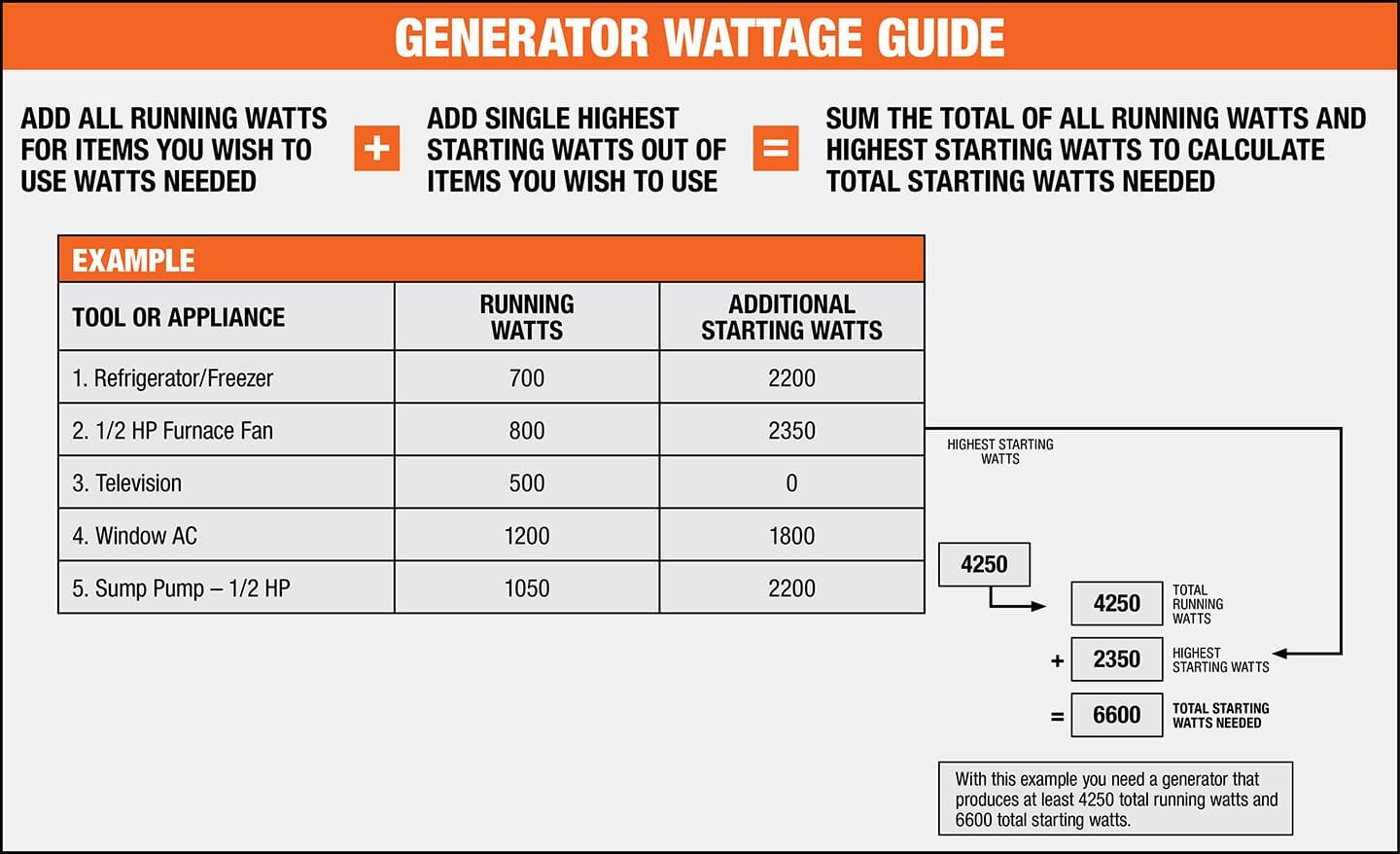
Your generator needs to be able to handle both. It needs to have enough running watts for everything you want on simultaneously, and enough starting watt capacity for the largest single surge from an appliance kicking on.
Let's Play "Appliance Detective"!
Grab a notepad, seriously. Now, take a walk around your house. Look at the back or bottom of your appliances. You’re looking for a sticker that lists watts (W), amps (A), or volts (V). If you see amps and volts, don't sweat it! Just do a quick calculation: Watts = Volts x Amps. (Most household outlets are 120V in North America, by the way.)
Here are some rough estimates to get you started, but always check your specific appliance:

- Refrigerator: 600-800 running watts, but a whopping 1500-2000 starting watts. See? Tricky!
- Freezer: Similar to a fridge, maybe a tad less, but still has a big surge.
- Lights (LED/CFL): Super low! 10-20 watts each. Incandescent are higher, like 60-100W.
- Microwave: 600-1500 running watts (depending on power), no big surge usually.
- TV: 100-300 watts (again, depends on size).
- Coffee Maker: 800-1500 watts (oh, the things we do for caffeine!).
- Furnace Fan (Gas): 600-1000 running, 1500-2000 starting.
- Portable Fan: 75-200 watts.
- Window AC Unit (Small): 1000-1500 running, 2000-3000 starting.
- Well Pump: Oh boy, these can be huge surges. 1000-2000 running, but 2000-4000 starting!
- Phone Charger: Minimal, like 5-10 watts. Don't even worry about it.
The "Add 'Em Up and Add Some More" Method!
Here’s your action plan:
- List your MUST-HAVES: Write down everything you absolutely need to run during an outage.
- Note their running watts: Sum these up. This is your total running wattage.
- Identify the BIGGEST surge: Look at your list. Which appliance has the highest starting watts? (Often it's the fridge, freezer, well pump, or AC).
- Calculate your minimum generator size: Take your total running watts, then add the difference between the biggest starting watt appliance and its running watts. Or, simpler: Take your total running watts and ensure your generator’s peak/surge rating is higher than the biggest surge appliance on your list.
- Add a buffer: Seriously, always round up or add another 10-20%. Because, well, life happens. And you might just decide you really need that toaster.
For example, if your fridge (2000W surge) and a few lights (500W running) total 1500 running watts, you'd need a generator with at least 1500 running watts and a surge capacity of at least 2000W (or more to be safe!).
So, What's the Magic Number?
There isn't one, sadly! But here are some common ranges for portable generators:
- 3,000 - 5,000 Watts: This will generally cover your absolute essentials (fridge, some lights, phone charging, maybe a small TV). Good for smaller homes or short outages where you just need to keep things ticking over.
- 5,000 - 7,500 Watts: This is a popular sweet spot for many. It handles essentials comfortably and adds in some creature comforts like a microwave, coffee maker, or a window AC unit (though maybe not all at once!). Perfect for a family.
- 7,500 - 10,000+ Watts: Now we’re talking more substantial power. You can likely run most major appliances, possibly even a small central AC unit, but you'll need to be mindful of your load. This is getting into "whole-house essentials" territory, but still usually requires some power management on your part.
Anything much bigger, and you’re probably looking at a permanently installed standby generator, which is a whole different (and much more expensive!) ballgame. For those, you're pretty much powering your whole house automatically.
The key takeaway? Don't just guess! Do a little homework, make your list, check your watts, and then add a little extra for good measure. A little planning now means a lot less stress when the lights go out. You've got this!