
How Many Watts For Portable Ac

Okay, folks, let's talk about something cool (pun intended!). We're diving into the wonderful world of portable AC units and, more specifically, those mysterious watts. Now, I know what you're thinking: "Watts? Sounds like something my grandpa used to yell about when the lights flickered." But trust me, understanding watts is key to staying comfy without blowing a fuse (literally or figuratively!).
Why should you care? Imagine this: You're finally ready to escape the summer heat, you excitedly plug in your brand-new portable AC, and... bam! Power outage. Or worse, a hefty electricity bill that makes you question all your life choices. Knowing about watts can save you from these little domestic dramas.
So, What Exactly Are Watts?
Think of watts like the "energy currency" your appliances use. It's how much electricity they need to do their job. A lightbulb might need 60 watts to shine brightly, while your microwave might gulp down 1000 watts to heat up that leftover pizza. Portable AC units, being more powerful, need a significant chunk of watts too.
Must Read
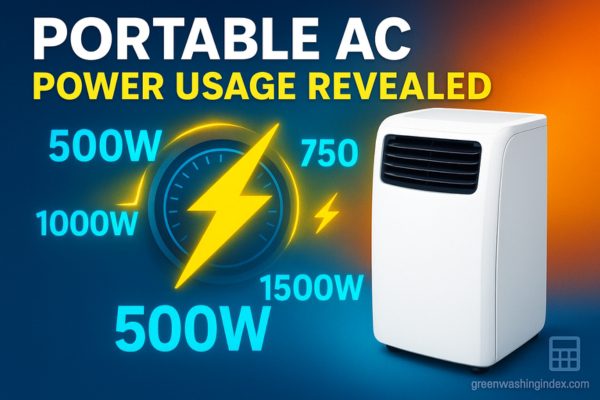
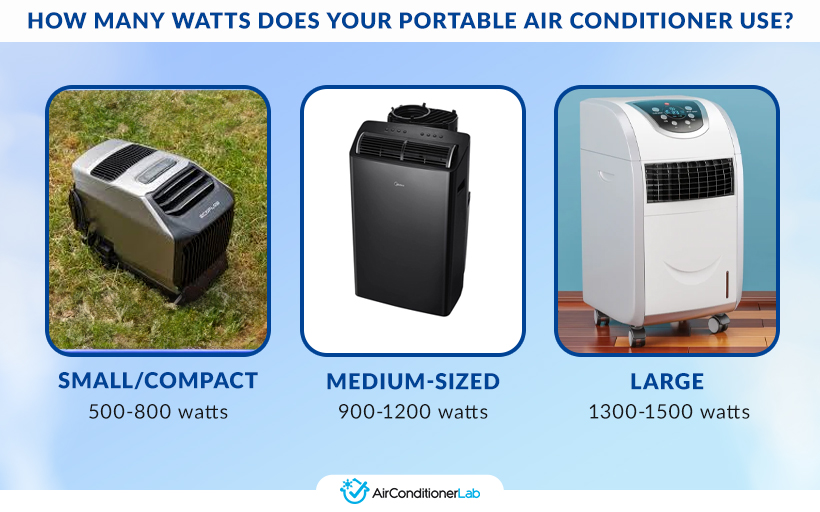
Generally, portable AC units fall in the range of 700 to 1500 watts. But that's a pretty wide range, right? Let's break it down.
Decoding the Wattage: Size Matters!
Just like with apartments, size matters! The bigger the room you want to cool, the more powerful (and therefore, the more watts) your AC unit will need. A small bedroom (think 150-250 square feet) might be perfectly happy with a 700-900 watt unit. But trying to cool a sprawling living room (say, 400+ square feet) with that same unit? You'll be sweating faster than you can say "heatstroke."

Bigger rooms require more BTUs (British Thermal Units), which is another measurement of cooling power. And higher BTU units, unsurprisingly, demand more watts.
Check Your Circuit Breaker, Buddy!
This is where things get real, folks. Your home's electrical circuits can only handle so much at once. Each circuit breaker is rated for a certain amperage (amps), which translates directly to the maximum wattage it can handle. Most standard household circuits are either 15 amps or 20 amps. To figure out the maximum wattage, you multiply the amperage by the voltage (which is usually 120 volts in North America).
So, a 15-amp circuit can handle 15 amps x 120 volts = 1800 watts. A 20-amp circuit can handle 20 amps x 120 volts = 2400 watts.
Now, here's the catch: you don't want to max out a circuit. It's a recipe for tripped breakers and frustration. As a general rule, it's best to keep your total wattage on a circuit below 80% of its maximum. So, aim for under 1440 watts on a 15-amp circuit and under 1920 watts on a 20-amp circuit.
Consider this: You've got your TV (let's say 200 watts), a lamp (60 watts), and your laptop charger (50 watts) all plugged into the same circuit. That's already 310 watts. Plugging in a 1500-watt AC unit on top of that might just send your circuit breaker into a tiny, electrical meltdown.
The Energy Efficiency Angle (Save Money, Save the Planet!)
Think of it this way: Two AC units might both cool the same-sized room, but one could use fewer watts to do it. That's what we call energy efficiency! Look for units with a high Energy Efficiency Ratio (EER) or a Seasonal Energy Efficiency Ratio (SEER). The higher the numbers, the less electricity they use to get the job done. It's like getting a car that gets better gas mileage – it saves you money in the long run and is kinder to the environment. Everybody wins!

Pro Tip: Running your AC unit on a lower setting, when possible, also uses fewer watts. Think of it like driving slower – you'll save gas (or, in this case, electricity!).
In a Nutshell: How to Choose Wisely
Alright, let's wrap this up. Here's your cheat sheet for choosing the right portable AC unit:
* Size of the room: Bigger room = higher BTU = more watts. * Check your circuit breaker: Know your amperage and calculate the maximum wattage you can safely use on a circuit. * Consider other appliances: Don't overload a circuit! Account for the wattage of everything else plugged into the same circuit. * Look for energy efficiency: Higher EER/SEER = less electricity used.So, there you have it! A (hopefully) painless explanation of watts and portable AC units. Now go forth, stay cool, and avoid those dreaded power outages and sky-high electricity bills! And remember, a little knowledge about watts can go a long way towards making your summer a whole lot more comfortable. Stay cool!