
How Many Valence Electrons Are In A Selenium Atom

Okay, so picture this: I'm trying to explain the concept of covalent bonding to my niece, Lily (who's more interested in TikTok dances, bless her heart). She keeps asking, "But why do atoms want to share?" I stammered something about "stability" and "full outer shells," but her eyes just glazed over. That's when I realized I needed to seriously break down the basics, starting with... valence electrons!
And that's how I found myself staring at the periodic table, trying to remember exactly how many valence electrons Selenium (Se) has. You know, the stuff they sometimes put in shampoos and dietary supplements? Yeah, that Selenium.
So, How Many Valence Electrons Does Selenium Have?
Alright, drumroll please... Selenium has six valence electrons. Ta-da! But hold on, don't just take my word for it. Let's dive a little deeper into why that is. (Because understanding the "why" is way more interesting than just memorizing, right?)
Must Read
First, a quick recap: Valence electrons are the electrons in the outermost shell of an atom. They're the ones that participate in chemical bonding – they're the social butterflies of the atomic world. These electrons determine how an atom will interact with other atoms.
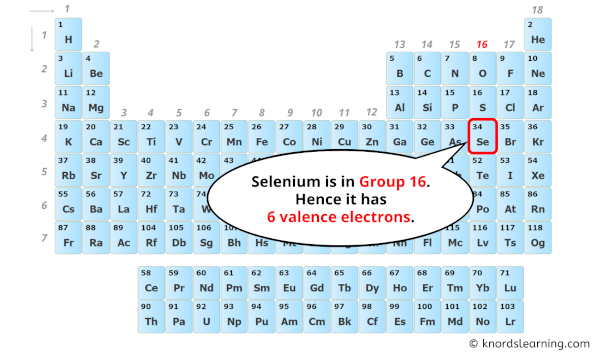
To figure out the number of valence electrons, you just need to find Selenium on the periodic table. It's in Group 16 (also known as Group 6A) – and here's the super-useful trick – the group number (for main group elements, at least) tells you how many valence electrons an element has! Boom! Science magic. (Okay, maybe not magic, but pretty darn cool, right?)
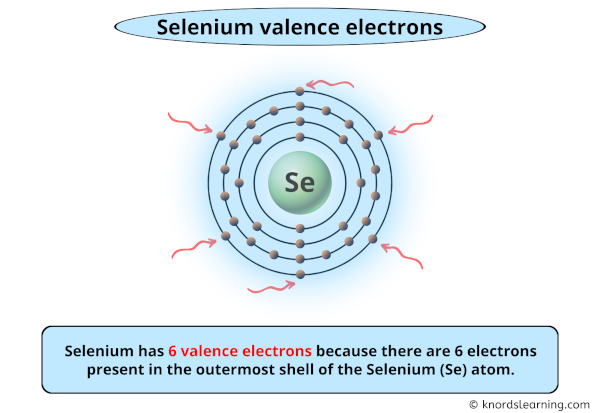
Think of it like this: All the elements in Group 16 are a bit like that one friend who almost has everything together. They have six out of the eight electrons they need to have a full outer shell, which makes them reactive. They're actively looking to either gain two more electrons or share some of their existing ones to achieve that sweet, sweet stability.
Selenium, specifically, is a nonmetal. It's sitting just below sulfur (S) in the same group, and it behaves similarly. Both tend to form two covalent bonds. These bonds is a way to share electrons with two different atoms, in effect gaining those two electrons to complete their valence shell. It can form compounds like hydrogen selenide (H2Se), similar to how sulfur forms hydrogen sulfide (H2S). See the pattern?

Why Does it Even Matter?
Good question! Knowing the number of valence electrons helps you predict how Selenium will react with other elements. Will it form an ionic bond? A covalent bond? How many atoms will it bond with? This is crucial for understanding chemical reactions and predicting the properties of compounds.
For example, those six valence electrons explain why Selenium can react with oxygen to form selenium dioxide (SeO2). Each oxygen atom needs two electrons to complete its valence shell, and selenium is happy to share two of its electrons with each oxygen atom.
Now, Lily might still be more excited about dancing trends than chemical bonding, but at least you now know a little more about valence electrons. And you can impress your friends at the next party. (Okay, maybe not impress, but at least you can drop a fun fact about Selenium.)
So next time you're pondering the mysteries of the periodic table, remember the social butterflies of the atomic world, and you'll be one step closer to understanding the fascinating world of chemistry. And always remember: Six valence electrons for Selenium!
