
How Many Combinations In 10 Numbers
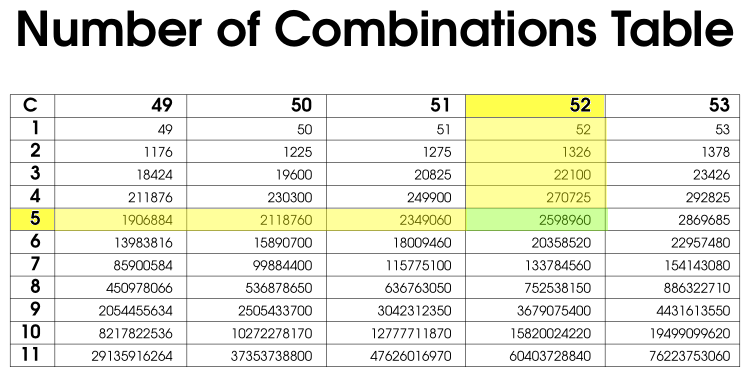
Okay, so picture this: I'm at a lottery draw, gripping my ticket so tight my knuckles are white. They announce the first number, and it's almost one of mine. The tension is unbearable! It got me thinking, though – what are my actual odds? And more specifically, how many darn combinations are even possible when you're picking numbers from a set?
Turns out, it's not as simple as just multiplying everything together. (Trust me, I tried that first. Disaster.) That's where the concept of combinations comes in. Think of it like this: it's about figuring out how many different groups you can make from a bigger set, where the order doesn't matter. Super important detail, that last bit!
The Combination Conundrum (aka Math Time!)
Let's simplify. Imagine you have 10 numbers – let's say 1 through 10 for easy visualization. And you want to choose, oh, let's say 3 of them. How many different sets of 3 numbers can you make?
Must Read
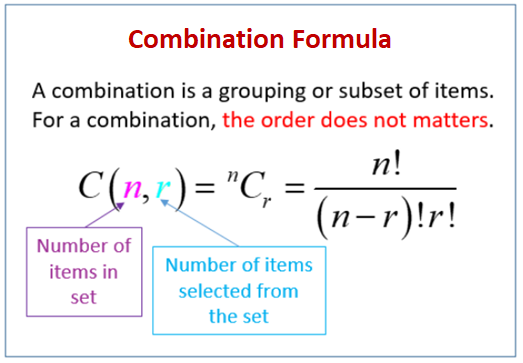
This is where the combination formula swoops in to save the day. It looks a bit scary at first, but don't worry, we'll break it down. It's written as "nCr" where:
- n is the total number of items (in our case, 10)
- r is the number of items you're choosing (in our case, 3)
And the formula itself is: nCr = n! / (r! * (n-r)!) – Whoa, hold on a sec! What's that "!" symbol? That's the factorial. It just means you multiply a number by all the positive whole numbers smaller than it. So, 5! = 5 * 4 * 3 * 2 * 1 = 120.

Okay, back to our 10 numbers choosing 3. Let's plug everything into the formula:
10C3 = 10! / (3! * (10-3)!) = 10! / (3! * 7!) = (10 * 9 * 8 * 7 * 6 * 5 * 4 * 3 * 2 * 1) / ((3 * 2 * 1) * (7 * 6 * 5 * 4 * 3 * 2 * 1))
Alright, that looks intimidating, I know. But here's the magic: you can cancel out a bunch of stuff! The 7! in the top and bottom cancels out completely, leaving us with:
(10 * 9 * 8) / (3 * 2 * 1) = 720 / 6 = 120
So, there are 120 different combinations of choosing 3 numbers from a set of 10! Not as bad as you thought, right?

Why Does Order Not Matter?
This is crucial. If order did matter, we'd be talking about permutations, not combinations. With permutations, picking 1, 2, 3 is different from picking 3, 2, 1. But with combinations, they're considered the same set. (Think of it like a fruit salad – the order you put the fruit in doesn’t change the ingredients.)
Let’s say you are picking 3 winning numbers in a lottery where the order matters. Then that's a permutation problem. And trust me, the number of possibilities skyrockets. Suddenly, those long odds feel even longer! – Aren't you glad we're sticking with combinations for now?
Beyond the Basics: Real-World Examples
Combinations aren't just for lottery tickets, though. They pop up everywhere! Here are a few examples:

- Poker Hands: How many different 5-card hands can you make from a deck of 52 cards?
- Team Selection: Choosing a team of 5 players from a group of 12.
- Password Generation: Creating a password with a specific number of characters from a defined set.
The applications are endless. And understanding combinations can give you a real edge in all sorts of situations. – Okay, maybe not a huge edge, but a little one!
Final Thoughts: Don't Panic!
Combinations might seem daunting at first, but with a little practice, they become much easier to grasp. And remember, there are tons of online calculators that can do the heavy lifting for you. (Google is your friend!) The key is understanding the concept of combinations: choosing a group where order doesn't matter.
Now, if you'll excuse me, I have a lottery ticket to check. Wish me luck! (And maybe calculate my odds while you're at it...)