
How Do I Convert Kw To Kwh
Ever stared at your electricity bill, feeling like you've just received a secret message from an alien civilization? Terms like kW and kWh might look like hieroglyphs designed to confuse mere mortals. Fear not, brave adventurer!
Today, we're going to unravel one of the universe's greatest (okay, maybe just your greatest) energy mysteries: how to transform that speedy kW into the cumulative cosmic power of kWh. Get ready to become an energy guru!
Meet the Dynamic Duo: kW and kWh
Imagine you're at a magical energy race. On one side, we have kW, our speedy little sprinter. Think of kW as the instant power your appliance demands at any given moment.
Must Read
It’s like your car’s speedometer, telling you how fast you're going right now. A hair dryer might sprint at a high kW, but only for a quick burst!
Then, we have kWh, the marathon runner. This is the total distance your energy has traveled over a period of time. It’s like your car’s odometer, tracking all the miles you’ve covered.
This magical number, kWh, is what your utility company actually charges you for. It's the grand total, the accumulated effort!
The Super Simple Secret Formula!
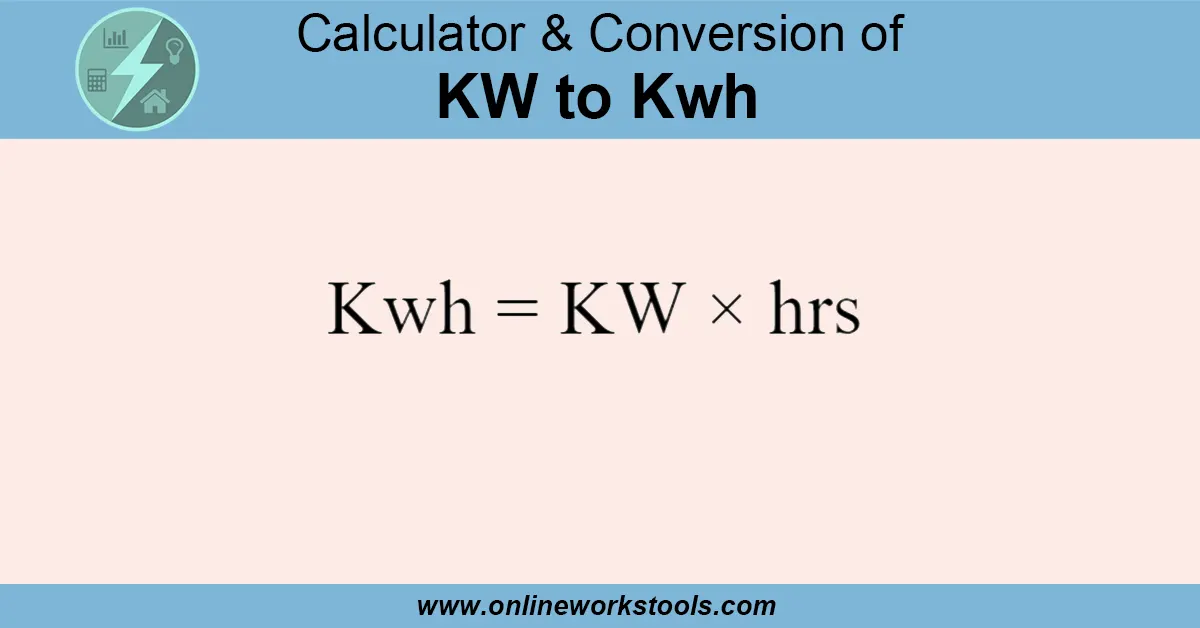
Ready for the big reveal? It’s so shockingly simple, you’ll wonder why you ever broke a sweat over it. To convert kW to kWh, you just need one other ingredient: time!
Specifically, you need the number of hours your appliance was busy doing its thing.
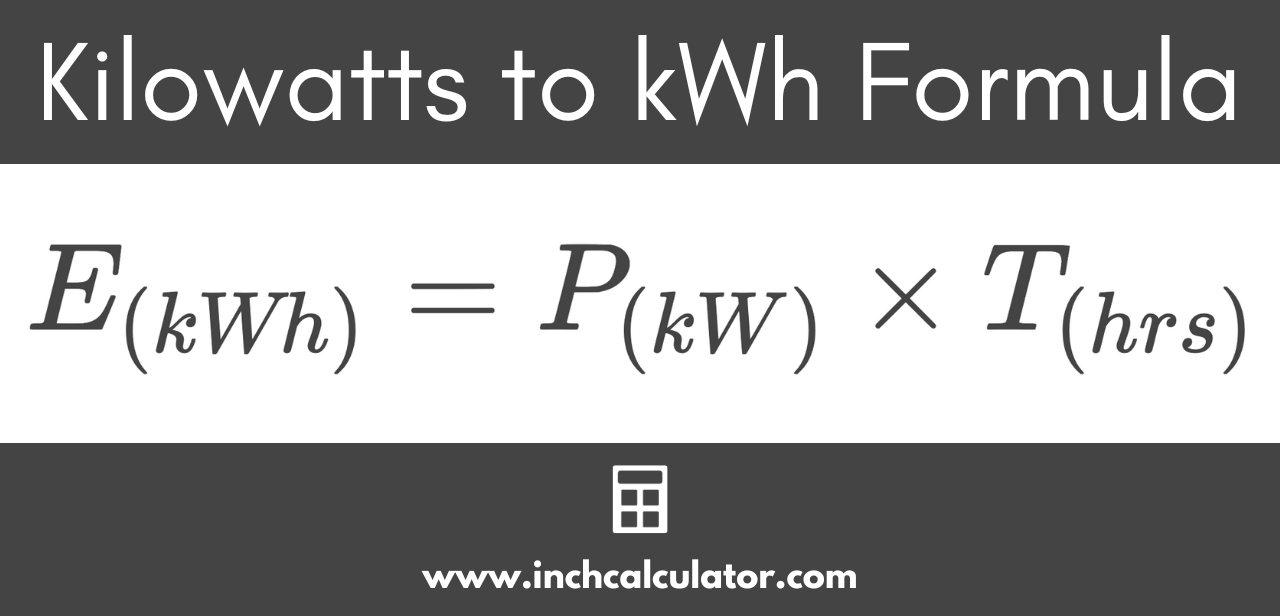
kW × Hours = kWh
Yes, it’s that easy! It's like saying "speed times time equals distance." This little formula is your key to unlocking energy enlightenment.
Let's Toast to Understanding (with an actual toaster!)
Imagine your trusty toaster, poised to deliver golden perfection. A typical toaster might chug along at about 1.2 kW (that's 1200 watts, for those who like bigger numbers!).
But you don't toast for hours, do you? You're usually in and out, quick as a flash! Let's say you use it for about 5 minutes each morning.
First, we need to convert those 5 minutes into hours. There are 60 minutes in an hour, so 5 minutes is 5/60 = approximately 0.083 hours.
Now for the magic! 1.2 kW × 0.083 hours = 0.0996 kWh. See? Barely a dent in your bill for that delicious toast!
Shine Bright: The Lightbulb Saga
Let's illuminate our understanding with a lightbulb. An old-school incandescent bulb might suck up 0.06 kW (60 watts). If you leave that bulb on for, say, 10 hours a day (oops!).

The calculation: 0.06 kW × 10 hours = 0.6 kWh. Every single day! It adds up faster than you can say "flick the switch!"
Now, let's look at a modern LED bulb, a true energy superhero. It might only use 0.009 kW (9 watts). Left on for the same 10 hours: 0.009 kW × 10 hours = 0.09 kWh.
That's a massive difference, almost seven times less energy! This is why those little kW differences really matter over hours of usage.
The Mighty Hair Dryer: Quick Power Burst!
Your hair dryer is a true beast of immediate power. It can easily hit 1.8 kW or even higher! That's some serious energy muscle for a short task.
But thankfully, you're not blow-drying your hair for an entire hour (we hope!). Let's say you use it for 15 minutes, which is 0.25 hours.
So, 1.8 kW × 0.25 hours = 0.45 kWh. It's a noticeable chunk, but because the duration is short, it's not a bill-buster unless you're styling a whole salon's worth of hair!
The Air Conditioner: Summer's Silent Power Drinker
Ah, the blissful hum of an air conditioner on a hot day. This is where kW and kWh really start to dance a tango on your electricity bill.
A typical central air conditioning unit might run at around 3.5 kW. Now, imagine it's a sweltering summer day, and you run it for a glorious 8 hours.
The math for that sweet relief: 3.5 kW × 8 hours = 28 kWh! That's per day! Over a month, that's a serious number.
Understanding this helps you see why those hot days can make your bill jump. It's the high kW combined with many, many hours.
Gaming Rig: Powering Virtual Worlds
For the gamers out there, your powerful PC is another great example. A high-end gaming computer, when running full tilt, could draw about 0.5 kW (500 watts).
If you embark on an epic gaming marathon, say, 4 hours of intense virtual adventures, let's do the sums.
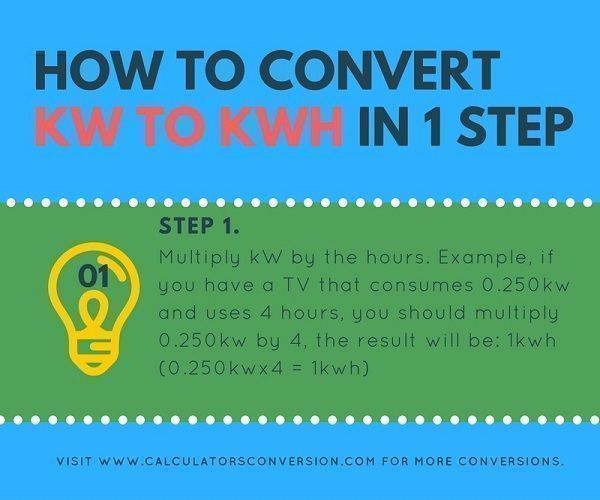
0.5 kW × 4 hours = 2 kWh. Not too bad for saving the world (or conquering it!). But consistent daily usage definitely adds up.
You are now an Energy Master!
See? No alien messages, no secret codes, just a simple formula and a dash of common sense! You've successfully tamed the wild beast of energy conversion.
Now, when you see kW or kWh, you won't flinch. You’ll understand that kW is the oomph an appliance uses right now.
And kWh is the total energy party it hosted over a period of time, the amount that makes its way onto your bill.
Go forth and impress your friends, baffle your neighbors, and perhaps even save a few bucks by becoming an energy-conscious superstar. You’re officially a power pro!