
Guitar Chords How To Play

Alright, settle in, folks, because we're about to embark on a journey. A journey into the wild, wonderful, and occasionally finger-cramping world of guitar chords! Trust me, learning guitar chords is like learning to ride a bike made of wood and covered in bees. It might seem impossible at first, but once you get the hang of it, you'll be pedaling your way to rock stardom (or at least being able to strum “Wonderwall” at your next campfire).
The Almighty A Chord (and Why It's Not So Scary)
Let's start with a classic: the A major chord. Now, I know what you're thinking: "A major what-now?! Sounds complicated!" But fear not, brave strummer! It's actually pretty simple. Think of it as a tiny house party happening on your fretboard.
Here's the lowdown: You're basically squishing three fingers onto the 2nd fret. Your index, middle, and ring fingers all pile onto the 2nd fret of the D, G, and B strings respectively. Imagine them as really close friends attending a very small concert. The E string is open, as is the A string, and the remaining string (high e) is also open, creating the overall A Major Chord.
Must Read
Important Note: Make sure you’re pressing down hard enough to get a clear sound. If it sounds buzzy, your fingers might be a little too timid. Give it some oomph! Not too much, unless you want to accidentally invent a new form of guitar torture.
Once you get your fingers in position, strum all six strings. Hear that? That's the sound of progress! That's the sound of approximately 75% of all pop songs ever written. Okay, maybe I'm exaggerating a little. But seriously, A major is a workhorse chord. You’ll use it all the time.
The E Chord: Easy Peasy Lemon Squeezy (Hopefully)
Next up, we have the E major chord. This one's almost criminally easy. It's like the "walk" signal in guitar chords. It says, "Hey, you! You can do this!"
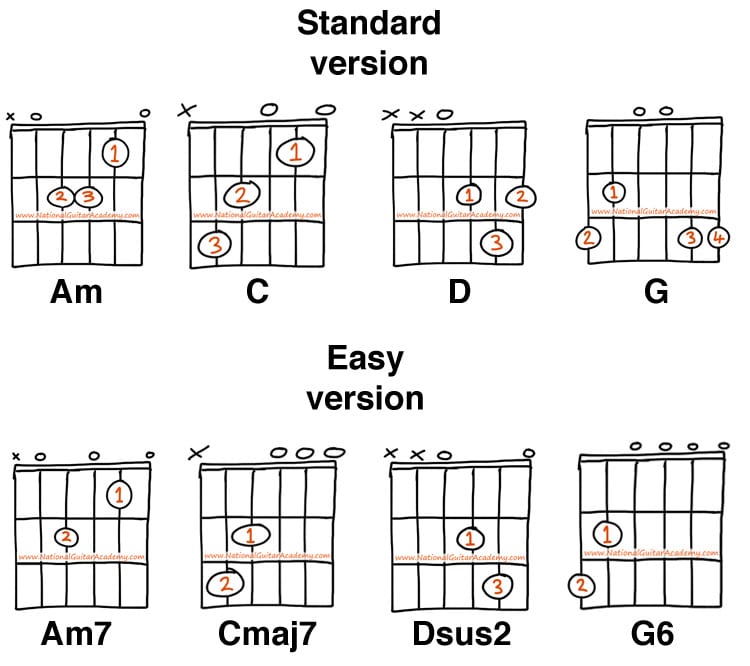
Place your index finger on the 1st fret of the G string. Then, put your middle finger on the 2nd fret of the A string, and your ring finger on the 2nd fret of the D string. Basically you are only fretting the A, G and D strings. Strum all six strings and BAM! You're playing an E major chord. Congratulations! You’re officially one step closer to serenading your cat with a heartfelt ballad.
Pro Tip: Try to avoid touching any strings you're not supposed to be touching. We're aiming for clean, crisp notes, not a muddy mess of sound. Think of it like trying to eat a chocolate bar without getting chocolate on your face. Difficult, but not impossible.
The D Chord: A Bit of a Stretch, But Totally Worth It
Now for something slightly more challenging: the D major chord. This one requires a bit of finger gymnastics, but don't let that intimidate you. Think of it as a yoga pose for your fingers.

Put your index finger on the 2nd fret of the G string. Then, your middle finger goes on the 2nd fret of the high E string, and your ring finger goes on the 3rd fret of the B string. Leave the D string open. The E and A strings are also not strummed. Basically you are only fretting the G, High E, and B strings. Strum the four strings (D, G, B, e). Boom! You're playing a D major chord.
Troubleshooting Tip: Are your fingers getting in each other's way? Try adjusting your hand position slightly. Sometimes, just a small tweak can make a big difference. Imagine you're trying to park a car in a tight space. Sometimes you need to angle it just right to squeeze in there.
Here's a joke: Why did the guitar player break up with the bass player? Because they couldn't find the right chord-ination!

Putting It All Together: Chord Progressions!
So, you've learned a few chords. Now what? Well, you string them together to create magical things called "chord progressions." A chord progression is just a sequence of chords that sounds good together. Think of it as a recipe for a song.
A really common and easy progression is: A - D - E. Practice switching between these chords smoothly. It might feel awkward at first, but with practice, it'll become second nature. You will be able to play many songs!
Practice Tip: Start slow. Seriously, slower than a snail riding a tricycle. Speed will come with time. The key is to focus on accuracy and clean transitions between chords. Rome wasn't built in a day, and neither was your guitar prowess.

Final Thoughts (and a Warning!)
Learning guitar chords takes time, patience, and a willingness to embrace the occasional frustration. There will be days when your fingers feel like sausages and your brain feels like scrambled eggs. But don't give up! Every guitar hero started somewhere. And most of them probably started by butchering "Smoke on the Water."
Warning: Playing guitar can be addictive. Side effects may include: loss of sleep, increased coffee consumption, and the sudden urge to wear a cowboy hat. You have been warned!
Now go forth and strum! And remember, even if you only ever learn three chords, you can still write a hit song. Just ask the Ramones. They’re famous for it!