Ever feel like math is a secret language spoken only by super-geniuses with pocket protectors and an insatiable craving for quadratic equations? Well, prepare to have your socks knocked off! There's a ridiculously cool little trick hidden in the world of numbers, and it’s surprisingly easy to grasp, especially with the help of a Fermat's Little Theorem calculator. Think of it as your secret decoder ring for solving some pretty awesome math puzzles!
What's This "Fermat's Little Theorem" Thingamajig?
Okay, the name sounds intimidating. "Fermat's Little Theorem." Sounds like something you’d learn after years of intense training. But trust me, it’s simpler than parallel parking on a busy street. In a nutshell, it's about finding remainders after some crazy-big calculations. Imagine you have to figure out what's left over after dividing some ENORMOUS number by a prime number. Sounds like a job for a supercomputer, right? Wrong! Fermat's Little Theorem swoops in like a mathematical superhero!
The Magic Formula (Don't Panic!)
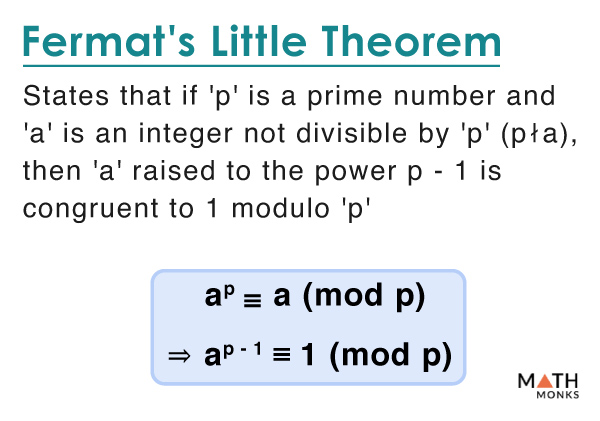
The core idea is this: if you have a prime number, let's call it p, and any other whole number, let’s call it a (as long as a isn't divisible by p), then a raised to the power of (p-1), when divided by p, will always leave a remainder of 1. Bam! Mind blown? Okay, maybe not quite yet, but stick with me!
Think of it like this: You're baking cookies. You start with a HUGE batch, say 1000 cookies (that's our a). Then you decide to divide them evenly amongst 7 friends (7 is our p, a prime number, because it’s only divisible by 1 and itself). Fermat’s Little Theorem basically tells you that if you did some very specific cookie shuffling (raising 1000 to the power of 6, which is 7-1), and then divided that truly gigantic number of cookies by 7, you'd be left with only ONE cookie remaining. One lonely, delicious cookie. The mathematical equivalent of finding a ten-dollar bill in your old jeans!
Enter the Fermat's Little Theorem Calculator!
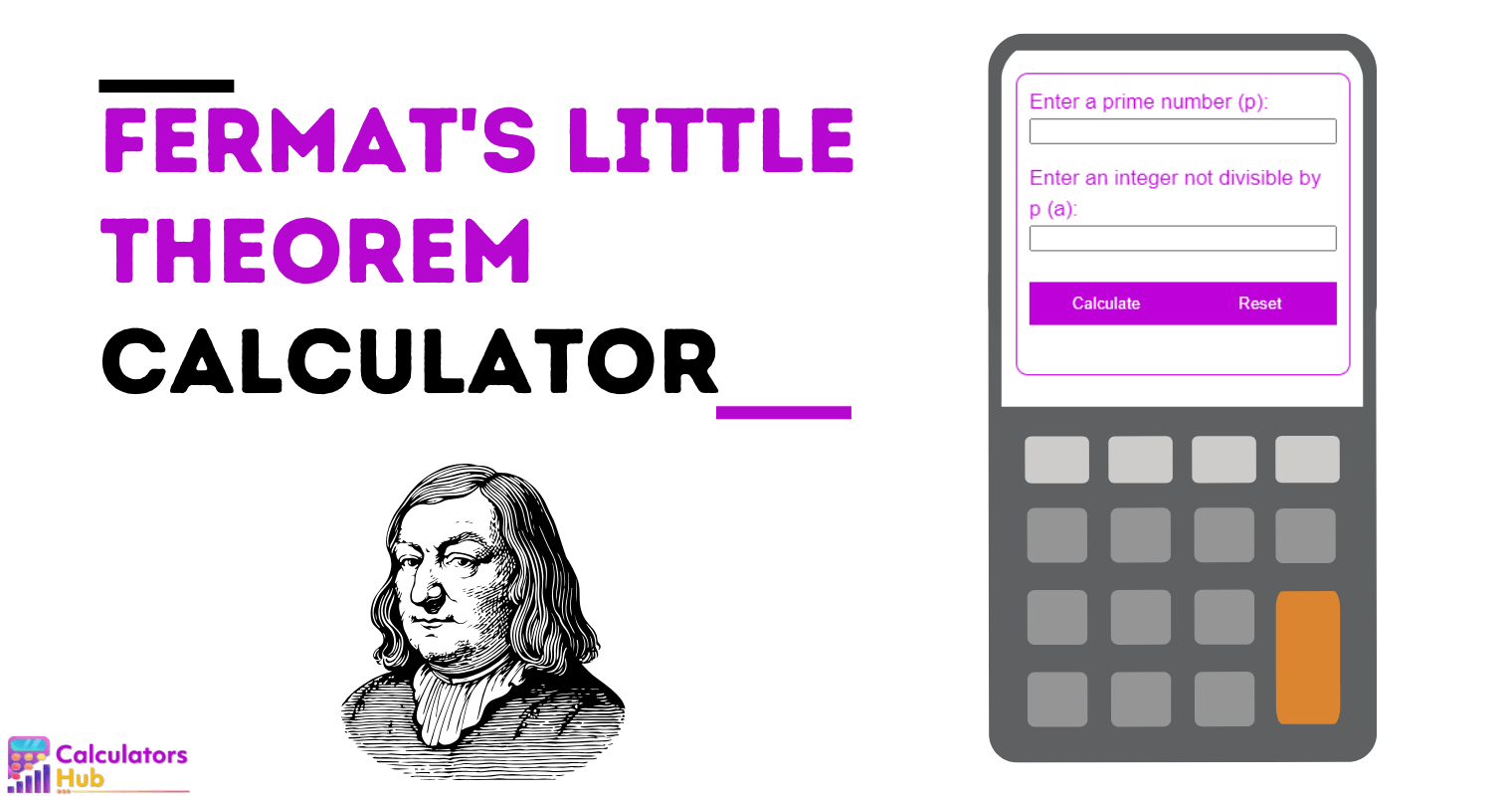
Now, nobody in their right mind wants to manually calculate something like 1000 to the power of 6. That’s where our trusty Fermat's Little Theorem calculator comes to the rescue. These calculators are like little mathematical wizards that take the prime number (p) and the other number (a), and poof, they instantly spit out the remainder. It's like having a personal math tutor who never gets tired or asks annoying questions!
Fermat’s Little Theorem - Formula, Proof, Examples
They're incredibly easy to use. Most just have two simple input boxes: one for the number you're raising to a power (a), and one for the prime number you're dividing by (p). You type in the numbers, click a button, and voila! The remainder is revealed! No more wrestling with exponents and long division until your brain melts!
Using a Fermat's Little Theorem calculator is like having a cheat code for certain types of math problems. It turns complex calculations into a simple, effortless task.
Fermat's Little Theorem Calculator
Why Bother With This Theorem At All?
You might be thinking, "Okay, that's kind of neat, but when would I ever use this?" Well, Fermat's Little Theorem has applications in cryptography (keeping your online information secure!), computer science, and even generating random numbers. It's a fundamental concept that underlies a lot of the technology we use every day, even if we don't realize it. Plus, it’s a fantastic way to impress your friends at parties. Imagine casually dropping, "Oh yeah, using Fermat's Little Theorem, I can tell you the remainder when 2 raised to the power of 100 is divided by 101 in approximately 0.003 seconds." You'll be the life of the party (or at least the most mathematically intriguing person in the room)!
So, ditch the math anxiety and embrace the power of Fermat's Little Theorem. Grab a calculator, plug in some numbers, and prepare to be amazed at the magic of mathematics. It's not just for the super-geniuses anymore. It's for anyone who wants to unlock a little bit of the universe's numerical secrets!