
Converting Smaller Units To Larger Units
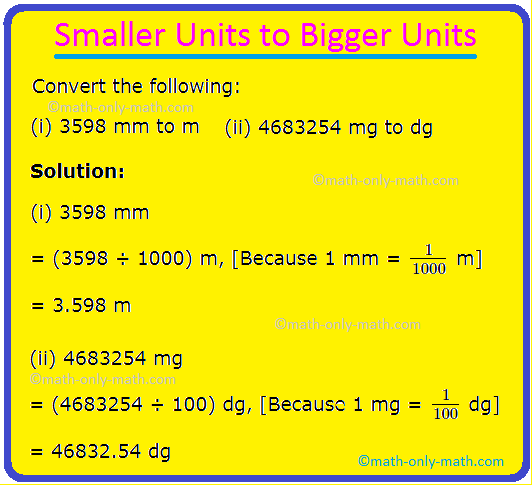
Alright, settle in, grab your imaginary (or real!) coffee, because we're about to demystify something that, frankly, can sometimes feel like trying to herd cats. You know, when you have a gazillion tiny little things, and you just want to make sense of the big picture? That's exactly what we're talking about today: taking those small, numerous units and turning them into fewer, more manageable, and much cooler-sounding larger units.
Ever looked at a recipe that calls for, like, 3000 milliliters of something? Your first thought probably isn't, "Oh, wonderful, 3000 ml!" No, your brain, being the clever little rascal it is, immediately starts doing mental gymnastics to figure out, "Wait, isn't that just... three liters?" Bingo! That's the magic right there. You just converted smaller units to larger units without even breaking a sweat. See? You're already a pro!
The Big Reveal: It's All About Grouping!
Think about it this way: you're not actually making the quantity smaller. You're just changing how you label it. It's like having a giant pile of LEGO bricks. You could count them all individually – "one brick, two bricks, three bricks..." – and end up with a number like 5,000 bricks. Or, you could say, "I have 50 large sets of LEGOs." Which sounds less exhausting? Exactly.
Must Read
So, how do we make this happen? How do we go from "5,000 bricks" to "50 sets"? The secret sauce, my friend, is division. Don't let that word scare you! It's not the intimidating long division from elementary school. This is the friendly, helpful kind of division. The kind that makes your life easier.
Time to Shine: Minutes to Hours!
Let's start with a classic. Time! We all deal with it, right? Imagine someone says, "I'll be there in 180 minutes." Your internal monologue probably goes, "Ugh, 180 minutes? That sounds like forever!" But then your brain kicks in, remembering that crucial little number: there are 60 minutes in an hour.
![What is Metric System? - [Definition, Facts & Example]](https://cdn-skill.splashmath.com/panel-uploads/GlossaryTerm/9987f824e4b944fcbbbcc69e0a7c24b3/1551238722_Conversion-of-big-and-small-units-in-metric-system-of-measurement.png)
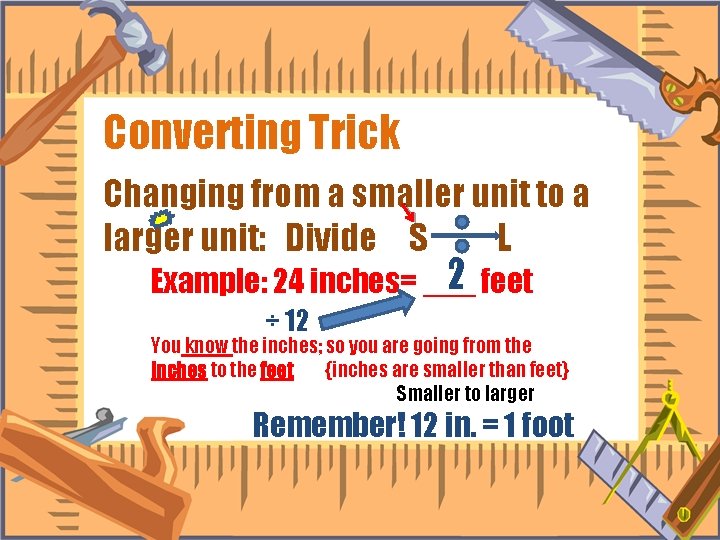
So, you take that 180 minutes, and you divide it by 60. What do you get? 180 ÷ 60 = 3. Ah, three hours! See? Suddenly, it doesn't sound quite so bad, does it? Three hours is a perfectly normal amount of time. It’s concise, it’s clear, and it doesn't sound like you're going to grow a beard waiting.
Measuring Up: Centimeters to Meters!
Okay, next up! You're trying to measure something, maybe a new rug for your room, and you've got a tape measure that only gives you centimeters. You dutifully measure and find out your rug needs to be 350 centimeters long. Again, a slightly unwieldy number, right?
But then you remember: there are a neat and tidy 100 centimeters in every meter. That's our magic number for this conversion! So, you grab your calculator (or just your brilliant brain) and do the simple math: 350 ÷ 100 = 3.5.
Voila! Your rug needs to be 3.5 meters long. Much easier to visualize, isn't it? "Three and a half meters" sounds so much more professional than "three hundred fifty centimeters," especially when you're trying to impress the salesperson. Just sayin'.
Cha-Ching! Pennies to Dollars!
Who hasn't had a giant jar of pennies lurking somewhere? You know, the one you promise yourself you'll take to the bank "someday." You finally get around to it, dump them out, and start counting... 500 pennies! Wow, that's a lot of copper! But what does it really mean?
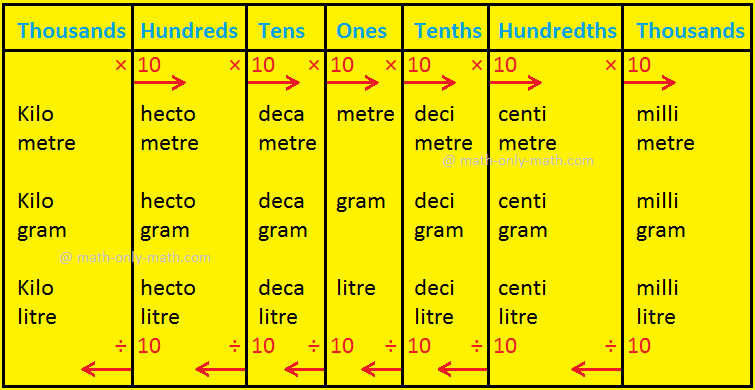
We all know that there are 100 pennies in one dollar. So, to figure out your monetary treasure, you simply take your 500 pennies and divide by 100. 500 ÷ 100 = 5.
Congratulations! You've officially converted your mountain of small change into a neat, round five dollars. See? Suddenly that "someday" jar doesn't seem so overwhelming. And five dollars is way more fun to say than 500 pennies, don't you think?
So, Why Bother With All This Dividing?
Good question! Besides making your numbers look less intimidating and more polished, converting smaller units to larger ones has some real perks:

- It makes values easier to understand. "Kilograms" often make more sense for a person's weight than "grams."
- It helps us avoid ridiculously long numbers. Can you imagine saying someone weighs "75,000 grams"? Nope, "75 kilograms" rolls off the tongue.
- It simplifies comparisons. Is 200 cm bigger than 1.5 m? Not if you convert 200 cm to 2 m first!
- It just generally makes things look cleaner and more professional.
The Takeaway: Your Super Simple Strategy!
At the end of the day, converting smaller units to larger units is a breeze once you know the secret:
- Identify the two units you're working with (e.g., minutes and hours).
- Figure out the "conversion factor" – that magical number that tells you how many small units make up one big unit (e.g., 60 minutes = 1 hour).
- Then, you simply divide the number of smaller units by that conversion factor. Ta-da!
See? No biggie! You're not changing the actual amount of stuff, just giving it a more grown-up, sophisticated name. It's like taking a whole bunch of toddlers and grouping them into "three kindergarten classes." Same kids, just organized better.
So next time you encounter a monster number in tiny units, take a deep breath, remember our little coffee chat, and confidently divide your way to a more sensible, understandable, and frankly, less headache-inducing larger unit. You've totally got this!